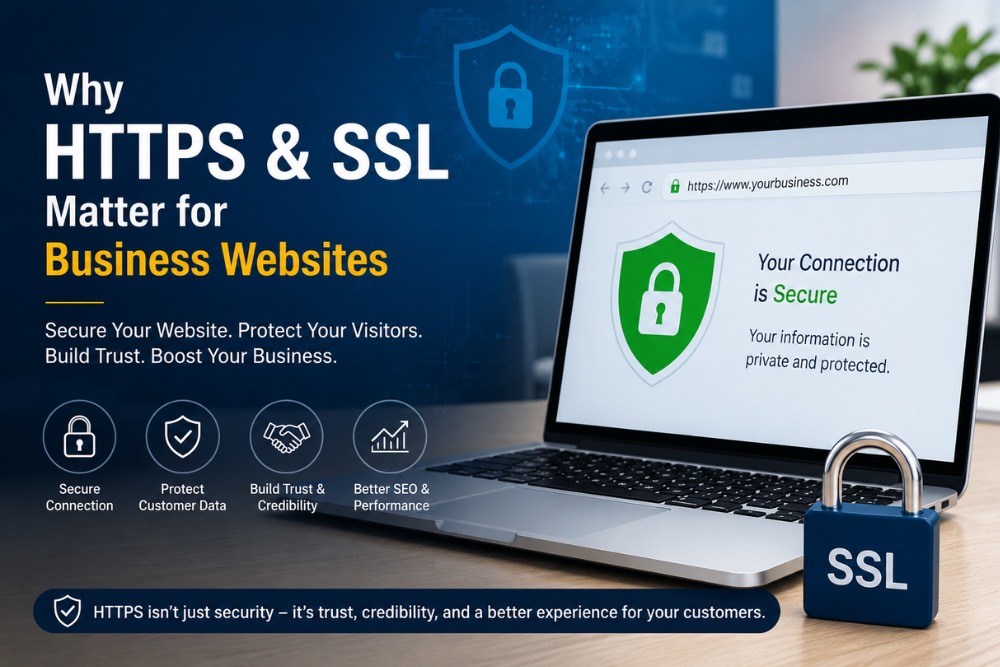
Every business today relies on its website to create a strong first impression. Before calling a company, booking a service, or making a purchase, most customers search on Google, compare different businesses, and browse multiple websites to decide which one appears the most trustworthy. If a website loads slowly, looks outdated, or displays a "Not Secure" warning, many visitors leave within seconds and continue searching for a competitor. This is why HTTPS and SSL have become essential for every business website, regardless of its size or industry.
Many business owners assume website security only matters for eCommerce stores or businesses that process online payments. In reality, any website that collects customer information through contact forms, enquiry forms, appointment bookings, or login pages should use HTTPS to protect visitor data. A secure website not only safeguards sensitive information but also builds confidence, strengthens your professional image, and encourages visitors to interact with your business without hesitation.
Google also recommends HTTPS as part of a secure and reliable web experience, making it an important element of modern technical SEO. While an SSL certificate alone will not guarantee higher search rankings, it helps establish trust with both users and search engines. Businesses investing in professional Web Designing in Delhi understand that website security, fast performance, mobile responsiveness, and a great user experience work together to create a website that supports long-term business growth and generates more enquiries.
What Is HTTPS?
HTTPS (HyperText Transfer Protocol Secure) is the secure version of HTTP, the technology that allows your browser and a website to communicate with each other. The biggest difference is that HTTPS encrypts the information exchanged between your device and the website, making it much more difficult for anyone to intercept or read sensitive data during transmission. This encrypted connection helps protect customer information while creating a safer browsing experience.
Whenever someone visits a website, data constantly moves between the visitor's browser and the web server. This may include contact form submissions, login details, appointment requests, payment information, or other personal information. On a website that still uses HTTP, this information is transferred without encryption. HTTPS secures this communication by using an SSL/TLS certificate, helping protect customer data and reducing security risks.
You can easily identify whether a website uses HTTPS by looking at the address bar in your browser. Secure websites display a padlock icon and begin with https://, while older websites may still use http://. Modern browsers such as Google Chrome often display a "Not Secure" warning for HTTP websites, which can reduce visitor confidence and discourage potential customers from submitting enquiries or sharing personal information.
For businesses, HTTPS is much more than a technical upgrade. It improves website security, builds customer trust, supports modern technical SEO, and demonstrates that your business takes online privacy seriously. Whether you operate a local business website, a corporate website, or an eCommerce store, HTTPS has become a standard requirement for creating a secure and professional online presence.
What Is an SSL Certificate?
An SSL (Secure Sockets Layer) certificate is a digital security certificate that enables a website to use HTTPS and establish a secure connection between the web server and a visitor's browser. Although modern websites now use the more advanced TLS (Transport Layer Security) protocol, the term SSL certificate is still widely used by website owners, developers, and hosting providers. Simply put, an SSL certificate helps protect the information shared between your website and its visitors.
Whenever someone submits a contact form, logs into an account, requests a quotation, or enters personal information, that data travels between the visitor's browser and your website. An SSL certificate encrypts this communication, making it extremely difficult for hackers or unauthorized users to intercept or read the information during transmission. In addition to encryption, it also verifies that visitors are connected to your genuine website rather than a fake or fraudulent version, helping protect both your business and your customers.
You can easily identify a website with a valid SSL certificate by looking for the padlock icon in the browser's address bar and the https:// prefix in the website URL. These security indicators have become familiar trust signals for internet users because they confirm that the website provides an encrypted and secure browsing experience. Many visitors now notice these indicators before submitting enquiry forms, creating accounts, or sharing personal information.
An SSL certificate is not only important for eCommerce websites or businesses that process online payments. Every business website that collects customer enquiries, appointment bookings, registration details, or contact information benefits from HTTPS because it improves website security, strengthens customer confidence, and supports a more professional online presence. Businesses developing a new website should include SSL from the beginning as part of the Website Development Process, ensuring that security becomes an integral part of the website rather than an afterthought.
How HTTPS Protects Business Websites
Website security is no longer a concern only for large companies or online stores. Today, businesses of every size collect valuable customer information through contact forms, appointment bookings, enquiry forms, login pages, newsletter subscriptions, and other online interactions. Whether you run a local business, healthcare clinic, educational institute, consultancy, restaurant, or service company, protecting this information is essential. Customers expect their personal details to remain private, and a secure website demonstrates that your business takes their privacy seriously from the very first interaction.
HTTPS protects your website by encrypting the data exchanged between a visitor's browser and your web server. This encryption prevents sensitive information such as names, email addresses, phone numbers, passwords, payment details, and other personal data from being intercepted while it travels across the internet. Without HTTPS, information is transferred in a less secure format, making it more vulnerable on public or unsecured networks. By securing every connection, HTTPS helps reduce security risks while providing a safer browsing experience for both businesses and their customers.
The benefits of HTTPS extend far beyond data protection. Modern browsers such as Google Chrome clearly warn visitors when a website is not secure, and many users immediately leave after seeing these warnings. Even if your products or services are excellent, a "Not Secure" message can reduce customer confidence before they even explore your website. A secure HTTPS connection builds trust, encourages visitors to submit enquiry forms, request quotations, create accounts, and interact with your business more confidently. It also strengthens your professional image, making your website appear more reliable than competitors still using HTTP.
Although HTTPS is a vital part of website security, it should not be viewed as a one-time solution. A secure business website also requires regular software updates, reliable hosting, routine backups, malware protection, and ongoing maintenance to remain protected against evolving security threats. Businesses that combine HTTPS with these best practices create a stronger foundation for customer trust, improved user experience, and long-term online success. If you want to strengthen your website's overall security, our guide on Website Security for Businesses: Best Practices to Protect Your Website explains additional measures that help keep business websites safe and reliable.
Why Google Prefers HTTPS Websites
Google's primary goal is to deliver safe, reliable, and high-quality search results, which is why HTTPS has become a standard recommendation for every website. Although HTTPS is only one of many Google ranking signals, it helps create a secure browsing experience that protects user data and builds trust. Search engines favour websites that provide visitors with a safe, fast, and reliable experience, making HTTPS an important part of a strong technical SEO foundation rather than a standalone ranking factor.
Why HTTPS Supports Better SEO
Protects customer information through encrypted data transmission.
Builds visitor trust with the secure padlock icon in the browser.
Prevents "Not Secure" browser warnings that may discourage enquiries.
Improves user experience by creating a safer browsing environment.
Strengthens the technical SEO foundation of your website.
Works alongside website speed, mobile responsiveness, and quality content to improve overall website performance.
A secure website alone will not achieve top rankings if other important SEO factors are ignored. Google also evaluates website speed, mobile usability, content quality, website structure, internal linking, and overall user experience before deciding where a page should rank. To understand these ranking factors in more detail, read our guide on How Google Evaluates Business Websites Before Ranking Them. Combining HTTPS with a well-optimized website helps improve user trust, strengthens technical SEO, and creates a better experience for both visitors and search engines.
How HTTPS Builds Customer Trust
Trust plays a major role in every customer's decision-making process. Before contacting a business, requesting a quotation, or booking a service, most people compare multiple websites to determine which company appears more reliable and professional. They look for clear business information, customer reviews, contact details, and an overall user-friendly experience. While many visitors may not understand the technical aspects of HTTPS or SSL certificates, they immediately notice browser security indicators. A website displaying a secure padlock icon creates a positive first impression, whereas a "Not Secure" warning can raise doubts before visitors even begin exploring your services.
HTTPS helps build confidence by protecting the information visitors share with your website. Whether someone is submitting a contact form, booking an appointment, creating an account, or requesting a callback, they expect their personal information to remain private. An encrypted connection reassures users that their data is being transmitted securely, making them more comfortable interacting with your business. This increased confidence often leads to higher engagement, more enquiries, and a better overall user experience because visitors feel safe while browsing your website.
For local businesses, customer trust often determines whether a visitor becomes a customer or chooses a competitor instead. Imagine two businesses offering similar services at comparable prices. One website uses HTTPS, loads quickly, and provides a secure browsing experience, while the other displays browser security warnings and appears less reliable. Most users will naturally choose the business that feels more trustworthy. Along with website security, factors such as responsive design, fast loading speed, clear navigation, and valuable content also influence customer confidence. Businesses looking to improve these areas should also understand the 10 Essential Features Every Business Website Must Have, as these elements work together to create a professional online presence.
Building trust is not achieved through a single feature but through the overall experience your website provides. HTTPS forms an important part of that experience by protecting customer information and reinforcing your business's credibility from the moment someone visits your website. When combined with strong website design, useful content, and excellent performance, HTTPS helps create a website that visitors trust, search engines value, and businesses can rely on for generating long-term enquiries and sustainable growth.
HTTPS vs HTTP: Understanding the Difference
Although HTTP and HTTPS differ by only one letter, they provide completely different levels of security and trust. The "S" in HTTPS stands for Secure, meaning all data exchanged between a visitor's browser and your website is encrypted using an SSL/TLS certificate. This encryption helps protect sensitive information such as contact details, passwords, payment information, and enquiry form submissions from unauthorized access. HTTP, on the other hand, transfers data without encryption, making it less secure and no longer suitable for modern business websites where customer privacy and online security are expected.
For businesses, choosing HTTPS is about much more than protecting data. Modern web browsers clearly identify secure and non-secure websites, and visitors often judge a business based on these security indicators before interacting with the website. A secure connection builds confidence, encourages users to submit enquiries, and reinforces your business's credibility. Whether you operate a corporate website, service business, educational institution, healthcare practice, or eCommerce store, HTTPS has become the industry standard for delivering a safe and professional online experience.
HTTP
HTTPS
Data is transferred without encryption
Data is encrypted before transmission
May display "Not Secure" browser warnings
Displays a secure padlock icon
Lower customer confidence
Builds greater customer trust
Higher risk when submitting forms
Protects contact forms and customer data
Outdated for modern business websites
Recommended security standard for all websites
Limited protection against data interception
Supports better website security and technical SEO
Switching from HTTP to HTTPS is no longer an optional website upgrade but a fundamental requirement for businesses that want to build customer trust and maintain a professional online presence. Along with improving website security, HTTPS creates a better user experience, strengthens your technical foundation, and reassures visitors that their personal information is handled responsibly. For businesses focused on long-term digital growth, adopting HTTPS is one of the simplest yet most valuable improvements that can enhance both credibility and overall website performance.
Does HTTPS Improve SEO?
Many business owners wonder whether installing an SSL certificate will instantly improve their Google rankings. The answer is no—HTTPS alone will not move a website to the top of search results. However, Google has confirmed that HTTPS is a ranking signal because it helps create a safer browsing experience for users. While its direct impact on rankings is relatively small, it remains an essential part of a modern website's technical SEO foundation and demonstrates that your business follows current web security standards.
Search engines evaluate hundreds of factors before deciding where a website should rank. Content quality, website speed, mobile responsiveness, user experience, website structure, internal linking, backlinks, and search intent all have a much greater influence on long-term SEO success. HTTPS works alongside these elements rather than replacing them, helping search engines identify your website as secure and trustworthy. Businesses looking to improve their overall online visibility should understand how different ranking factors work together, as explained in our guide on How to Rank a Website Designing Business in Delhi.
Although HTTPS is not a major ranking factor, its indirect SEO benefits are significant. Visitors are more likely to stay on a secure website, explore multiple pages, submit enquiry forms, and interact with your business when they feel confident that their information is protected. A positive browsing experience often leads to stronger engagement, higher customer trust, and improved conversion opportunities, all of which contribute to the long-term success of your website.
The strongest-performing websites are built on a combination of security, performance, valuable content, and excellent user experience. HTTPS supports this foundation by protecting customer data, strengthening your website's credibility, and aligning with Google's recommendations for modern websites. When combined with effective technical SEO and high-quality content, HTTPS becomes an important part of building a website that earns both customer trust and sustainable search visibility.
Common Problems Businesses Face Without SSL
Many business owners underestimate the importance of installing an SSL certificate, assuming it only matters for eCommerce websites. In reality, operating a website without HTTPS can affect customer trust, website security, and even business growth. Modern internet users expect every professional website to provide a secure browsing experience, and browsers now clearly identify websites that fail to meet this expectation. As a result, businesses without SSL often lose potential enquiries before visitors even begin exploring their products or services.
Some of the most common problems businesses face without SSL include:
"Not Secure" browser warnings that discourage visitors from using your website.
Reduced customer trust and a less professional online image.
Unencrypted data transmission that increases the risk of sensitive information being intercepted.
Lower confidence when visitors submit contact forms, enquiries, or personal details.
Missed opportunities to follow Google's recommended website security standards.
A weaker technical foundation for long-term SEO and website performance.
Higher chances of visitors leaving your website before taking action.
Fortunately, these issues are easy to avoid by implementing HTTPS and maintaining a secure website. An SSL certificate not only protects customer information but also helps create a safer, more trustworthy browsing experience that encourages visitors to engage with your business. When combined with quality content, fast loading speeds, mobile-friendly design, and regular website maintenance, HTTPS becomes an essential part of building a professional website that supports customer confidence and sustainable online growth.
How to Move Your Website from HTTP to HTTPS
Upgrading your website from HTTP to HTTPS is more than a technical improvement—it's an investment in your business's credibility, security, and long-term online success. A secure website reassures visitors that their information is protected, strengthens your professional image, and aligns with modern web standards expected by both users and search engines. Although the migration process is usually straightforward, it should be carried out carefully to ensure a smooth transition without disrupting your website's performance or user experience.
Best Practices for a Smooth HTTPS Migration
Install a valid SSL certificate before making any changes.
Redirect every HTTP URL to its HTTPS version using permanent (301) redirects.
Update internal links, images, scripts, and other website resources to use HTTPS.
Check for mixed-content warnings and resolve any insecure elements.
Submit the HTTPS version of your website to Google Search Console.
Test your website thoroughly to ensure all pages, forms, and redirects work correctly after the migration.
A successful HTTPS migration should feel invisible to your visitors. They should continue browsing your website without encountering broken pages, security warnings, or interrupted functionality. Once completed correctly, HTTPS provides lasting benefits by protecting customer data, improving trust, supporting technical SEO best practices, and creating a more secure digital experience. Rather than viewing HTTPS as a one-time upgrade, businesses should consider it an essential part of maintaining a modern, reliable, and professional website that is prepared for future growth.
Common HTTPS and SSL Mistakes Businesses Make
Installing an SSL certificate is an important first step, but it does not guarantee that your website is fully secure or properly configured. Many businesses unknowingly make mistakes after enabling HTTPS, which can lead to browser security warnings, indexing issues, or a poor user experience. These problems not only reduce the effectiveness of HTTPS but can also affect customer confidence and your website's overall technical performance.
To get the full benefits of HTTPS, businesses should avoid these common mistakes:
Allowing the SSL certificate to expire, causing browsers to display security warnings.
Failing to redirect all HTTP pages to their HTTPS versions using permanent (301) redirects.
Leaving mixed-content issues where secure pages load images, scripts, or other resources over HTTP.
Forgetting to update canonical URLs, XML sitemaps, and other technical SEO settings after migration.
Ignoring regular SSL testing and security checks after the website goes live.
Assuming HTTPS alone is enough to protect the website without ongoing maintenance and security updates.
HTTPS should be viewed as one part of a broader website security strategy rather than a one-time setup. Keeping your SSL certificate active, monitoring your website regularly, installing software updates, maintaining reliable backups, and following security best practices all contribute to a safer and more trustworthy online presence. Businesses that treat website security as an ongoing priority are better equipped to protect customer data, maintain their professional reputation, and deliver a secure browsing experience that visitors can trust.
Final Thoughts
HTTPS is no longer an optional feature for business websites—it has become a fundamental requirement for building trust, protecting customer data, and maintaining a professional online presence. Whether your website generates enquiries, books appointments, sells products, or simply showcases your services, visitors expect every interaction to take place over a secure connection. Failing to meet this expectation can reduce customer confidence and negatively affect your business's credibility.
While HTTPS alone won't guarantee higher Google rankings, it plays an important role in a strong technical SEO strategy. Combined with fast loading speeds, responsive design, high-quality content, and an excellent user experience, HTTPS helps create a website that both visitors and search engines trust. Investing in website security today not only protects your business from unnecessary risks but also provides a solid foundation for long-term SEO performance, customer confidence, and sustainable business growth.
HTTP transfers website data without encryption, while HTTPS uses an SSL/TLS certificate to encrypt communication between a user's browser and the website. HTTPS provides better security, protects sensitive information, and helps build trust with visitors.
HTTPS is one of Google's ranking signals and contributes to a secure browsing experience. While switching to HTTPS alone will not move a website to Page 1, it supports technical SEO and is considered a best practice for modern websites.
A website usually displays a "Not Secure" warning when it does not have a valid SSL certificate or is still using HTTP instead of HTTPS. This warning can reduce visitor confidence and discourage users from submitting forms or personal information.
Yes. Whether you operate a small business website, portfolio, corporate website, or eCommerce store, an SSL certificate helps protect user data, improves trust, and secures communication between visitors and your website.
HTTPS encrypts data exchanged between users and your website, helping prevent interception during transmission. However, it is only one part of website security. Regular updates, secure hosting, strong passwords, backups, and ongoing maintenance are also important for protecting a website.
Open your website in a browser and look for the padlock icon next to the URL. You should also see the address begin with https:// instead of http://. If your website shows security warnings or uses HTTP, you should install or renew an SSL certificate.
Grow Your Local Business
Get a Professional Website From a Web Designing Company in Delhi