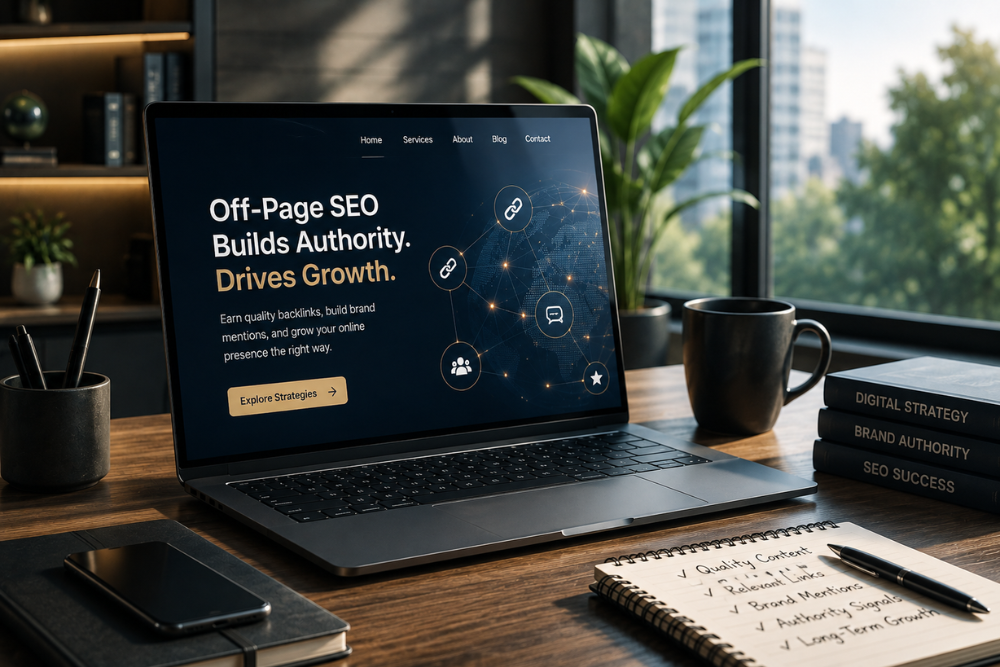
Ranking a website in Google is not determined only by what happens on the website itself. A business can have well-written pages, strong technical SEO, useful content, and a mobile-friendly design, yet still struggle to compete against websites that have built stronger recognition across the wider web. This is where off-page SEO becomes important. It focuses on how your website and brand are referenced, discussed, discovered, and connected outside your own domain.
For many businesses, off-page SEO is still understood simply as "getting backlinks." That approach is too narrow. Backlinks are an important part of external SEO, but a strong strategy also considers brand mentions, relevant industry references, digital PR, local citations, reviews, partnerships, and the overall reputation of the business. The real objective is to build a website that has a reason to be trusted and referenced by other relevant sources rather than simply trying to increase the number of links pointing to it.
This distinction matters because Google is designed to reward useful, reliable, people-first content rather than pages created mainly to manipulate search visibility. Its current guidance also makes clear that links are one part of a much broader ranking system, not a shortcut to guaranteed rankings. A successful off-page SEO strategy therefore works alongside good content, technical performance, strong website structure, and a genuine reputation in the market. Publishing genuinely useful SEO content can make those external references more valuable because other websites have something worthwhile to discover and share.
For a business competing in a crowded search market, this external layer can make a significant difference. When relevant websites reference your company, useful content earns genuine links, customers talk about your business, and your brand becomes visible in trusted places, your online presence becomes stronger beyond your own website. That can support organic visibility while also creating referral traffic, brand awareness, partnerships, and new customer opportunities.
What Is Off-Page SEO?
Off-page SEO is the process of improving a website's authority, relevance, visibility, and reputation through activities that take place outside the website itself. While on-page SEO focuses on the content, structure, and elements you can directly control, off-page SEO looks at how your business is recognised and connected across the wider web. This can include relevant backlinks, brand mentions, digital PR, local citations, customer reviews, industry references, and other forms of external recognition that help establish your business beyond its own website.
The difference becomes clearer when you consider how people evaluate a real business. Your website can explain your services, showcase your experience, and provide useful information, but independent references from other websites can add another layer of credibility. When a relevant industry publication mentions your company, a local business resource references your services, or another website links to one of your useful guides, your business becomes part of a wider network of information that customers and search engines can discover.
Backlinks are an important part of off-page SEO because links help search engines discover webpages and understand connections between different websites and pieces of content. However, not every backlink carries the same value, and simply increasing the number of links does not guarantee higher rankings. Relevance, context, quality, and the reason behind the reference are far more important than treating link building as a numbers game.
A professional off-page SEO strategy is therefore less about collecting as many links as possible and more about earning meaningful recognition. When relevant websites reference your business because your content is useful, your expertise is valuable, or your service is genuinely relevant to their audience, those references have a much stronger purpose. This creates a healthier foundation for long-term SEO because your website is building a real reputation across the web rather than relying on random directories, unrelated websites, automated submissions, or manipulative link-building practices.
Why Off-Page SEO Matters for Search Visibility
Imagine two businesses competing for the same commercial search. Both have professionally designed websites, similar services, well-optimised pages, fast loading speeds, and useful content. One business, however, has developed relationships with relevant publications, received genuine industry references, earned links to useful resources, and built a recognisable presence outside its own website. The other has very little external recognition. When several businesses already meet the basic standards of good website design and content, this wider online presence can become an important part of the competitive picture.
On-page SEO helps Google understand what your website offers, but off-page SEO helps establish how your business is recognised beyond your own domain. External references can introduce your brand to new audiences, strengthen credibility, and create additional paths through which potential customers can discover your business. Google uses many systems and signals when determining which results are most relevant and useful, so no single SEO activity should be treated as a guaranteed way to achieve higher rankings.
The value of off-page SEO also goes beyond rankings. A relevant article mentioning your company can introduce your brand to potential customers even if they do not immediately visit your website. A useful backlink can bring qualified referral traffic, while a local business reference can help someone discover your company when comparing providers. Genuine customer reviews can also influence whether a visitor feels confident enough to make an enquiry.
A strong off-page SEO strategy can therefore contribute to several areas of online growth:
Greater brand visibility across relevant websites and platforms.
Higher-quality referral traffic from external sources that already attract your target audience.
Stronger brand credibility through genuine industry and customer references.
More opportunities to earn relevant backlinks to useful website content.
Better local visibility through relevant business references and customer reviews.
A stronger overall online reputation that supports long-term business growth.
For this reason, businesses should not judge off-page SEO only by the number of backlinks gained each month. The quality of referring websites, relevant brand mentions, referral visitors, branded searches, customer trust, and recognition within the industry provide a much better picture of whether your external SEO efforts are actually creating value. The goal is not simply to make your backlink profile larger; it is to make your business more visible, credible, and relevant across the places where potential customers and search engines can discover it.
Backlinks: The Foundation of Off-Page SEO
A backlink is a link from another website to a page on your website, and it remains one of the most important elements of off-page SEO. Links help search engines discover webpages and understand relationships between different pieces of content across the web. However, the real value of a backlink is not determined simply by the number of links a website has. A better question is whether the link comes from a relevant source, appears naturally within useful content, and gives readers a genuine reason to visit your website. This is why professional link building focuses on relevance and value rather than treating backlinks as a simple numbers game.
For example, imagine your website publishes a detailed guide explaining how businesses can improve their websites to generate more enquiries. A relevant business publication may reference that guide because it provides useful information for its readers, while a marketing professional may recommend it as an additional resource. A local business website could also mention it when discussing digital growth. However, the page receiving that backlink should also provide a strong experience once visitors arrive. OurOn-Page SEO Checklist explains how content structure, search intent, internal linking, page experience, and other on-page elements can help turn a useful external reference into a stronger website experience. By comparison, hundreds of links from unrelated websites, low-quality directories, automatically generated pages, or articles created mainly to insert keyword-rich anchor text may look impressive in an SEO report but provide little genuine value.
The goal of professional off-page SEO should therefore not be to build the largest backlink profile possible, but to develop a relevant, credible, and natural backlink profile that makes sense for the business. Google specifically warns against manipulative practices such as buying or selling links for ranking purposes, excessive link exchanges, automated link creation, and other schemes designed primarily to influence search rankings. When backlinks are earned because your content is genuinely useful, your expertise is relevant, or your business provides value to another audience, they can support more than search visibility by creating referral traffic, brand exposure, professional relationships, and new opportunities for growth.
What Makes a Backlink Valuable?
A valuable backlink starts with relevance. When another website covers a topic closely connected to your business and naturally references your page as a useful source, the relationship makes sense to both readers and search engines. The surrounding content also matters because it provides context and explains why your website is being referenced. A link that genuinely helps readers discover additional information is far more meaningful than a link placed simply to increase the number of backlinks pointing to your domain.
For example, a website designing business could naturally earn references from technology publications, entrepreneurship resources, local business websites, marketing articles, or educational resources discussing website development. The important factor is not where the link comes from alone, but whether the source is relevant to the business and its audience. A visitor reading an article about improving a business website may reasonably want to explore a related website design resource, making that external reference useful from both a marketing and user-experience perspective.
The quality of the referring website also deserves attention, but businesses should avoid becoming too focused on third-party SEO scores. Metrics such as Domain Authority or Domain Rating can be useful for comparing potential opportunities, but they are not Google ranking factors. A more practical evaluation is whether the website is relevant, credible, useful to its audience, and capable of sending genuine visitors or strengthening brand visibility. This keeps the focus on real value rather than chasing numbers inside an SEO tool.
Another important factor is why the link exists. An editorial link included because your content genuinely supports the publisher's article is very different from a link created primarily because someone was paid to influence rankings. Sustainable link building should therefore begin with useful content, genuine relationships, and relevant opportunities rather than manipulation. When a backlink makes sense to a real reader and provides additional value, it becomes part of a much healthier off-page SEO strategy.
Quality Backlinks vs. Random Backlinks
One of the most common mistakes businesses make with off-page SEO is treating backlink building as a numbers game. It is easy to look at an SEO report and feel that a website is improving simply because the number of referring domains has increased, but the total count does not tell the full story. A backlink is valuable when it comes from a relevant source, appears in a useful context, and gives readers a genuine reason to visit the linked website. If a business collects hundreds of links from unrelated websites that have little connection with its industry or audience, the backlink profile may look impressive on paper while providing very little real business value.
The difference becomes easier to understand when quality backlinks are compared with random ones:
Quality Backlinks
Random Backlinks
Come from websites relevant to your industry or audience
Come from unrelated or low-value websites
Are placed naturally within useful content
May be added mainly to create a link
Give readers a genuine reason to visit your website
Often provide little value to the reader
Can bring relevant referral visitors
Usually bring little meaningful traffic
Can strengthen brand visibility and credibility
May add numbers without building reputation
Are commonly earned through useful content and relationships
May come from automation, poor directories, or manipulative tactics
Consider a local website designing company that publishes a detailed guide about choosing the right website for a small business. If a respected business publication refers to that guide while explaining how companies can improve their online presence, the backlink has a clear purpose. The publication's readers are already interested in business growth, and the linked resource gives them additional information. The same guide might also be referenced by a local business resource, a marketing consultant, or a technology website because it provides useful information for their audience. Each reference can potentially bring relevant visitors while helping more people discover the business.
Now compare that with receiving hundreds of links from unrelated websites that have nothing to do with website design, business development, technology, or the audience you serve. A link from an unrelated website may not introduce your company to a single relevant customer, and it gives the reader little reason to follow it. This is why a smaller number of genuinely relevant references can be more valuable from a business perspective than a large collection of random backlinks. The objective is not to make the backlink report look bigger; it is to build an external presence that makes sense when a real person looks at it.
The strongest way to earn this type of backlink is to create something that other people genuinely want to reference. A detailed industry guide, original research, useful statistics, practical checklist, informative case study, expert explanation, comparison, or helpful tool can give publishers a legitimate reason to mention your website. For example, if your website publishes original information about common website problems faced by local businesses, a business publication discussing digital growth may find that information useful enough to reference. The link is then created because the content adds something to the publisher's article, not simply because someone wanted another backlink.
This is why sustainable off-page SEO should begin with the quality of the website itself. Before asking other websites to reference your content, make sure the destination page provides a strong experience, answers the subject properly, and gives visitors something genuinely useful. Google's people-first guidance also emphasises creating original, substantial, useful content for people rather than producing content primarily to attract search-engine traffic. When your website consistently offers resources that are worth reading and sharing, earning relevant external references becomes a much more natural part of long-term SEO.
Brand Mentions Strengthen Your Wider Online Presence
Not every valuable reference to a business comes in the form of a clickable backlink. A brand mention occurs when another website, publication, business, community, or online resource talks about a company, service, product, or area of expertise. The mention may include a link, but it can also simply refer to the business by name. From a marketing perspective, these references can help a company become more familiar to people who may not yet be actively searching for its services.
For example, a Delhi business publication might discuss how local companies can improve their online presence and mention Delhi Web Designing as a website design provider. Another business resource could refer to a useful guide published on the company's website, while an industry discussion may recommend a local provider to someone looking for professional web design. These references can place the business in front of relevant audiences and create opportunities for people to discover it naturally. If someone wants to learn more after seeing the reference, they can explore the company's website design services and understand what it offers.
Brand mentions should not be treated as guaranteed direct Google ranking factors. An unlinked mention is different from a backlink, and there is no reliable basis for assuming that every mention automatically improves rankings. Its value is better understood as part of a wider online presence that can increase brand awareness, introduce a business to relevant audiences, create referral opportunities, and sometimes lead to useful relationships or editorial backlinks in the future.
This is especially valuable for local businesses because customers often encounter a company in several places before making a decision. A business that appears naturally across relevant publications, local resources, professional discussions, customer reviews, and useful industry content can build greater familiarity than one that is visible only on its own website. The goal is not to force your brand into as many places as possible, but to build a reputation that naturally earns attention where potential customers are already looking.
How Off-Page SEO Builds Website Authority
Off-page SEO helps build the reputation of a business beyond its own website. A company can have strong content and a professional website, but customers may still discover it through business publications, reviews, recommendations, industry websites, or local resources. When a business is mentioned in relevant places for genuine reasons, it becomes more visible and familiar to the people who matter.
Backlinks are an important part of this process, but good off-page SEO is not about collecting links simply to increase a number. A useful article may earn a reference from another website, while a business may gain visibility through a local publication or an industry recommendation. These activities can bring visitors, introduce the brand to new audiences, and create relationships that may lead to further opportunities.
The main areas of off-page SEO can be understood simply:
Activity
What It Helps With
Quality backlinks
Relevant referral traffic and external visibility
Brand mentions
Brand awareness and recognition
Digital PR
Media exposure and industry visibility
Local citations
Local discovery and business credibility
Customer reviews
Trust and purchase confidence
Industry relationships
Partnerships, references, and referrals
For a local business, these activities can work particularly well together. Customers often check several sources before contacting a company, including its website, reviews, recommendations, and local search results. Building a consistent presence across relevant local sources can therefore support the wider customer journey. Businesses that want to improve this area can also explore our guide to local SEO tips for small businesses in Delhi, which covers practical ways to strengthen local visibility.
The goal is not to make your business appear everywhere. It is to build a credible presence in the places where your potential customers already look. When useful content, relevant backlinks, genuine mentions, reviews, and local visibility support each other, off-page SEO becomes part of a natural long-term marketing strategy rather than simply a link-building campaign.
How to Measure Off-Page SEO and Build Authority Over Time
Off-page SEO should not be judged only by the number of backlinks a website has. A growing backlink count may look positive in an SEO report, but the number alone does not show whether those links are relevant, whether they bring useful visitors, or whether your brand is becoming more recognised. A better approach is to look at the overall direction of your external visibility and whether it is creating genuine value for the business.
Keep an eye on four simple areas:
Relevant backlinks from useful and trustworthy websites.
Referral traffic coming from external sources.
Brand visibility across relevant websites and publications.
Organic and branded search growth over time.
Off-page SEO also depends on what happens after visitors reach your website. Someone may discover your business through an external article, visit your website, explore a service page, and then decide whether to make an enquiry. If the website is slow, confusing, or difficult to navigate, some of the value created through external visibility can be lost. A strong website structure helps visitors move naturally from the information they discover to the pages that matter to them.
For local businesses, this wider authority can be especially useful because customers often research a company through several sources before making a decision. Reviews, local references, industry mentions, referral traffic, and search visibility can all contribute to that process. Rather than expecting dramatic changes overnight, measure whether your online presence is becoming more relevant, trusted, and visible over time. Off-page SEO is a long-term process, and its real value is seen when stronger visibility begins creating better opportunities for traffic, trust, enquiries, and business growth.
Common Off-Page SEO Mistakes to Avoid
One of the biggest mistakes businesses make is assuming that more backlinks automatically lead to better rankings. This can push businesses towards low-quality directories, unrelated websites, automated link-building services, excessive guest posting, or paid links created mainly for SEO purposes. A large backlink profile may look impressive in a report, but if the links have little relevance or genuine value, they do not necessarily create a stronger online presence. Google's spam policies also address manipulative link practices, which is why sustainable off-page SEO should focus on earning useful references rather than manufacturing ranking signals.
Another common problem is concentrating on external links while ignoring the pages receiving those visitors. A backlink can bring someone to your website, but if the destination page is thin, outdated, difficult to navigate, or unclear about what the business offers, the opportunity to build trust can quickly disappear. Off-page SEO works best when external visibility leads visitors to useful content and well-structured pages that genuinely answer their needs. Strong website structure, clear information, and a professional user experience therefore support the value created by external SEO.
It is also important to remember that not every mention, link, or website has the same value. A relevant industry publication, local business resource, or trusted website may be useful because its audience is connected to your business, while an unrelated website may offer little practical benefit. Before pursuing an opportunity, ask whether the source is relevant, whether its audience could genuinely benefit from your content, and whether the reference would still make sense if search engines were not involved.
Keep these common mistakes in mind:
Chasing backlink quantity instead of relevance.
Buying links mainly to influence rankings.
Using unrelated websites simply to gain a link.
Relying on automated link building or mass submissions.
Ignoring the quality of linked pages on your own website.
Treating every mention as equally valuable.
Ignoring local and industry relevance when choosing opportunities.
Expecting immediate results from off-page SEO.
The final mistake is expecting authority to develop overnight. Genuine recognition takes time because it depends on consistent effort, useful content, trustworthy relationships, customer experiences, and relevant external references. A strong off-page strategy is built gradually, with each quality mention, useful resource, legitimate backlink, and positive customer interaction adding another layer to the business's online presence. The aim is not to find a shortcut around Google's systems, but to build a reputation that can stand on its own even without them.
Off-Page SEO and On-Page SEO Work Together
On-page SEO and off-page SEO are sometimes treated as separate strategies, but they work best when they support each other. On-page SEO improves what visitors see and experience on your website, while off-page SEO helps build recognition and credibility around your business beyond the website. One focuses on making your pages useful and understandable; the other helps those pages and your brand gain attention in relevant places across the web.
On-Page SEO
Off-Page SEO
Improves content and page structure
Builds external recognition
Optimises titles, headings, and URLs
Earns relevant backlinks and mentions
Strengthens internal linking and usability
Builds relationships and external references
Helps match search intent
Supports wider authority and reputation
Happens mainly on your website
Happens mainly outside your website
The two strategies become more effective when used together. A useful article may be strong enough to earn an external reference, but the page itself still needs good structure, clear information, and a smooth user experience. Our On-Page SEO Checklist covers the key elements that help make individual pages easier for users and search engines to understand. In the same way, building backlinks to weak or unhelpful content will not create a strong long-term foundation.
The most important point is that off-page SEO should bring people to a website that is ready to serve them. A visitor may arrive through a backlink, a brand mention, or an external recommendation, but the website must then give that person a clear reason to continue. Useful content, well-organised pages, clear service information, fast performance, and simple navigation help turn that external visibility into genuine engagement and potential enquiries.
When both sides are handled properly, SEO becomes much more than link building or keyword optimisation. On-page SEO makes your website worth visiting, while off-page SEO helps more relevant people discover it. Together, they create a stronger foundation for organic visibility, trust, and long-term business growth.
Final Thoughts
Off-page SEO is not about collecting as many backlinks as possible or trying to make your business appear on every website. The real goal is to build a credible online presence through relevant references, useful backlinks, genuine brand mentions, customer reviews, industry relationships, and other forms of recognition that make sense for your business. When people discover your company through trusted sources and find useful information when they reach your website, those external signals become part of a much stronger customer journey. Over time, this can support greater visibility, stronger brand recognition, referral traffic, and more opportunities to turn interested visitors into enquiries.
The best off-page SEO strategy also works alongside strong content, technical performance, website structure, and user experience rather than replacing them. A business may earn a valuable backlink, but that opportunity becomes far more useful when the visitor lands on a clear, trustworthy, well-optimised page that answers their questions and makes the next step easy. This is why sustainable SEO should focus on building something worth recommending first and then earning recognition naturally. Authority takes time, but when your website consistently provides value and your business becomes more visible in relevant places, off-page SEO can become a lasting part of your organic growth strategy.
Off-page SEO is the process of improving a website's reputation, visibility and authority through activities that take place outside the website itself. It commonly includes earning relevant backlinks, building brand mentions, digital PR, local citations and developing a stronger presence across relevant websites and online platforms.
Yes, backlinks remain an important part of SEO because links help search engines discover and understand relationships between webpages. However, the quality, relevance and context of a backlink matter far more than simply increasing the number of links pointing to a website.
Quality backlinks are best earned by creating genuinely useful resources, publishing original information, developing industry relationships, contributing expert knowledge and gaining relevant editorial coverage. The focus should be on earning references that are valuable to users rather than creating links solely to manipulate search rankings.
Brand mentions can strengthen online visibility and reputation, but an unlinked brand mention should not be treated as a guaranteed direct ranking factor. Mentions can increase brand awareness, introduce your business to new audiences and create opportunities for referral traffic, relationships and relevant backlinks.
On-page SEO focuses on elements within your website, including content, headings, URLs, internal links and page structure. Off-page SEO focuses on external recognition and activities such as backlinks, brand mentions, digital PR, citations and online reputation. A strong SEO strategy uses both approaches together.
There is no fixed timeline for off-page SEO because results depend on competition, website quality, content, industry authority and the quality of external references earned. Building genuine authority is normally a gradual process, so sustainable results require consistent effort rather than short-term link-building campaigns.
Grow Your Local Business
Get a Professional Website From a Web Designing Company in Delhi