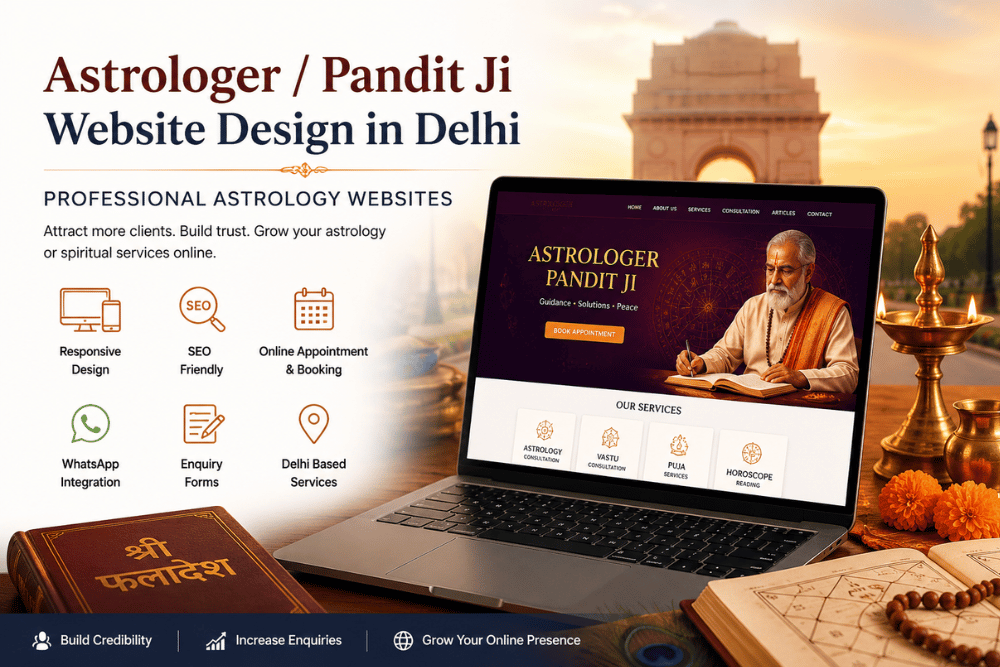
Astrologer / Pandit Ji Website Design in Delhi | Professional Astrology Websites
15 Aug, 2026
People looking for an astrologer or Pandit Ji in Delhi often want more than a phone number. Before making an enquiry, they may want to understand the services offered, learn about the consultation process, know whether online or in-person consultations are available, and get a better idea of who they are contacting. A professional website brings this information together in one place and gives the practitioner a stronger online presence that is not dependent only on social media, referrals, or messaging platforms.
A well-designed astrology website should feel clear, professional, and genuine from the first visit. Important services such as astrology consultations, horoscope guidance, vastu services, puja services, or other offerings can be presented through properly organized pages instead of being crowded into a single section. Clear service descriptions, an informative About page, genuine trust information, easy navigation, and convenient contact options help visitors understand the offering before deciding whether to enquire. The design should support the personality of the practice without becoming overly complicated or filled with unnecessary decorative elements.
For an astrologer or Pandit Ji serving Delhi, the website can also become a long-term foundation for organic search visibility. Each important service can have a clear purpose, while useful supporting content can answer questions that potential clients may search before contacting the practitioner. With mobile-friendly design, fast performance, meaningful page structure, and natural internal linking, the website can serve two purposes at once: helping people find and understand the services while creating a professional platform for consultation enquiries and future online growth.
Why an Astrologer or Pandit Ji Needs a Professional Website
For an astrologer or Pandit Ji, a website can become much more than an online profile. People searching for astrology consultations, vastu guidance, puja services, horoscope-related guidance, or other spiritual services often want to understand the person and the service before making contact. They may want to know what is offered, how consultations work, whether appointments are available online or in person, and how they can discuss their requirements. Bringing this information together on a professional website makes the decision process easier and gives visitors a clear place to learn before they enquire.
The presentation also needs to match the nature of the service. Astrology and spiritual services are personal, so visitors may be more comfortable with a website that feels calm, genuine, informative, and easy to navigate rather than one overloaded with animations or promotional elements. Clear service descriptions, authentic images, an informative About section, relevant experience or credentials where applicable, genuine testimonials, and straightforward contact options can all contribute to a stronger first impression. The website should communicate professionalism without making claims that cannot be properly supported.
A well-planned website can help an astrologer:
Present different services in an organized way
Explain consultation options clearly
Build a professional online identity
Make phone, WhatsApp, or enquiry contact easier
Support local and organic search visibility
Answer common questions before a consultation
Provide information for both new and returning clients
Create a foundation for future content and SEO growth
The structure of the website should then reflect the actual services being offered. If a Pandit Ji provides several types of consultations or religious services, visitors should be able to find each important offering without reading through one oversized page. Dedicated service sections can explain what the service involves, who it may be relevant to, how the consultation or booking process works, and what information the visitor should provide when making an enquiry. This makes the website easier to use while also giving individual services a clearer place within the overall site structure.
The website should also make the next step obvious without becoming overly promotional. Someone reading about a particular consultation may be ready to ask a question, while another visitor may first want to learn more about the practitioner. Natural contact points, simple enquiry forms, click-to-call options, WhatsApp access, and appointment information can support both types of visitors. When the website connects useful information with an easy enquiry journey, it becomes a practical business tool rather than simply another online listing.
For an astrologer serving Delhi, this foundation can also support broader SEO and content development over time. Helpful articles can answer genuine questions, while relevant internal links can guide readers from informational content toward appropriate service pages when there is a natural connection. The result is a website that can support visibility, trust, service discovery, and consultation enquiries without relying on repetitive keyword targeting or an overcrowded design.
What Should an Astrologer Website Include?
A professional astrologer website should make it easy for a visitor to understand the person, the services, and the next step. Someone searching for an astrologer or Pandit Ji may want to know what type of consultation is available, whether appointments are online or in person, how the consultation works, and how to contact the practitioner. Instead of putting all this information into one long page, a better website gives each important topic enough space while keeping the overall navigation simple. This creates a more comfortable experience for visitors and gives search engines a clearer understanding of the website.
A practical astrologer website can include:
Website Element
Why It Matters
Service pages
Explain important consultations and services
About page
Introduce the astrologer or Pandit Ji
Contact section
Make enquiries and communication easier
Appointment information
Explain the consultation process
FAQs
Address genuine questions before contact
Testimonials
Add trust when genuine testimonials are available
The service structure deserves particular attention. If the practitioner genuinely offers astrology consultation, horoscope guidance, vastu services, puja services, or other spiritual services, important offerings can be presented through focused sections or dedicated pages. Each page can explain the service in simple language, describe what visitors can expect, provide relevant practical information, and offer an easy way to enquire. This is better than creating many thin pages with almost identical content simply to target different keywords. For businesses planning a strong website structure, the guide on what pages every business website must have can also help when deciding which information deserves its own page.
The same principle should apply to contact and mobile experience. A visitor who has finished reading about a service should be able to call, send a WhatsApp message, submit an enquiry, or understand the appointment process without searching through the entire website. Helpful articles can answer genuine questions that potential clients have before contacting the practitioner, while relevant service pages can provide the next step when the visitor is ready. Natural internal links between these pages should support that journey rather than simply being added for SEO. This creates a cleaner website structure, improves content discovery, and gives the overall site a stronger SEO foundation without making the content feel forced.
Building a Professional Website for Astrology Consultations
An astrology website should make the consultation journey clear from the first visit. People may arrive with very different requirements, such as personal astrology guidance, horoscope consultation, marriage-related guidance, vastu services, puja services, or other spiritual offerings. Instead of placing every service into one crowded page, a professional website can organize important services into clear sections or dedicated pages. Each service should explain what it covers, what a visitor can expect, how the consultation is conducted, and what the next step is. This gives potential clients enough information to understand the service before they decide to contact the astrologer.
The consultation process should be equally straightforward. If online consultations are available, the website can explain how an appointment is requested, how the client can share their requirements, what communication method is used, and what happens after the enquiry. For in-person consultations, the relevant location and appointment information can be presented clearly. Simple options such as WhatsApp, phone calls, enquiry forms, or appointment requests should be available where they genuinely help. The aim is to remove uncertainty without making the website feel overly promotional. A clear customer journey is especially important when improving website navigation, because visitors should be able to move naturally from understanding a service to taking the next step.
A strong website should also accommodate visitors who are at different stages of making a decision. Someone who already knows the required service may go directly to a service page, while another visitor may first want to understand the astrologer's background, approach, or available consultation options. Clear navigation, relevant FAQs, supporting information, and properly placed contact options can connect these different journeys without making the website repetitive. Service pages can also link naturally to related consultation information when it genuinely helps the visitor, rather than adding links simply for SEO.
The overall goal is to make the website feel like a helpful introduction to the astrologer rather than a collection of disconnected pages. Well-organized services, informative content, mobile-friendly design, fast performance, genuine trust information, and accessible contact options should work together as one experience. When visitors can understand the service, find answers to their questions, and contact the practitioner without unnecessary steps, the website becomes much more effective at supporting enquiries. This also helps avoid common website conversion mistakes where interested visitors leave simply because the next action is unclear.
Astrology Website Design That Supports Google Visibility
A professional astrologer website should be planned for search visibility from the beginning, rather than trying to add SEO after the website has already been designed. Someone searching for an astrologer in Delhi may be looking for a particular service, consultation type, or answer to a specific question. The website should therefore make those topics easy to understand through useful pages, clear headings, descriptive titles, readable content, and logical navigation. Repeating the same keyword across every page can make the content feel unnatural; a stronger approach is to use relevant terms where they genuinely describe the service and the visitor's search intent.
This becomes especially important when an astrologer or Pandit Ji offers several different services. Instead of creating multiple pages that say almost the same thing, each important service should have a genuine purpose and enough useful information to stand on its own. An astrology consultation page can explain that consultation, while vastu services, puja services, horoscope guidance, or other genuine offerings can be presented separately when they deserve dedicated content. Supporting articles can then answer practical questions that people may have before contacting the practitioner and, where relevant, guide readers naturally toward the appropriate service page. This creates a useful content structure without turning the website into a collection of pages created only to target keyword variations.
The technical side of the website also has an important role in search performance and user experience. Pages should load efficiently, the website should work smoothly on smartphones and desktops, and visitors should be able to move between important sections without confusion. Images can be optimized while maintaining good visual quality, unnecessary scripts can be reduced, and the website structure can be kept clean so that important content is easy to access. These improvements are useful not only for search visibility but also for people who arrive from Google and need to quickly understand the service. A broader understanding of how Google evaluates business websites before ranking them can also help when planning the website's structure and overall user experience.
A strong SEO-friendly astrology website should ultimately feel like a useful website first and an SEO project second. Service pages, helpful articles, FAQs, internal links, images, navigation, and contact options should all have a clear purpose. When related pages are connected naturally, visitors can continue researching without having to return to the main menu, while search engines can better understand the relationship between different topics across the website. This approach creates a cleaner foundation for long-term organic visibility and gives the astrologer a website that can grow with new services, useful content, and changing customer needs.
Features That Make an Astrologer Website More Useful
The most useful features on an astrologer website are not necessarily the most advanced ones. They are the features that help a visitor understand the service, feel comfortable with the information provided, and take the next step without unnecessary effort. A clear service menu, informative About section, easy-to-find contact details, WhatsApp or click-to-call options, enquiry forms, appointment information, and FAQs can create a much better experience than a website filled with animations or complicated functions. Every feature should have a practical purpose and support the way the astrologer actually communicates with clients.
The service pages should also work as useful information points rather than simple sales pages. If an astrologer offers several genuine services, each important offering can explain what it involves, how the consultation works, and what a visitor should know before making an enquiry. Helpful FAQs, consultation information, and relevant supporting content can then answer common questions without making the main service page unnecessarily long. Where two topics are genuinely connected, a natural internal link can help visitors continue their research and discover relevant information without having to search through the entire website.
A professional website should also be built with future growth in mind. An astrologer may later add online consultations, new services, additional FAQs, useful articles, appointment features, photographs, or genuine client testimonials. A flexible structure makes these additions easier without creating a confusing navigation system or requiring a complete redesign. This is why website development should consider content management, page structure, mobile usability, performance, and future expansion from the beginning. A well-planned website can continue supporting enquiries and organic visibility as the practice develops, instead of becoming outdated shortly after launch.
Choosing the Right Website Design for a Pandit Ji or Astrologer
A professional astrologer website should be planned around how potential clients actually search, compare, and contact the practitioner. Some visitors may already know the consultation they want, while others may first want to understand the astrologer, available services, consultation process, and practical details before making a decision. A well-planned homepage can introduce the practice and highlight the main services, while focused service pages can provide deeper information for visitors who want to explore a particular offering. This structure keeps the website easy to understand without forcing every visitor through the same journey.
The design should also reflect the actual way the practice operates. An astrologer offering online consultations may need appointment information, enquiry forms, WhatsApp communication, consultation details, and clear instructions for getting started. A Pandit Ji providing puja or spiritual services may need dedicated service information, areas served, photographs, event-related details, and convenient enquiry options. These differences are important when selecting a development approach because the website should be built around real requirements rather than simply placing different text into a standard template. A capable Website Development Company in Delhi can help plan the structure, functionality, and future scalability according to the practice's actual needs.
The difference between visual design and useful website development is equally important. A website can look attractive but still perform poorly if visitors struggle with navigation, pages load slowly, important information is difficult to find, or contact options are hidden. Mobile responsiveness, readable typography, optimized images, clean page structure, simple menus, secure development, and clear calls to action should work together as one experience. The website should also leave room for future additions such as new consultation services, helpful articles, FAQs, appointment features, or other functionality without requiring the entire site to be rebuilt.
For an astrologer or Pandit Ji building a long-term online presence, the better choice is therefore not simply the website with the most impressive visual effects. It is a website that communicates the practice clearly, works reliably across devices, supports genuine enquiries, and provides a strong foundation for SEO and future content. When design, development, content, usability, and search-friendly structure are planned together, the website becomes a practical digital platform that can continue supporting the practice as its services and online audience grow.
Local SEO for Astrologers in Delhi
For an astrologer or Pandit Ji serving Delhi, local SEO should help genuine potential clients discover the practice when they are looking for relevant services. The website should establish the Delhi connection naturally through its main pages, service information, contact details, and useful content rather than repeating phrases such as “astrologer in Delhi” throughout every paragraph. A strong local website makes it clear what services are offered, where consultations are available, whether online appointments are possible, and how visitors can contact the practitioner.
A useful local SEO foundation includes:
Clear service pages for important astrology offerings
Accurate business and contact information
Genuine Delhi service-area information
Mobile-friendly and fast website performance
Helpful content based on real client questions
Clear navigation between related pages
Natural internal links between supporting content and services
Consistent business information across relevant profiles
The website structure is particularly important when the astrologer offers several services. Instead of creating separate pages for every Delhi locality with almost identical content, the site can build stronger topical relevance through genuine service pages and useful supporting articles. For example, an article answering a common question about a particular consultation can naturally introduce the relevant service page when the reader wants more information. This creates a useful path from Google search to educational content and then toward an enquiry, without making the website feel like it was written only for search engines.
Local relevance should also be supported by accurate information about the actual service area. If consultations are available in Delhi, the website can explain that clearly and provide relevant location or appointment information. If the astrologer serves clients online across different areas, that can also be communicated honestly. Creating dozens of near-identical locality pages simply by changing the area name usually adds little value. A better approach is to make each important page genuinely useful and let the overall website demonstrate its relevance through services, content, business information, and customer-focused structure. The broader principles in Local SEO for Website Designers in Delhi are also relevant when planning this type of local search strategy.
Over time, helpful content can become an important part of the website's local visibility. Articles can address questions people may have before contacting an astrologer, while service pages can provide more detailed information for visitors who are ready to enquire. Natural internal linking between these pages helps users discover related information and gives search engines a clearer understanding of how the website's topics connect. Combined with strong mobile usability, clear navigation, useful content, and accurate local information, this creates a more sustainable SEO foundation than relying on repetitive location keywords alone.
Creating a Website That Converts Visitors Into Enquiries
The purpose of an astrologer website is not simply to attract visitors; it should make it easy for genuinely interested people to understand the service and start a conversation. A visitor may first read about the astrologer, then check a particular consultation, look at FAQs, and only later decide to enquire. The website should support this natural decision process instead of pushing visitors toward contact before they have enough information. Clear service pages, useful consultation details, visible contact information, WhatsApp, click-to-call options, and simple enquiry forms can give visitors an easy next step when they are ready.
The content also has an important role in conversion. Before contacting an astrologer or Pandit Ji, a potential client may have practical questions about the consultation process, appointment availability, online sessions, required information, service areas, or how the enquiry will be handled. Answering these questions directly can remove unnecessary hesitation. The same applies to trust information: where genuine testimonials, practitioner information, experience details, or other relevant credentials are available, they can be presented clearly without exaggerated promises. A website should help visitors make an informed decision rather than relying on aggressive sales language.
The enquiry journey should also work smoothly on mobile devices. Someone searching for an astrologer from a smartphone may want to call immediately, send a WhatsApp message, or submit a short enquiry form. If the contact option is hidden at the bottom of a long page or the form asks for unnecessary information, the visitor may simply leave. Good conversion-focused design keeps the important action accessible while allowing visitors to continue reading when they are not yet ready to contact the practitioner. Businesses can also review common website conversion mistakes to understand how navigation, page structure, unclear messaging, and unnecessary friction can affect enquiries.
The strongest approach is to connect useful information, professional presentation, and a simple enquiry journey throughout the website. A service page can answer the visitor's main questions, an FAQ can remove remaining uncertainty, and a relevant internal link can take the reader to another useful page when there is a genuine connection. When these elements are combined with responsive design, fast performance, clear navigation, and a sensible SEO structure, the website becomes more than an online profile. It becomes a practical digital platform that can support visibility, trust, service discovery, and genuine consultation enquiries over the long term.
Why Mobile-Friendly Design Matters for an Astrologer Website
Many people looking for an astrologer or Pandit Ji will first visit the website from a smartphone. They may come from a Google search, social media profile, recommendation, or a shared WhatsApp link. If the website is difficult to read, the menu is confusing, the pages load slowly, or the contact button is hard to find, the visitor may leave before understanding the services. A mobile-friendly design keeps the experience simple by adjusting the layout, text, images, buttons, forms, and navigation to different screen sizes.
Speed is equally important. Astrology websites can include photographs, service images, videos, testimonials, contact forms, and other visual elements, but these should not make the pages unnecessarily heavy. Proper image optimization, clean development, suitable hosting, and removal of unnecessary scripts can help pages load more efficiently. A faster website also makes it easier for visitors to move between service pages and reach the contact or appointment section without frustration.
The website should also be easy to maintain after launch. Services may change, new consultation options may be introduced, contact information may need updating, and fresh articles may be added to support Google visibility. Regular updates help keep the website accurate and useful instead of allowing important information to become outdated. Businesses can also review a practical website maintenance guide when planning how their website should be managed after development.
Final Thoughts
A professional astrologer or Pandit Ji website should be built around trust, clarity, and the way real visitors make decisions. People may first want to understand the practitioner, then explore a particular service, check how the consultation works, and finally decide whether to make an enquiry. A well-structured website brings these stages together through clear service pages, useful information, genuine trust signals, simple navigation, and convenient contact options. This makes the website feel more like a professional introduction to the practice rather than just an online listing.
The strongest website is not necessarily the one with the most features or the most decorative design. It is the one that makes important information easy to understand and the next step easy to take. Responsive design, fast-loading pages, readable content, well-organized services, mobile-friendly contact options, and natural internal linking should work together without making the visitor feel overwhelmed. Helpful supporting content can also give people answers before they enquire, while relevant service pages provide a natural path when they are ready to take action.
For an astrologer serving Delhi, the website should also be planned as a long-term digital asset rather than something created only for an initial online presence. Services may expand, new content may be added, consultation methods may change, and the website may gradually become an important source of organic visitors and enquiries. With a clean SEO-friendly structure, useful content, professional presentation, strong user experience, and regular maintenance, the website can continue supporting visibility and genuine consultation enquiries as the practice grows.
A professional website gives a Pandit Ji a dedicated place to explain astrology, consultation, puja, and other spiritual services. It can also help visitors understand the services, explore available options, and contact the Pandit Ji directly for further information.
An astrologer website can include individual service pages, consultation information, an About section, testimonials, frequently asked questions, contact details, WhatsApp enquiries, appointment options, and clear information about the services offered.
A well-structured website can make it easier for potential clients to understand the services and take the next step. Clear service pages, visible enquiry buttons, WhatsApp options, contact forms, and appointment information can create a simpler path from website visit to consultation enquiry.
Yes. Important services can be presented on separate pages so visitors can understand each offering in greater detail. This can also create a clearer website structure and give each service a more relevant page for search visibility.
A mobile-friendly astrologer website should have readable content, simple navigation, properly sized buttons, fast-loading pages, easy-to-use enquiry forms, and quick access to contact or WhatsApp options. This allows visitors to explore services comfortably from smartphones.
SEO can help an astrologer website become more discoverable for relevant searches by using useful service content, clear page structure, descriptive titles, optimized URLs, internal linking, mobile-friendly design, and good website performance. This creates a stronger foundation for organic search visibility.
Grow Your Local Business
Get a Professional Website From a Web Designing Company in Delhi