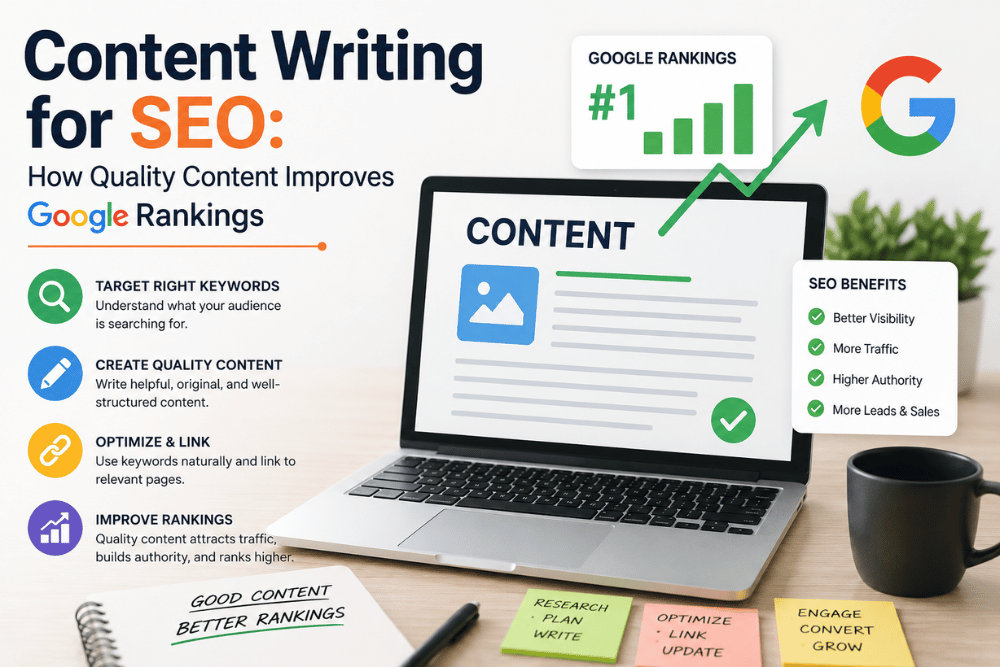
Content Writing for SEO: How Quality Content Improves Google Rankings
06 Aug, 2026
Every day, millions of people use Google to search for answers, compare products, research services, and make buying decisions. Before contacting a business or making a purchase, they often read blog articles, service pages, guides, and reviews to find the most reliable information. If your website does not provide the content users are searching for, it becomes difficult for both potential customers and search engines to discover your business. This is why Content Writing for SEO has become one of the most important elements of building long-term online visibility and attracting consistent organic traffic.
Modern SEO is no longer about inserting keywords into a webpage and expecting higher rankings. Google's algorithms have become far more advanced, evaluating how well your content satisfies search intent, answers user questions, demonstrates expertise, and delivers a positive reading experience. High-quality content helps search engines understand your website, while also building trust with visitors who are looking for accurate and valuable information. Businesses that consistently publish useful, well-structured, and original content are far more likely to improve their Google rankings than websites that rely on thin, outdated, or keyword-focused pages.
Whether you operate a local business, an eCommerce store, a professional service, or a growing company, SEO content writing plays a vital role in your digital marketing strategy. Every blog post, landing page, service page, and industry guide contributes to your website's authority by expanding your expertise across related topics. As your content library grows, your website becomes more relevant to a wider range of search queries, allowing you to rank for more keywords while attracting visitors who are actively searching for your products or services.
Effective SEO content is not written for search engines alone—it is written for people first. A successful SEO content strategy begins by understanding what your audience wants to know and then delivering clear, accurate, and comprehensive answers in a logical format. When high-quality content is supported by keyword research, search intent optimisation, internal linking, topical authority, and a strong website structure, it becomes a long-term asset that continues generating organic traffic, strengthening your online authority, and improving Google rankings long after it is published.
Why Content Writing Is One of the Most Important SEO Ranking Factors
Content is one of the most valuable assets a business can invest in because it influences almost every aspect of search engine optimisation. A professionally designed website may create a strong first impression, but without high-quality content, it becomes difficult for search engines to understand what your business offers or why your pages deserve to rank. Every service page, blog article, buying guide, and FAQ helps build your website's authority while answering the questions your potential customers are actively searching for. This is why businesses that consistently publish useful and relevant content often achieve stronger organic visibility than websites that rely only on technical optimisation or paid advertising.
Unlike short-term marketing campaigns, SEO content continues delivering value long after it has been published. A single well-researched article can rank for dozens of related search queries, attract qualified visitors, and generate enquiries for months or even years without additional advertising costs. As more quality content is added, your website gradually develops topical authority, making it easier for Google to recognise your expertise within your industry. This creates a cumulative effect where every new article strengthens the performance of existing pages instead of competing against them.
Quality content also improves the overall user experience by helping visitors find clear, reliable, and actionable information. When users quickly find answers to their questions, they are more likely to stay on your website, explore additional pages, and trust your business. This naturally increases engagement, supports stronger internal linking, and creates more opportunities for visitors to move from learning about your business to becoming customers. Businesses that combine valuable content with a well-organised website often create a stronger digital presence than competitors who publish only promotional content.
An effective SEO content strategy is therefore much more than writing articles around keywords. It involves understanding customer intent, covering topics comprehensively, and connecting related pages to build a complete knowledge base around your services. For example, a business publishing articles about website design, local SEO, digital marketing, and business growth demonstrates broader expertise than a website with only a handful of isolated pages. This is one reason why businesses also invest in resources such as How Google Evaluates Business Websites Before Ranking Them, as understanding the broader ranking factors helps create content that supports both users and long-term SEO performance.
Ultimately, content is what transforms a website from an online brochure into a valuable business resource. It attracts targeted visitors, answers customer questions, strengthens authority, supports other SEO activities, and generates sustainable organic traffic. While search algorithms continue to evolve, businesses that consistently create original, informative, and user-focused content remain in the strongest position to improve rankings, increase visibility, and build long-term online growth.
How Google Uses Content to Understand and Rank Your Website
Publishing high-quality content is only the beginning of the SEO process. After Google discovers a page, it begins analysing that content to understand exactly what it is about, how valuable it is for users, and whether it deserves to appear ahead of competing websites. Modern search algorithms no longer rely on simple keyword matching. Instead, they evaluate how completely a page covers a topic, how well it satisfies user intent, and whether it demonstrates the experience, expertise, authority, and trustworthiness expected from high-quality search results. The goal is not simply to identify pages that contain the right words, but to identify pages that provide the best overall answer.
To build this understanding, Google examines the entire structure of the page rather than isolated elements. It analyses titles, headings, supporting paragraphs, related terms, images, internal links, and the logical flow of information to determine the primary topic and the depth of coverage. A page that explains a subject from multiple angles, answers common follow-up questions, and presents information in a clear, organised format is easier for Google's systems to interpret than a page offering only a brief overview. This comprehensive approach helps search engines understand not only what the page discusses but also how useful it is likely to be for different types of search queries.
Google also evaluates how individual pages contribute to the authority of the website as a whole. It looks for relationships between related articles, service pages, and educational resources to determine whether a website demonstrates consistent expertise within a particular subject. For example, an article about SEO content writing becomes significantly stronger when it is supported by related resources covering website structure, local SEO, technical optimisation, user experience, and business growth. This interconnected content architecture helps search engines recognise topical authority while encouraging visitors to continue exploring relevant information across the website.
Another important factor is user behaviour. After a page appears in search results, Google observes how visitors interact with it. If users spend time reading the content, visit additional pages, and find the information useful enough to continue their journey on the website, these positive engagement signals reinforce the value of the content. Conversely, if visitors leave immediately because the page fails to answer their question or provides a poor reading experience, it becomes more difficult for that page to compete against stronger alternatives. While no single behavioural metric determines rankings, the overall user experience contributes to Google's understanding of content quality over time.
For businesses aiming to achieve long-term organic growth, understanding how Google evaluates content is just as important as creating the content itself. Successful SEO is built on publishing comprehensive, well-structured, and genuinely helpful information that serves real users first. When high-quality content is combined with strong website architecture, strategic internal linking, and a clear topical focus, it becomes far easier for Google to understand your expertise, trust your website, and reward your pages with stronger visibility in search results.
Understanding Search Intent: The Foundation of Successful SEO Content
Before writing any SEO content, it is important to understand why someone is searching in the first place. This is known as search intent, and it is one of the strongest factors influencing modern Google rankings. Search engines are no longer trying to match pages based only on keywords—they want to recommend content that completely satisfies the user's goal. If your article answers the exact question a visitor has, it has a much better chance of ranking than content that simply repeats the target keyword.
Every search query reflects a different stage of the customer's journey. Some users are looking for basic information, while others are comparing solutions or are ready to purchase a product or service. For example, someone searching for "Content Writing for SEO" usually wants to learn how SEO content works, why it matters, how it improves Google rankings, and what techniques are used to create content that performs well. If an article only defines the term without answering these follow-up questions, visitors will often return to Google and choose another result that provides more complete information.
Understanding search intent also helps businesses plan their content more strategically. Instead of publishing random blog posts, every article should answer a specific customer question and naturally connect with related topics across the website. This creates a stronger topical structure, improves user experience, and makes it easier for search engines to understand the relationship between different pages. Businesses that invest time in researching what their audience actually searches for generally create content that attracts more qualified visitors and generates better long-term organic traffic.
Search intent and keyword research work together because the best keywords are those that reflect genuine customer needs rather than simply having high search volume. Choosing the right topics before writing often has a greater impact than optimising the article after it is published. If you want to learn how to identify valuable search opportunities before creating content, our guide on Local SEO Tips to Rank Your Business Higher on Google in Delhi explains how keyword targeting and search intent work together to improve long-term search visibility.
How to Write SEO-Friendly Content That Google and Readers Love
Once you understand what your audience is searching for, the next step is presenting that information in a way that is easy to read, easy to understand, and easy for search engines to interpret. High-performing SEO content is not created by adding more keywords—it is created by organising information logically, answering questions clearly, and providing enough depth for readers to leave without needing to search again. Articles that solve problems completely generally perform much better than pages that provide only short or generic explanations.
A well-written SEO article follows a natural structure that guides readers from one idea to the next. It begins with a clear introduction, explains important concepts through meaningful headings, supports the discussion with practical examples where appropriate, and finishes with actionable conclusions. This structure improves readability while helping Google understand the hierarchy of the content. Long, well-organised articles also encourage visitors to spend more time on the page, which contributes to stronger engagement and a better overall user experience.
Rather than forcing keywords into every paragraph, professional SEO writing uses them naturally where they fit the context. The primary keyword should appear in important places such as the title, introduction, and relevant headings, while related terms are incorporated naturally throughout the article. At the same time, supporting images, descriptive alt text, relevant internal links, and a clear content hierarchy all help strengthen the page without making it feel over-optimised. Businesses looking to improve overall website performance often combine high-quality content with technical improvements discussed in Website Speed Optimization, as fast-loading pages and valuable content work together to improve both user experience and search performance.
The most successful SEO content always puts the reader first. When visitors quickly find useful information, continue reading, and naturally explore other relevant pages on the website, search engines receive stronger quality signals. Over time, this combination of valuable content, good readability, logical structure, and strategic internal linking creates a stronger foundation for sustainable Google rankings and long-term organic growth.
These two sections can also be significantly stronger. Right now they're a bit generic and repeat ideas like "topical authority" and "internal linking." For a page targeting "Content Writing for SEO", I'd make one section about avoiding quality issues and the other about building a content ecosystem. Here's a more premium version.
Common Content Writing Mistakes That Hurt Google Rankings
Publishing content consistently is important, but publishing the wrong type of content can limit your website's SEO performance. Many businesses spend time creating blog posts and service pages yet struggle to gain organic visibility because the content fails to meet Google's quality standards. In most cases, the problem is not a lack of effort—it is a lack of strategy. Pages that are poorly structured, fail to answer user questions, or provide little original value often find it difficult to compete against websites that publish more comprehensive and user-focused content.
Instead of trying to publish more articles, businesses should focus on improving the quality of every page they create. Well-written SEO content should satisfy search intent, provide practical information, and encourage visitors to continue exploring the website. Even small improvements in content quality can strengthen user engagement, increase topical relevance, and improve long-term search visibility.
Some of the most common mistakes that prevent content from ranking include:
Common Mistake
How It Affects SEO
Writing for search engines instead of users
Makes content feel unnatural and reduces readability.
Ignoring search intent
Fails to answer what users are actually searching for.
Publishing thin or generic content
Struggles to compete against detailed, authoritative resources.
Using duplicate or unedited AI-generated content
Weakens originality and reduces trust.
Poor heading structure
Makes the content difficult to read and understand.
Missing internal links
Reduces topical connections between related pages.
Outdated information
Lowers relevance and user confidence over time.
Another mistake many businesses overlook is treating every article as a standalone page. Google understands websites more effectively when related topics are connected through logical internal links. For example, after learning about SEO content writing, readers may naturally want to understand How to Audit Your Business Website for Better SEO and Lead Generation, helping them continue their learning journey while strengthening your website's overall content structure. This creates a better user experience and reinforces the relationship between closely related topics.
Avoiding these common mistakes does not guarantee overnight rankings, but it creates a much stronger foundation for long-term SEO success. High-quality, original, and well-organised content consistently outperforms pages created only to target keywords, making it one of the most valuable investments for sustainable organic growth.
Building Topical Authority Through High-Quality Content
Topical authority is one of the most valuable assets a website can build because it demonstrates consistent expertise within a specific subject. Instead of evaluating a single page in isolation, Google increasingly looks at how comprehensively a website covers an entire topic. A business that publishes multiple high-quality articles around related subjects sends stronger signals of expertise than a website with only a few disconnected pages. As your content library grows, search engines gain greater confidence in your knowledge, making it easier for both existing and newly published pages to achieve stronger visibility in search results.
Building topical authority requires a clear content strategy rather than publishing random articles whenever new ideas arise. Every piece of content should answer a specific customer question while supporting a broader topic relevant to your business. For example, a website offering SEO services can strengthen its authority by covering subjects such as keyword research, content writing, technical SEO, local SEO, website performance, user experience, and conversion optimisation. Each article adds another layer of expertise, and together they create a complete resource that is far more valuable than a single page attempting to cover everything. This structured approach also allows your website to rank for a much wider range of related search queries, bringing in visitors at different stages of the buying journey.
Consistency is equally important because topical authority develops over time rather than after publishing a handful of articles. Every well-researched guide, informative blog post, and detailed service page contributes to the overall strength of your website. As your content becomes broader, deeper, and more useful, search engines begin recognising your website as a reliable source of information within your industry. This not only improves keyword coverage but also strengthens user trust, encourages visitors to explore additional content, and creates a sustainable foundation for long-term organic growth. Businesses that invest in building topical authority are not simply publishing more content—they are building a knowledge hub that continues to generate visibility, credibility, and qualified traffic for years to come.
Why Content Freshness Matters for Long-Term SEO Success
Creating high-quality SEO content is a major step toward improving Google rankings, but maintaining those rankings requires continuous attention. Search behaviour changes over time, new competitors publish better resources, and customer questions evolve as industries develop. If your content remains unchanged for years, it can gradually lose relevance even if it once ranked well. Businesses that regularly review and improve their existing articles often achieve more stable rankings because they continue providing accurate, useful, and up-to-date information that matches current search intent.
Content freshness is not about changing the publication date or rewriting every article from scratch. In many cases, small but meaningful updates can significantly improve a page's performance. Expanding sections with more detailed explanations, answering newly emerging customer questions, improving readability, updating outdated information, strengthening internal links, and adding relevant examples all help increase the overall value of the content. These improvements not only create a better experience for readers but also signal that the website is actively maintained and committed to providing reliable information.
Regular content updates also strengthen your website's long-term authority. Instead of constantly publishing new articles, businesses can often achieve better results by improving their existing content library and ensuring that every page remains comprehensive, relevant, and useful. This approach helps preserve rankings, increases user trust, and allows older articles to continue attracting qualified organic traffic. Over time, a well-maintained content library becomes a valuable business asset that consistently supports visibility, lead generation, and sustainable SEO growth.
Why E-E-A-T Is Essential for High-Quality SEO Content
One of Google's primary goals is to recommend content that users can trust. This is why Experience, Expertise, Authoritativeness, and Trustworthiness (E-E-A-T) have become important principles for creating high-quality SEO content. While E-E-A-T is not a direct ranking factor, it plays a significant role in how Google evaluates the overall quality and credibility of a website. Businesses that consistently publish accurate, well-researched, and genuinely helpful content are more likely to build long-term trust with both users and search engines than websites that focus only on keywords or promotional messaging.
Strong E-E-A-T is developed through the quality of your content rather than technical tricks. Articles should explain topics clearly, answer practical customer questions, provide useful insights, and demonstrate genuine understanding of the subject being discussed. Content that is original, easy to understand, and supported by logical website structure creates a stronger impression of expertise than content filled with unnecessary jargon or generic information. As visitors continue finding reliable answers across multiple pages, confidence in your website naturally increases, encouraging repeat visits and stronger engagement.
Building trust is a long-term process that extends beyond a single article. Every informative blog post, detailed service page, and educational resource contributes to your website's overall reputation. When your content consistently helps readers solve problems instead of simply promoting products or services, it establishes your business as a reliable source of information within your industry. Over time, this stronger reputation improves user confidence, supports better organic visibility, and creates a solid foundation for sustainable SEO success.
Content Writing Supports Every Part of Your SEO Strategy
Many businesses view content writing as something they only need for publishing blog posts, but in reality, it influences every major part of a successful SEO strategy. Whether you are creating a service page, a location page, an industry-specific guide, or an educational blog, the quality of your content determines how effectively search engines understand your website and how confidently potential customers engage with your business. Without valuable content, even a technically well-optimised website will struggle to build authority, rank for competitive keywords, or convert visitors into enquiries.
High-quality content strengthens multiple areas of SEO at the same time. It provides the context needed for search engines to understand your services, supports on-page optimisation through natural keyword usage, improves user engagement by answering customer questions, and creates opportunities for meaningful internal linking between related topics. As your website grows, each new piece of content reinforces the others, helping search engines recognise the depth of your expertise while making it easier for visitors to discover additional information that matches their interests.
For example, a business offering website design services should not rely only on a single service page to attract customers. Publishing detailed resources about website performance, SEO, content strategy, conversion optimisation, and user experience helps build a much stronger digital presence because every article contributes additional topical relevance. Instead of competing with one page, your website begins supporting its core services through a connected network of informative content that answers customer questions at every stage of the buying journey.
The most successful SEO strategies therefore treat content as the foundation rather than the final step of optimisation. Technical SEO, keyword research, website structure, internal linking, and user experience all become significantly more effective when they are supported by high-quality, well-organised content. Over time, this integrated approach builds greater topical authority, strengthens organic visibility, improves user trust, and creates a website that continues generating qualified traffic and business opportunities long after each article is published.
How to Measure the Success of Your SEO Content
Publishing high-quality content is only the first step in building long-term organic visibility. To understand whether your SEO content is actually contributing to business growth, you need to measure its performance regularly and identify opportunities for improvement. Search rankings change constantly as competitors publish new content, user behaviour evolves, and Google continues refining its algorithms. Businesses that monitor their content and make regular improvements are more likely to maintain stable rankings than those that publish articles once and never revisit them.
Measuring SEO success goes far beyond tracking a single keyword position. A well-optimised article often ranks for dozens of related search queries, attracts visitors at different stages of the buying journey, and supports the performance of other pages through a strong internal linking structure. Evaluating multiple performance indicators provides a much clearer picture of how effectively your content is helping your overall SEO strategy.
Some of the most important SEO content metrics include:
Growth in organic traffic from Google Search.
Rankings for primary and related keywords.
Average time users spend on the page.
User engagement and pages viewed per session.
Click-through rate (CTR) from search results.
Leads, enquiries, or conversions generated through the content.
Internal link engagement and visitor navigation patterns.
Analysing these metrics helps businesses identify which articles continue attracting traffic, which pages require updates, and which topics deserve additional content. Rather than constantly publishing new blog posts, improving existing articles with better explanations, updated information, stronger headings, and enhanced internal linking often delivers faster and more sustainable SEO improvements.
Content performance should also be evaluated as part of your wider digital marketing strategy rather than in isolation. High-quality SEO content supports brand awareness, improves organic visibility, nurtures potential customers, and complements channels such as social media, local SEO, and paid marketing. Businesses looking to create a complete online growth strategy often combine SEO content with broader services offered by a Digital Marketing Company in Janakpuri, ensuring every marketing channel works together to generate consistent traffic, qualified leads, and long-term business growth.
SEO Content Writing Checklist
Before publishing any SEO article, take a few minutes to review it against a structured checklist. Even well-written content can miss important optimisation opportunities if it is published without a final review. A consistent quality-check process helps ensure every article delivers value to readers, follows modern SEO best practices, and supports your website's long-term organic growth. Rather than focusing only on keywords, aim to create content that is useful, easy to read, and aligned with both user expectations and search engine guidelines.
Before You Publish, Check That Your Article Includes:
✔ A clear primary keyword used naturally in the title, introduction, headings, and conclusion.
✔ Helpful headings that organise the content into logical sections.
✔ Original, informative, and user-focused content that satisfies search intent.
✔ Related keywords and relevant entities included naturally without keyword stuffing.
✔ Strategic internal links to supporting pages and related articles.
✔ An SEO-friendly title tag, meta description, and clean URL structure.
✔ Short, readable paragraphs with mobile-friendly formatting.
✔ Optimised images with descriptive file names and alt text.
✔ A clear conclusion that summarises the topic and encourages further exploration.
✔ Up-to-date information that reflects current best practices and user expectations.
Following this checklist consistently helps create articles that are easier for readers to understand and easier for search engines to evaluate. Over time, maintaining the same quality standard across every page strengthens your website's authority, improves user engagement, and supports more consistent organic rankings.
Final Thoughts
Content writing is no longer just a way to publish blog articles—it has become one of the most important foundations of successful SEO. Every high-quality page you create helps search engines understand your business, builds trust with potential customers, and expands your website's ability to rank for relevant search queries. Businesses that invest in original, informative, and well-structured content are not simply improving individual pages; they are building a long-term digital asset that continues generating traffic, leads, and authority over time.
Successful SEO content writing is built on understanding your audience before writing a single word. When every article is created around genuine search intent, organised with a clear structure, supported by natural internal linking, and regularly updated to remain relevant, it becomes far more valuable than content written only to target keywords. This approach not only improves Google rankings but also creates a better experience for visitors, encouraging them to stay longer, explore more pages, and develop greater trust in your brand.
The most successful websites do not rely on one or two articles to generate traffic. They build a comprehensive content library where every blog, service page, and resource strengthens the others, gradually increasing topical authority across the entire website. As this content ecosystem grows, it becomes easier to rank for competitive keywords, attract highly qualified visitors, and maintain long-term visibility without relying entirely on paid advertising.
If your goal is sustainable organic growth, treat every piece of content as an investment rather than a one-time marketing task. Consistently publishing valuable, well-researched, and user-focused content will strengthen your website, improve your online authority, and position your business as a trusted resource within your industry. Over time, this disciplined approach creates lasting SEO results, stronger brand credibility, and a reliable source of organic traffic that continues supporting business growth for years to come.
SEO content writing is the process of creating valuable, keyword-optimised content that helps search engines understand your pages while providing useful information that answers users' questions and improves Google rankings.
Quality content improves search visibility, increases user engagement, builds topical authority, and encourages visitors to spend more time on your website, all of which support better Google rankings.
Keywords help search engines understand the topic of a page and match it with relevant user searches. Using primary and related keywords naturally throughout the content improves relevance without keyword stuffing.
The ideal length depends on search intent, but comprehensive articles between 1,500 and 2,500 words often perform well for competitive topics because they cover the subject in greater depth.
Yes. Well-written, original, and user-focused content helps improve keyword relevance, topical authority, internal linking, and user engagement, all of which contribute to stronger long-term Google rankings.
Publishing high-quality content consistently is more important than publishing frequently. A regular schedule with valuable articles helps build website authority and keeps your website relevant for both users and search engines.
Grow Your Local Business
Get a Professional Website From a Web Designing Company in Delhi