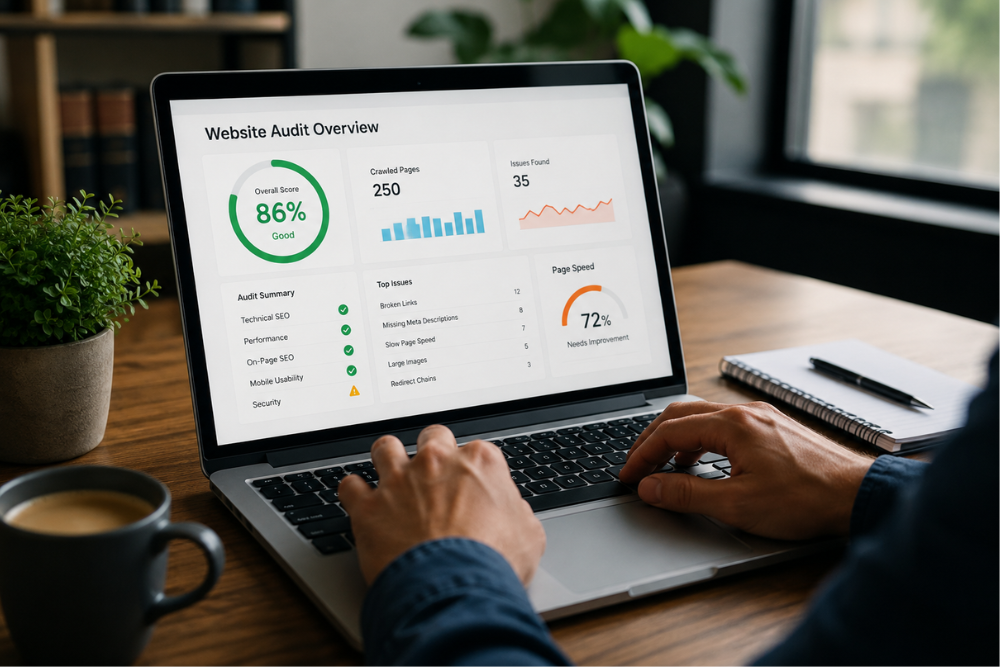
How to Audit Your Business Website for Better SEO and Lead Generation
Many businesses invest in a professional website expecting it to attract customers and generate enquiries for years. However, even well-designed websites can gradually lose their effectiveness as new content is added, customer expectations change, and search engine algorithms continue evolving. Without regular reviews, small technical issues often develop into larger problems that affect rankings, user experience, and lead generation.
A business website audit helps identify these problems before they begin impacting your online performance. It goes far beyond checking SEO by evaluating your website's technical health, structure, content quality, page speed, security, user experience, and conversion opportunities. Understanding how these areas work together makes it easier to improve search visibility while creating a better experience for potential customers.
Rather than waiting for rankings to decline or enquiries to decrease, businesses should make website audits part of their regular improvement strategy. Regular reviews help identify opportunities to improve performance, strengthen SEO, and increase lead generation over time. Businesses that already follow a structured Website Maintenance often find it much easier to keep their websites optimized as their business continues to grow.
Why Regular Website Audits Matter
A website audit provides a clear picture of how well your website is performing from both a user's perspective and a search engine's point of view. Instead of guessing why rankings have dropped or why enquiries have slowed down, an audit identifies the technical, structural, and content-related issues that may be limiting your website's performance.
Regular audits evaluate every part of your website, including page speed, mobile usability, website structure, content quality, security, and user experience. While many of these issues may seem minor individually, they often work together to reduce search visibility and make it harder for visitors to become customers. Businesses experiencing declining enquiries can also explore Why Your Business Website Is Not Getting Leads in Delhi, which explains how technical issues, poor user experience, and weak conversion elements can affect business growth.
Regular audits also help businesses make informed decisions. Instead of redesigning an entire website unnecessarily, an audit often reveals that only specific areas require improvement. Fixing broken pages, improving internal linking, updating outdated content, or optimizing slow-loading pages can often produce better results than rebuilding the website from scratch.
From a business perspective, website audits also reduce long-term costs. Identifying technical issues early prevents them from developing into larger problems that require significant time and investment to resolve. Businesses that review their websites consistently are generally better prepared to maintain strong SEO performance, improve user experience, and generate more qualified leads over time.
Signs Your Business Website Needs an Audit
Not every website problem is immediately obvious. In many cases, performance declines gradually, making it difficult for business owners to recognize when something is wrong. A website may continue receiving visitors, yet experience slower loading times, declining search rankings, lower engagement, or fewer enquiries because of issues that develop over time. A regular website audit helps identify these problems early, allowing businesses to improve their website before performance begins affecting growth.
One common pattern I've noticed is that many businesses only decide to audit their website after rankings drop or enquiries begin to decrease. By that stage, several technical, content, and user experience issues have usually accumulated, making them more time-consuming and expensive to resolve than if they had been identified earlier through regular reviews.
Some of the most common signs that your business website may need a complete audit include:
Warning Sign
What It May Indicate
Organic traffic is steadily declining
Technical SEO or content-related issues
Visitors are not converting into enquiries
Weak calls-to-action or poor user experience
Important pages have lost Google rankings
Search visibility or indexing problems
Pages load slowly on mobile or desktop
Website performance issues
High bounce rates
Poor navigation or irrelevant content
Broken links or outdated information
Website maintenance problems
New pages are not appearing in search results
Crawling or indexing issues
The website has not been reviewed for several months
Multiple unnoticed technical problems
Ignoring these warning signs often allows small issues to develop into larger problems that affect search visibility, customer confidence, and lead generation. In many cases, businesses also discover that their website no longer reflects their current brand, services, or customer expectations. Businesses looking to improve both the visual and functional aspects of their website can also explore Business Website Design in Delhi, where I explain how strategic website design supports better user experience, stronger SEO performance, and long-term business growth.
A website audit should therefore be viewed as preventive maintenance rather than a solution reserved only for existing problems. Businesses that evaluate and improve their websites consistently are generally better positioned to maintain strong online performance, adapt to changing customer expectations, and generate more qualified leads over the long term.
Understanding What a Website Audit Should Include
A complete website audit goes far beyond checking whether a website is online or identifying a few SEO errors. It provides a comprehensive evaluation of how effectively your website supports both users and search engines. The objective is to uncover technical issues, usability problems, content gaps, and conversion obstacles that may be limiting your website's overall performance.
Rather than focusing on a single metric, a business website audit examines multiple areas that work together to influence search visibility, user experience, and lead generation. These typically include:
Website structure and navigation
Technical SEO health
Page speed and Core Web Vitals
Mobile responsiveness
Content quality and relevance
Internal linking
Website security
User experience
Lead generation elements
Conversion opportunities
These areas should never be evaluated in isolation. For example, improving page speed without addressing confusing navigation or weak calls-to-action may increase traffic but still fail to generate more enquiries. Likewise, publishing valuable content without a logical website structure makes it more difficult for visitors to find information and for search engines to understand the relationship between different pages.
A successful website audit looks at the overall health of your website rather than individual issues. By reviewing every important element together, businesses can prioritize improvements that deliver better search visibility, stronger user engagement, and more consistent lead generation over the long term.
Review Your Website Structure
One of the first areas to examine during a website audit is your website structure. A well-organized website helps visitors find information quickly while making it easier for search engines to understand how your pages are connected. When the structure is confusing or poorly planned, users often struggle to navigate the website, while search engines may overlook important pages that deserve greater visibility in search results.
During the audit, review your main navigation, page hierarchy, internal linking, and URL structure. Important service pages should be accessible within a few clicks, related content should be logically connected, and every valuable page should have a clear purpose within the overall website. One common pattern I've noticed is that businesses continue adding new pages as they grow without reviewing the overall website structure. Over time, this creates inconsistent navigation, orphan pages, duplicate content, and disconnected sections that weaken both user experience and SEO performance.
A well-structured website does far more than improve search visibility. It helps visitors explore your content more easily, builds a smoother user experience, and naturally guides potential customers toward important actions such as requesting a quotation or contacting your business. If you'd like to learn more, How Website Structure Affects SEO and Lead Generation for Businesses explains how a well-planned website structure supports better rankings, stronger engagement, and long-term business growth.
Evaluate Technical Performance
Technical performance is the foundation of a healthy business website. No matter how informative your content or how attractive your design is, technical issues can prevent search engines from crawling, indexing, and ranking your pages effectively. They can also create a frustrating experience for visitors, reducing engagement and limiting lead generation.
A complete website audit should review the technical health of your website, including page indexing, XML sitemaps, broken links, redirects, canonical tags, duplicate content, and crawl errors. While these issues often remain invisible to visitors, they can gradually reduce search visibility and prevent important pages from performing as expected. Identifying and resolving these problems early helps create a stronger foundation for long-term SEO growth.
Technical performance also includes how efficiently your website loads and responds across different devices. Factors such as page speed, Core Web Vitals, server response times, image optimization, browser caching, and mobile performance all influence the overall user experience. One common pattern I've noticed is that websites rarely become slow because of a single issue. Instead, performance gradually declines as new plugins, media files, third-party scripts, and additional features are added without regular optimization. Businesses should also review tools such as Google Search Console and Google Analytics during a website audit to identify indexing issues, crawl errors, traffic trends, and pages that may require further optimization.
Regular technical reviews help businesses maintain a fast, reliable, and search-engine-friendly website while preventing small issues from developing into larger performance problems. Businesses looking to improve loading speed and overall website performance can also explore Website Speed Optimization, where I explain the most common performance challenges and practical ways to improve website speed without requiring a complete redesign.
Review Content and User Experience
Content is one of the most valuable assets on a business website, but it should evolve as your business grows. Outdated information, duplicate content, weak service descriptions, or poorly organized pages can reduce user engagement and search visibility, even if your website continues to receive traffic. Reviewing your content regularly ensures it remains accurate, relevant, and useful to potential customers.
During a website audit, evaluate every important page from the perspective of a first-time visitor. Ask whether the content clearly explains your services, answers common questions, builds trust, and encourages users to take the next step. One common pattern I've noticed is that many businesses focus on publishing new blog posts while overlooking existing service pages. In many cases, improving high-value pages delivers better long-term results than constantly creating new content.
User experience is equally important. Your website should be easy to navigate across both desktop and mobile devices, with clear menus, fast-loading pages, readable content, and visible calls-to-action. A smooth browsing experience encourages visitors to stay longer, explore more pages, and engage with your business. Businesses looking to strengthen both usability and website quality can also explore 10 Features Every Website Must Have, which explains the essential elements that contribute to better user experience, stronger engagement, and long-term business growth.
Review Website Security and Conversion Elements
A successful website audit should evaluate not only how well your website attracts visitors but also how effectively it protects them and converts them into customers. Website security and conversion optimization are closely connected because visitors are far more likely to contact a business when they feel confident that the website is professional, reliable, and secure.
Review important security elements such as SSL certificates, software updates, user permissions, backups, malware protection, and regular security monitoring. Even small security vulnerabilities can gradually affect customer trust, website stability, and search visibility if they are ignored. One common pattern I've noticed is that many businesses only think about website security after experiencing malware, website downtime, or browser security warnings. Preventive maintenance is almost always more effective and less expensive than recovering from a security incident.
A website audit should also evaluate how easily visitors can take action. Contact forms, enquiry buttons, phone numbers, WhatsApp integration, and calls-to-action should be clearly visible and simple to use across every important page. If visitors have difficulty contacting your business, even strong search rankings may produce very few enquiries.
Businesses that want to strengthen both security and customer confidence can also read Website Security for Businesses: Best Practices to Protect Your Website, where I explain the practical steps businesses can take to protect their websites while supporting long-term SEO performance and business growth.
Building a Long-Term Website Improvement Strategy
A website audit should never be viewed as the final step in improving your online presence. Instead, it should become the foundation of an ongoing optimization strategy that helps your website adapt to changing customer expectations, evolving search engine algorithms, and your business's long-term goals. Every audit provides valuable insights that help identify opportunities to improve technical performance, strengthen content, enhance user experience, and generate more qualified leads.
Rather than trying to fix every issue at once, businesses should prioritize improvements based on their potential impact. Resolving technical problems, updating high-value service pages, improving page speed, strengthening internal linking, and refining conversion elements often produce measurable improvements over time. One common pattern I've noticed is that businesses achieving consistent online growth rarely rely on major website overhauls. Instead, they make regular, incremental improvements that keep their websites competitive and aligned with user expectations.
Continuous optimization also helps businesses adapt as technology and customer behaviour evolve. Search engines increasingly reward websites that remain fast, relevant, secure, and easy to use, making regular reviews an important part of long-term success. Businesses planning significant improvements can also explore Website Redesign, which explains when a redesign is necessary and how to modernize a website without negatively affecting SEO performance.
Final Thoughts
A business website is one of your most valuable digital assets, but building it is only the beginning. Maintaining strong search visibility, delivering an excellent user experience, and generating consistent enquiries all require ongoing attention. Regular website audits help businesses identify technical issues, improve content quality, strengthen website performance, and uncover new opportunities for growth before small problems begin affecting rankings, customer trust, or conversions. Rather than reacting only when traffic declines or enquiries slow down, businesses that review their websites proactively are generally better positioned to achieve sustainable long-term success.
The most successful business websites are not necessarily the newest or the most visually impressive—they are the ones that continue evolving alongside changing customer expectations, technology, and search engine standards. By making website audits a regular part of your digital strategy, you create a website that remains fast, secure, user-friendly, and capable of supporting your business goals for years to come. Consistent improvements, supported by data and regular evaluation, build a stronger online presence while creating better experiences for your visitors and more opportunities for long-term business growth.
A website audit is a detailed review of your website's SEO, performance, security, content, user experience, and technical health to identify issues that may affect rankings and lead generation.
Most businesses should perform a complete website audit every three to six months, with regular checks for website performance, security, and technical issues
A website audit helps identify technical errors, content issues, and optimization opportunities that can improve search engine visibility and overall website performance.
A complete website audit should review website structure, SEO, page speed, mobile responsiveness, security, content quality, internal linking, and conversion elements.
Yes. Identifying usability issues, improving page performance, and optimizing calls-to-action can help convert more visitors into enquiries and customers.
Basic website audits can be performed using available tools, but professional audits provide deeper technical analysis and practical recommendations for improving SEO, performance, and business growth.
Grow Your Local Business
Get a Professional Website From a Web Designing Company in Delhi