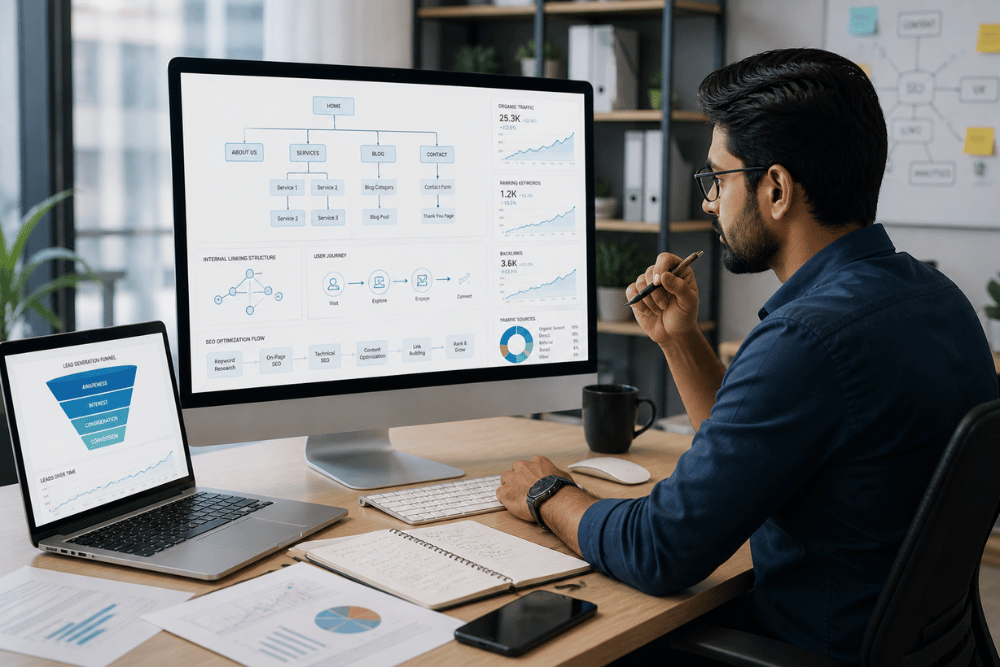
How Website Structure Affects SEO and Lead Generation for Businesses
05 May, 2026
A well-designed business website is often judged by its appearance, but its long-term success depends far more on how it is structured. Website structure forms the foundation that determines how search engines understand your content and how visitors interact with your business. Even the most visually appealing website can struggle to rank on Google or generate enquiries if its pages are poorly organised, difficult to navigate, or disconnected from one another. In contrast, a well-structured website creates a logical flow of information that helps users find what they need quickly while making it easier for search engines to crawl, index, and evaluate every important page.
Website structure influences nearly every aspect of online performance. It affects how authority flows between pages, how effectively keywords are targeted, how easily visitors move through the customer journey, and how confidently they make purchasing decisions. Clear navigation, organised service pages, meaningful internal linking, and a logical content hierarchy work together to improve user experience while strengthening SEO. These elements may seem technical, but they have a direct impact on business outcomes because a website that is easier to understand is also easier to trust, easier to rank, and more effective at converting visitors into genuine enquiries.
As Google's search algorithms continue to prioritise helpful content and positive user experiences, website structure has become one of the most important foundations of sustainable SEO and lead generation. Businesses that invest in a clear, scalable website architecture are better positioned to improve search visibility, support topical authority, and guide visitors naturally from discovering the business to becoming customers. Understanding how website structure affects SEO and lead generation is therefore not just a technical exercise—it is an essential part of building a website that supports long-term business growth.
How Website Structure Directly Impacts SEO Performance
Website structure is one of the strongest technical foundations of SEO because it determines how efficiently search engines discover, understand, and prioritise your content. Before a page has any opportunity to rank, Google first needs to crawl it, identify its purpose, and understand how it fits within the rest of your website. A logical hierarchy, organised navigation, meaningful URLs, and well-planned internal links make this process significantly easier. When every important page is positioned within a clear structure, search engines can interpret your website more accurately, understand the relationship between different pages, and match your content with relevant search queries.
A well-organised website also strengthens topical authority by connecting related pages into meaningful content clusters instead of leaving them isolated. This improves crawl efficiency, distributes internal authority more effectively, and helps search engines recognise the depth of your expertise. At the same time, visitors benefit from a smoother browsing experience because information is easier to find and the path from one page to another feels natural. When businesses regularly review their website architecture through a structured How to Audit Your Business Website for Better SEO and Lead Generation, they often identify hidden issues such as weak internal linking, confusing navigation, orphan pages, and content gaps that can limit both search visibility and enquiry generation.
Poor website structure has the opposite effect. Important pages may remain buried deep within the website, valuable content can become disconnected from related pages, and search engines may struggle to determine which pages deserve the highest priority. Even high-quality content can underperform if the website architecture creates unnecessary friction for users and crawlers alike. Businesses that invest in a scalable, well-planned website structure build a stronger foundation for long-term SEO because every page supports the overall website instead of competing against it. Over time, this improves crawlability, strengthens topical relevance, enhances user engagement, and creates better opportunities for sustainable organic traffic and consistent lead generation.
How Search Engines Understand Website Structure
Search engines rely on website structure to understand what your business does, how different pages relate to one another, and which content is most valuable for users. Every page on your website contributes to this understanding, but without a clear structure, those signals become fragmented and less effective. A logical page hierarchy, intuitive navigation, descriptive URLs, and meaningful internal links help search engines crawl your website efficiently while recognising the relationship between your service pages, supporting articles, and other important content. The better these relationships are organised, the easier it becomes for search engines to determine your expertise, topical relevance, and the overall quality of your website.
A useful way to think about website structure is as the blueprint of a building. A strong blueprint allows every room to connect naturally, making it easy for people to move through the building with confidence. Website structure works in exactly the same way for search engines. It guides crawlers from one page to another, helping them understand which pages are most important and how they support each other. Google analyses factors such as page hierarchy, navigation menus, internal linking, URL organisation, and content relationships to build a complete understanding of your website. Businesses that explore How Google Ranks Local Business Websites in Delhi often discover that strong rankings are built on much more than keywords alone. A well-organised website provides search engines with clear context, making it easier to identify the relevance, authority, and purpose of every important page.
A well-planned website structure also creates long-term SEO advantages because it allows your content to grow without becoming disorganised. As new services, locations, or blog articles are added, they fit naturally into an organised architecture instead of creating isolated pages that compete with one another. This improves crawl efficiency, strengthens topical authority, distributes internal page value more effectively, and creates a smoother experience for visitors exploring your website. Rather than treating website structure as a technical task, successful businesses view it as the framework that supports better search visibility, stronger user engagement, and sustainable organic growth over time.
How Good Website Structure Improves User Experience
Website structure influences far more than SEO—it shapes the entire experience visitors have when interacting with your business online. Every customer arrives on your website with a specific goal, whether it is understanding your services, comparing options, or contacting your business. A clear and logical structure helps them achieve that goal without confusion. Organised navigation, intuitive page layouts, and well-connected content make information easy to discover, allowing visitors to move naturally from one page to the next. Businesses that invest in professional Website Designing in Delhi often prioritise this user-first approach because a well-planned structure improves usability while supporting long-term search performance.
A positive user experience begins the moment someone lands on your website. Visitors should immediately understand what your business offers, where they can find relevant information, and how to take the next step. A structured homepage should guide users towards service pages, supporting resources, customer testimonials, FAQs, and contact options without unnecessary clicks or distractions. When this journey feels smooth and intuitive, visitors spend more time exploring the website, build confidence in the business, and are more likely to become genuine enquiries. These behavioural signals also support SEO because search engines increasingly reward websites that provide helpful and satisfying user experiences.
Good website structure ultimately removes friction from the customer journey. Instead of forcing visitors to search for answers, it presents information in a logical sequence that supports decision-making at every stage. Clear navigation, organised content, mobile-friendly layouts, and meaningful internal links work together to improve engagement, strengthen trust, and encourage action. Over time, this creates measurable business benefits by improving customer satisfaction, increasing conversion opportunities, and building a stronger foundation for sustainable SEO and lead generation.
The Connection Between Website Structure and Lead Generation
Generating more website traffic is important, but traffic alone does not grow a business. The real objective is turning visitors into enquiries, and that is where website structure plays a crucial role. Every visitor arrives with a purpose, whether it is learning about your services, comparing businesses, or deciding whether to contact you. If important information is difficult to find or the journey feels confusing, visitors often leave before taking any action. A well-structured website removes these obstacles by guiding users naturally from one stage of the decision-making process to the next, making it easier to build trust and encourage enquiries.
A strong website structure supports every step of the customer journey. From the homepage to service pages, testimonials, FAQs, and contact forms, each page should help visitors move forward with confidence. Instead of forcing users to search for information, the website should present answers in a logical sequence that reduces uncertainty and simplifies decision-making. The table below shows how website structure influences lead generation throughout the customer journey.
Website Structure Element
How It Supports Lead Generation
Clear Navigation
Helps visitors find important pages quickly without confusion.
Well-Organised Service Pages
Explains services clearly and answers common customer questions.
Trust Signals
Testimonials, case studies, certifications, and reviews build confidence.
Internal Linking
Guides visitors to related information and keeps them engaged.
Strong Calls-to-Action
Encourages visitors to enquire, call, or request a quotation.
Easy Contact Options
Makes it simple to contact the business through forms, phone, or WhatsApp.
Businesses that organise their websites around customer behaviour usually achieve better results because they reduce friction throughout the buying journey. Instead of expecting visitors to figure everything out on their own, the website provides the right information at the right time, making every step feel natural and intuitive. Many of the issues that prevent websites from generating consistent enquiries are not caused by a lack of traffic but by structural problems that affect usability and conversions. Businesses that want to identify and resolve these issues often begin by understanding Why Your Business Website Is Not Getting Leads in Delhi, where the most common barriers to website conversions are explained in greater detail. Over time, a well-planned website structure creates a smoother user experience, higher-quality enquiries, and a stronger foundation for sustainable business growth.
How Internal Linking Strengthens Website Authority
Internal linking is much more than connecting one page to another—it is the system that gives your entire website structure, context, and authority. Every internal link helps search engines understand how your content is organised, which pages are most important, and how different topics support one another. Instead of evaluating every page in isolation, Google analyses these connections to build a clearer understanding of your expertise. When related pages are linked naturally, they create topical relationships that strengthen the authority of the entire website rather than individual pages alone.
A successful internal linking strategy follows a logical hierarchy instead of placing links randomly throughout the content. For example, a business may publish an authority article about website structure, which naturally links to a supporting article explaining Website Development Process. That supporting article can then connect to a service page such as Website Designing Company in Dwarka, while also linking to related resources like Website Speed Optimization or What Pages Every Business Website Must Have. Each page supports the next, creating a connected content ecosystem where authority flows naturally across the website. This organised architecture helps search engines understand topic relationships while guiding visitors towards the pages that are most valuable for their needs.
The benefits extend far beyond SEO. Internal links encourage visitors to continue exploring your website instead of returning to search results after reading a single page. As users move between closely related topics, they gain a deeper understanding of your expertise, spend more time engaging with your content, and build greater confidence in your business. Over time, this improves user engagement, strengthens topical authority, distributes internal page value more effectively, and supports the pages that matter most for generating enquiries. A well-planned internal linking strategy transforms individual articles into a connected knowledge base that benefits both search engines and potential customers.
Common Website Structure Mistakes That Hurt SEO
Many businesses invest time in writing content and improving website design but overlook the structure that connects everything together. A website may contain valuable information, yet still struggle to rank because search engines cannot easily understand how the pages relate to one another. At the same time, visitors may find it difficult to navigate the website, reducing engagement and increasing the chances of leaving without making an enquiry.
Website structure problems rarely come from a single issue. Instead, several small mistakes work together to weaken SEO performance, reduce user experience, and limit lead generation. The table below highlights some of the most common structural problems businesses face and explains why they matter.
Website Structure Mistake
Why It Hurts SEO and Business Growth
Confusing Navigation
Visitors struggle to find important information, while search engines find it harder to understand your website hierarchy. This often reduces engagement and weakens crawl efficiency.
Weak Internal Linking
When related pages are not connected, search engines cannot easily understand the relationship between your topics. This reduces topical authority and prevents important pages from receiving enough internal ranking signals.
Deep Page Structure
Pages that require several clicks to reach are crawled less efficiently and often receive less visibility. Important services should always be easy for both users and search engines to access.
Orphan Pages
Pages without internal links are difficult for Google to discover and almost impossible for visitors to find naturally. As a result, valuable content often remains invisible.
Poor URL Structure
Long, confusing, or inconsistent URLs make it harder for search engines and users to understand what a page is about, reducing clarity across the website.
Unorganised Content Hierarchy
Publishing pages without clear categories or logical grouping weakens topical relevance and makes the website appear less organised from both an SEO and user perspective.
Broken Internal Links
Broken links interrupt the user journey, waste crawl budget, and create a poor browsing experience that can negatively affect trust.
Missing Calls-to-Action
Even when visitors find the right information, they may leave without contacting the business if the next step is not clearly presented. This reduces conversion opportunities despite receiving traffic.
Website structure should make every page easier to discover, easier to understand, and easier to navigate. When navigation is logical, related pages support one another, and important content is connected through meaningful internal links, search engines gain a clearer understanding of your website while visitors enjoy a smoother experience. Businesses that regularly review their website architecture often identify hidden structural issues before they begin affecting rankings or conversions, which is why many also perform a website audit to evaluate crawlability, internal linking, page hierarchy, and overall SEO performance.
Why Local Business Websites Need Better Structure
Website structure becomes even more important for local businesses because local customers search and make decisions differently from a broader online audience. When someone searches for a nearby clinic, coaching institute, restaurant, salon, or service provider, they are usually looking for quick, reliable information rather than spending time exploring multiple websites. They want to know what services you offer, where you are located, whether you serve their area, and how they can contact you. If this information is difficult to find, most users simply return to Google and choose another business.
Search engines also rely on website structure to understand local relevance. A well-organised website with dedicated service pages, location-specific content, clear navigation, and meaningful internal links helps Google identify what your business offers and where those services are available. This creates stronger local relevance, improves crawl efficiency, and increases the likelihood of appearing for location-based searches. Businesses that build their websites around both service topics and target locations often create a stronger foundation for long-term local SEO.
Website structure also influences how quickly customers develop confidence in your business. Visitors should be able to move naturally from the homepage to service pages, read testimonials, view business information, and find contact details without unnecessary clicks or confusion. When important information is organised logically, customers spend less time searching and more time evaluating whether your business is the right choice. This smoother experience reduces hesitation and makes enquiries more likely.
For local businesses, website structure is not simply an SEO consideration—it is a business advantage. A clear website architecture improves search visibility, strengthens customer trust, simplifies the decision-making process, and creates a better overall experience for both visitors and search engines. In competitive local markets, these improvements often become the difference between a website that simply exists and one that consistently supports long-term business growth.
How to Build a Website Structure That Supports Long-Term Growth
A strong website structure does not happen by accident. It starts with careful planning around how customers search, explore information, and make buying decisions. Instead of creating pages whenever a new service is added, businesses should build their website with a clear hierarchy where every page has a specific purpose and supports the overall customer journey. This approach makes the website easier for visitors to navigate while helping search engines understand the relationship between different pages.
A well-structured business website usually follows these principles:
1. Build Around Core Business Pages
Every business website should begin with its most important pages, including the homepage, service pages, about page, contact page, and key trust pages. These pages form the foundation of the website and should be easy to access from the main navigation. A clear structure helps visitors understand your business quickly while giving search engines a strong understanding of your website hierarchy.
2. Create Dedicated Pages for Important Services
Instead of combining multiple services on one page, give each major service its own dedicated page. This allows you to explain the service in greater detail, target relevant search terms more effectively, and create a better experience for customers looking for specific information. Dedicated pages also make internal linking more meaningful as your website grows.
3. Support Important Pages with Helpful Content
Your service pages should not exist on their own. Supporting articles that answer common customer questions help strengthen topical relevance and demonstrate expertise. When these articles naturally connect back to relevant service pages, they improve both the customer journey and the overall authority of your website.
4. Connect Related Pages Through Internal Linking
Every important page should be connected to other relevant pages wherever it adds value for the reader. For example, a service page can link to supporting articles, while educational blogs can direct visitors towards the most relevant services. This creates a logical content network that helps users discover more information while allowing search engines to understand the relationship between different topics across the website.
5. Keep Navigation Simple and Customer-Focused
Visitors should never struggle to find important information. Clear menus, logical page categories, visible contact options, and consistent navigation make the website easier to use. When users can move naturally from one page to another, they stay engaged longer and are more likely to contact your business.
6. Review and Improve Your Structure Regularly
Website structure should evolve as your business grows. New services, additional locations, and fresh content should fit naturally into the existing hierarchy instead of being added randomly. Regularly reviewing navigation, internal links, and page organisation helps maintain a clean website architecture that supports SEO, user experience, and long-term business growth.
A well-planned website structure is a long-term investment rather than a one-time task. When every page has a clear purpose, every section supports the customer journey, and related content is connected logically, the website becomes easier to crawl, easier to navigate, and more effective at generating enquiries. Over time, this organised approach creates a stronger foundation for sustainable SEO performance, higher user engagement, and consistent business growth.
Closing Thoughts
Website structure is much more than a technical aspect of website development—it is the foundation that supports SEO, user experience, and lead generation. A well-organised website helps search engines understand your content, makes it easier for visitors to find the information they need, and creates a smoother journey from discovery to enquiry. As your website grows, a clear structure ensures that every new page strengthens your overall online presence rather than creating confusion.
Businesses that invest in a strong website structure often see benefits that extend far beyond higher search rankings. Better navigation, logical content organisation, meaningful internal linking, and clear page hierarchy improve customer trust, increase engagement, and create more opportunities to convert visitors into enquiries. These improvements work together to build a website that not only attracts traffic but also supports long-term business growth.
Whether you are launching a new website or improving an existing one, building the right structure from the beginning is one of the smartest long-term investments you can make. A scalable website architecture creates a stronger foundation for future content, better SEO performance, and a more effective online presence that continues to deliver value as your business grows.
Website structure is the way pages are organized and connected across a website. A well-structured website helps search engines crawl and understand content more efficiently while making it easier for visitors to navigate and find important information.
Yes. Website structure influences Google rankings by improving crawlability, internal linking, page hierarchy, and user experience. A clear website structure helps search engines understand which pages are most important and how they relate to each other.
A strong website structure guides visitors through a clear customer journey, making it easier to understand services, build trust, and find contact options. This reduces confusion and increases the chances of converting visitors into enquiries.
Every business website should include a homepage, service pages, an about page, a contact page, testimonials, FAQs, and supporting blog content. Together, these pages improve SEO, customer trust, and lead generation.
Internal linking helps search engines discover and understand related pages while distributing authority throughout the website. It also improves user experience by guiding visitors to relevant content and encouraging them to explore more pages.
Businesses can improve website structure by organizing pages into a clear hierarchy, simplifying navigation, strengthening internal linking, creating dedicated service pages, and regularly updating content to support both SEO and user experience.
Grow Your Local Business
Get a Professional Website From a Web Designing Company in Delhi