01 Jun, 2026
Why do some businesses consistently appear on the first page of Google while others struggle to generate organic traffic despite investing heavily in SEO? This is one of the most common questions business owners ask when they see competitors attracting leads, enquiries, and customers from search results while their own website receives limited visibility. In many cases, both businesses offer similar services, target the same audience, and operate within the same market, yet the results are completely different. The reason is rarely a single ranking factor. Instead, it comes down to how search engines evaluate the overall quality, relevance, credibility, and usefulness of a business online.
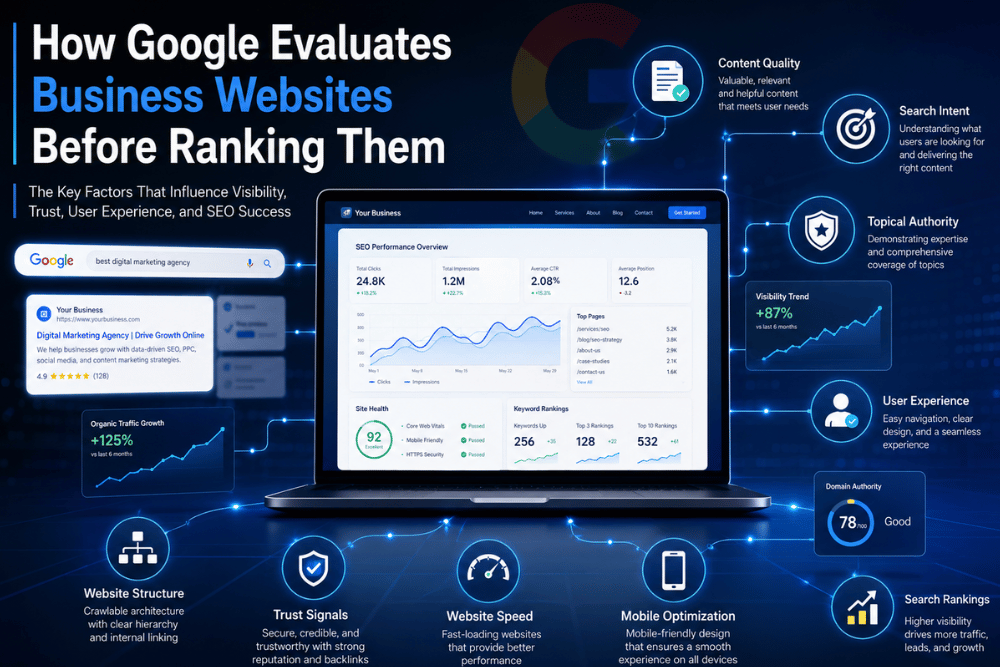
Many companies still believe that rankings are determined mainly by keywords, backlinks, or technical optimization. While these elements remain important, they represent only a small part of a much larger evaluation process. Modern search algorithms analyze hundreds of signals to determine whether a business deserves visibility for a particular search query. Content quality, search intent, topical authority, website structure, user experience, trust signals, and overall expertise all contribute to how a business is assessed and positioned within search results. Businesses that perform well across these areas are often rewarded with stronger rankings and more sustainable organic growth.
Over the years, Google's ranking systems have become significantly more sophisticated. Rather than evaluating individual pages in isolation, search engines now examine the bigger picture. They look at how effectively a business answers customer questions, demonstrates industry expertise, organizes information, builds trust, and helps users achieve their goals. This holistic approach allows Google to identify businesses that consistently provide value and separate them from competitors relying solely on traditional SEO tactics. As a result, companies that focus on delivering a better overall experience frequently outperform businesses that concentrate only on rankings.
Understanding how Google evaluates business websites is essential for any company that wants long-term success through organic search. Instead of chasing algorithm updates or relying on short-term SEO tricks, businesses can achieve better results by understanding what search engines are actually measuring and why certain competitors consistently perform better than others. In this guide, we'll break down the key factors Google considers before ranking a business website and explain how each factor contributes to long-term visibility, authority, and growth.
Why Do Similar Businesses Get Different Rankings on Google?
One of the most common questions business owners ask is why a competitor ranks higher despite offering similar services. In many cases, both businesses operate in the same market, target similar keywords, and serve the same audience, yet one consistently attracts more organic traffic and leads. The explanation is usually not a single ranking factor but the combined effect of multiple quality signals that influence how search engines evaluate a business.
Google no longer compares businesses based only on keywords or backlinks. Instead, it looks at the overall quality of the online presence and attempts to determine which company is most likely to provide a valuable experience for users. Factors such as content depth, topical authority, user experience, trustworthiness, website structure, and relevance all contribute to this evaluation. Even small differences across these areas can create a significant gap in rankings over time.
For example, two businesses may offer the same service in the same location, but one may invest more effort in educating potential customers through helpful content, answering common questions, improving website usability, and building authority around related topics. As a result, search engines gain a clearer understanding of that business and its expertise. This often leads to stronger visibility, better engagement, and greater trust from both users and search engines.
Strong search visibility is rarely the result of a single SEO improvement. Companies that perform well in competitive search results usually strengthen multiple areas of their online presence at the same time, including content quality, website structure, user experience, topical authority, and trust signals. Each of these elements contributes to how search engines evaluate a business, and their combined impact is often far greater than any individual ranking factor. When these fundamentals work together, they create a stronger foundation for sustainable organic growth and make it easier for search engines to view the business as a reliable and authoritative resource within its industry.
Google's Goal Is to Find the Most Valuable Result
When someone searches on Google, the search engine is not simply looking for pages that contain matching keywords. Its primary objective is to identify the result most likely to solve the user's problem, answer their question, or help them achieve a specific goal. This is why ranking well today requires far more than basic optimization. Businesses must demonstrate that their content provides genuine value and addresses the needs behind a search query.
To determine which pages deserve visibility, Google evaluates a combination of relevance, expertise, trust, usability, and content depth. A page may contain the right keywords, but if it fails to answer important questions or provide meaningful information, it is unlikely to perform as well as a more comprehensive resource. Search engines have become increasingly effective at understanding context, which means they can often identify the difference between content created primarily for rankings and content created to help users.
This shift has changed the way successful businesses approach SEO. Instead of focusing only on ranking factors, they focus on becoming the best source of information within their industry. They publish content that addresses customer concerns, explains complex topics clearly, and helps users make informed decisions. Over time, these efforts strengthen credibility, improve engagement, and create the type of value that search engines are more likely to reward.
A useful way to think about SEO is that Google is constantly comparing competing pages and asking a simple question: Which result is most likely to help the user? Businesses that consistently provide the best answer, the clearest information, and the strongest overall experience often gain a significant advantage in search results. This is why long-term SEO success is usually achieved by improving quality and usefulness rather than focusing on individual ranking tactics alone.
Search Intent Determines What Type of Page Can Rank
Before Google compares pages, it first tries to understand what the user actually wants to achieve. This process is known as search intent, and it plays a major role in determining which type of content appears in search results. A page can be technically optimized, have strong backlinks, and include the right keywords, yet still struggle to rank if it does not align with what users expect to find.
Consider how people search online. Someone looking for website maintenance tips is usually searching for information, advice, or solutions to a specific problem. In contrast, a person searching for a website design company is often evaluating service providers and may be close to making a business decision. Although both searches are related to websites, the expectations behind them are completely different. Because of this, Google will rarely rank the same type of content for both queries.
Many businesses overlook this principle and create pages based solely on keyword volume rather than user intent. They attempt to rank service pages for informational searches or publish general blog posts for highly commercial queries. When the content format does not match user expectations, search engines often favor competing pages that provide a more relevant experience.
Search intent also influences how a page should be structured. Informational content needs to educate, explain concepts, and answer common questions. Commercial content, on the other hand, should focus on building trust, demonstrating expertise, showcasing solutions, and helping potential customers make informed decisions. Businesses that understand these differences are usually better positioned to create content that satisfies both users and search engines.
In competitive industries, understanding intent can often be the difference between a page that consistently attracts organic traffic and one that struggles to gain visibility. The more closely a page aligns with the reason behind a search, the easier it becomes for Google to recognize its relevance and reward it with stronger rankings.
Content Quality Remains the Foundation of SEO
Even when a page perfectly matches search intent, it still needs to provide meaningful value. This is where content quality becomes one of the most important factors in Google's evaluation process. Search engines are constantly trying to identify pages that offer the most useful, accurate, and complete information for a topic. As a result, content that lacks depth or originality often struggles to compete against more comprehensive resources.
High-quality content is not defined by word count alone. A longer article does not automatically deserve higher rankings. What matters is whether the content genuinely helps the reader understand a topic, solve a problem, or make a better decision. Strong content addresses important questions, explains concepts clearly, and provides practical insights that users can apply. It also demonstrates expertise by covering a subject in sufficient detail rather than relying on generic advice.
This is one reason businesses should invest time in understanding the complete Website Development Process before creating content strategies. Well-planned websites typically have a clearer content structure, stronger topic coverage, and a better understanding of what information potential customers are actually looking for. These factors contribute to both a better user experience and stronger SEO performance.
Another characteristic of high-performing content is originality. Google increasingly favors content that offers unique insights, real-world experience, and information that goes beyond what is already available in search results. Simply repeating information from competing articles rarely creates a competitive advantage. Businesses that share expertise, practical examples, and industry knowledge often build greater authority over time.
Instead of focusing on keyword density or arbitrary SEO formulas, businesses should ask a more important question: Does this content provide more value than the pages currently ranking on the first page? The answer to that question often determines whether a page becomes a long-term asset capable of attracting traffic, links, and leads for years to come.
Why Topical Authority Has Become So Important
One of the biggest changes in modern SEO is that Google no longer evaluates content on a page-by-page basis alone. Instead, it tries to understand whether a business has genuine expertise in a particular subject area. This is where topical authority becomes important. Rather than looking at a single article or service page, Google evaluates how comprehensively a business covers a topic and whether it consistently provides useful information across related subjects.
For example, imagine two companies offering website design services. The first company has only a homepage and a few service pages. The second company has detailed resources covering website development, website maintenance, website speed, user experience, lead generation, conversion optimization, website redesign, and SEO best practices. Even if both companies target similar keywords, the second business is likely to be viewed as a stronger authority because it demonstrates broader expertise and provides more value to users.
Topical authority is built when related pieces of content support each other and collectively answer the questions users commonly ask within a specific industry. Search engines see these content relationships as signals of expertise. When a business consistently publishes useful content around its core services, it becomes easier for Google to understand what the company specializes in and which topics it should be trusted to rank for.
A strong topical authority strategy often includes content that addresses different stages of the customer journey. Some pages educate users who are just beginning their research, while others help potential customers compare options or make decisions. This creates a content ecosystem that benefits both users and search engines. Instead of relying on a handful of service pages, businesses build authority by covering important topics from multiple angles.
Some of the content areas that help strengthen authority in the website design and development industry include:
- Website design and user experience best practices
- Website development and project planning
- Website maintenance and long-term performance
- Website speed optimization and technical improvements
- Lead generation and conversion-focused design
- Business website strategy and growth planning
- SEO fundamentals and organic visibility
- Website redesign and performance improvements
Building topical authority is a long-term process, but the benefits extend far beyond individual rankings. When a business consistently covers related topics in depth, search engines develop a clearer understanding of its expertise and the value it provides to users. Over time, this stronger topical relevance can improve the visibility of both existing and newly published content, helping the business compete more effectively for important industry-related searches.
This is one reason why businesses should focus on building content clusters rather than publishing random blog posts. A strategic approach helps every article support a larger goal while strengthening the overall authority of the website. For example, content about Business Website Design in Delhi naturally connects with discussions about user experience, website performance, lead generation, and business growth. These connections help search engines understand the depth of expertise behind the content while providing readers with a more complete understanding of the subject.
Topical authority is not built overnight. It requires consistency, thoughtful content planning, and a commitment to helping users solve real problems. However, businesses that invest in becoming a trusted source of information within their industry often achieve stronger rankings, greater visibility, and more sustainable SEO growth than those that focus only on individual keywords or isolated pages.
Website Structure Helps Google Understand Relationships Between Pages
Creating high-quality content is important, but content alone is not enough to achieve strong search visibility. Google also needs to understand how different pages connect with one another and how information is organized across the site. This is where website structure plays a crucial role. A well-structured website helps search engines discover pages more efficiently, understand topic relationships, and identify which pages are most important. Without a clear structure, even valuable content can become difficult for search engines to interpret, reducing its ability to contribute to overall rankings. This is one reason why websites with similar content quality often achieve very different SEO results. The business with a stronger structure usually makes it easier for both users and search engines to navigate and understand its content.
Many businesses unknowingly create content silos that work against their SEO efforts. They publish blog posts, service pages, and guides without considering how those pages fit into a larger content strategy. As a result, valuable information becomes isolated, making it harder for authority and relevance signals to flow throughout the site. Google prefers websites that demonstrate clear topical organization because it helps the search engine understand the depth of expertise behind the content. For example, content about website speed, user experience, website maintenance, and website development should naturally support each other because these topics are closely connected. When related pages are linked strategically, Google gains a clearer understanding of the subject matter and can better evaluate the website's authority within that niche.
A strong website structure also improves the experience for visitors by helping them find relevant information without unnecessary effort. Users who can easily navigate between related topics tend to spend more time exploring a site, which often leads to higher engagement and stronger trust signals. This is why businesses looking to improve both SEO performance and lead generation should pay close attention to How Website Structure Affects SEO and Lead Generation for Businesses. A logical hierarchy, well-planned internal linking strategy, and clearly connected content clusters not only help search engines understand the site more effectively but also create a smoother journey for potential customers. Over time, this combination of better usability and stronger topical relevance can significantly improve organic visibility and overall website performance.
User Experience Has Become a Powerful Ranking Factor
User experience has become an important part of modern SEO because Google wants to rank pages that people find useful and easy to navigate. A visitor forms an opinion about a business within a few seconds of landing on a page, and that first impression can influence whether they stay or leave. If the layout is confusing, the content is difficult to read, or important information is hard to find, users are more likely to return to search results and look elsewhere. This is why businesses can no longer focus only on keywords and backlinks while ignoring the overall experience they provide.
A positive experience is created through a combination of factors rather than a single improvement. Mobile responsiveness ensures that pages work properly across different devices, while clear navigation helps visitors move between important sections without frustration. Readable content, logical page structure, secure browsing, and fast-loading pages all contribute to how users interact with a site. When these elements work together, visitors are more likely to engage with the content, explore additional pages, and spend more time learning about the business.
Search engines pay close attention to signals that help determine whether visitors are finding a page useful and easy to interact with. Although high-quality content remains a critical ranking factor, even the most informative content can struggle if the overall experience creates friction for users. Visitors expect pages to load quickly, present information clearly, and make navigation simple and intuitive. When businesses combine valuable content with a seamless user experience, they often see higher engagement, longer visit durations, improved lead generation, and stronger organic visibility over time.
The relationship between user experience and SEO continues to grow stronger as search engines become more advanced. Companies that invest in usability improvements often benefit from higher engagement, stronger trust, and better conversion rates in addition to improved visibility. This is one reason why Website Speed Optimization plays such an important role in modern SEO, as performance directly affects how users interact with a page. In competitive industries, providing a better experience can often be the factor that separates top-ranking businesses from their competitors.
Website Speed Is More Important Than Most Businesses Realize
Website speed is often treated as a technical concern, but its impact extends far beyond development and performance metrics. In today's digital environment, users expect pages to load almost instantly. When a site takes too long to appear, visitors frequently leave before interacting with the content, exploring services, or completing an enquiry. This creates a poor first impression and can significantly reduce the opportunities a business has to engage potential customers.
Fast-loading pages contribute to a smoother and more enjoyable browsing experience. Visitors can access information quickly, navigate between pages without frustration, and complete actions more efficiently. Whether someone is reading a blog article, reviewing service information, or submitting a contact form, speed plays a direct role in how they perceive the quality and professionalism of a business. Even small delays can influence user behavior and reduce overall engagement.
Google also recognizes the importance of performance because it directly affects user satisfaction. A faster site helps visitors achieve their goals more efficiently, which aligns with Google's objective of delivering the best possible experience in search results. While speed alone will not guarantee higher rankings, it can strengthen the effectiveness of other SEO efforts by supporting better engagement, lower abandonment rates, and a more positive browsing experience.
For businesses, improving performance should be viewed as an investment rather than a technical task. Faster pages often lead to better user engagement, stronger trust, improved lead generation, and higher conversion opportunities. In competitive industries where multiple businesses offer similar services, providing a faster and smoother experience can become an important advantage that helps attract and retain potential customers.
Trust Signals Help Google Determine Credibility
Trust is one of the most important factors Google considers when evaluating a business. Search engines want to recommend companies that appear reliable, professional, and capable of serving users effectively. This is especially important in competitive industries where multiple businesses offer similar services. If Google cannot identify clear signs of credibility, it becomes much harder for a company to achieve strong visibility regardless of how much effort has been invested in SEO.
Credibility is built through a combination of trust signals that help both users and search engines determine whether a business is legitimate. These signals often include secure HTTPS connections, accurate contact information, customer reviews, transparent business details, professional branding, and consistency across online platforms. When potential customers visit a site, they naturally look for evidence that the business is genuine and capable of delivering quality services. Search engines perform a similar evaluation by analyzing various indicators of trust and reliability.
For example, when someone searches for a Website Designing Company in Dwarka, they are unlikely to choose a provider based on design alone. They often compare reviews, check business information, evaluate service details, and look for signs of expertise before making a decision. These same trust indicators help search engines understand whether a business deserves visibility for important commercial searches. The stronger these signals become, the easier it is for both users and Google to develop confidence in the business.
Trust is also reinforced through content quality and consistency. Businesses that regularly publish useful information, demonstrate expertise, and maintain a professional online presence tend to build stronger authority over time. As Google's algorithms continue to evolve, credibility remains one of the strongest foundations of sustainable SEO success because search engines ultimately want to recommend businesses that users can trust.
Why Some Websites Rank Without Strong Backlink Profiles
For many years, backlinks were considered one of the most important ranking factors in SEO. While they still play a significant role, Google has become much better at evaluating the overall quality of a business rather than relying heavily on link signals alone. This is why some local businesses and niche websites are able to achieve impressive rankings even when they have fewer backlinks than their competitors. In many cases, these businesses focus on creating a better overall experience and providing more value to users, which helps them earn visibility despite having a smaller backlink profile.
Google now evaluates websites through a combination of factors that work together to demonstrate relevance, expertise, and usefulness. A business may have fewer backlinks but still perform well if it excels in areas such as:
- Creating comprehensive content that answers important customer questions
- Building strong topical authority around its primary services
- Matching content closely with user search intent
- Maintaining a clear and logical website structure
- Providing a fast and user-friendly browsing experience
- Demonstrating expertise through valuable and original information
- Building trust through reviews, contact information, and business transparency
When these elements are consistently implemented, search engines gain a stronger understanding of what the business offers and why its content deserves visibility. This often allows smaller businesses to compete effectively against larger competitors that may have stronger backlink profiles but weaker content or user experience.
That said, backlinks still remain an important part of SEO because they help search engines evaluate authority and trust across the web. The key difference is that backlinks work best when they support an already strong foundation. A business that combines quality content, topical relevance, positive user experience, and trustworthy information is far more likely to benefit from backlinks than a business that relies on links alone. The most successful SEO strategies focus on strengthening the entire website rather than chasing a single ranking factor, which is why many businesses are able to achieve strong rankings even without an extensive backlink profile.
Common Reasons Business Websites Fail to Rank
Many businesses invest significant time and money into SEO but still struggle to achieve meaningful visibility in search results. In most cases, the problem is not a lack of effort but a collection of small mistakes that weaken the overall quality of the site. Google evaluates multiple factors when determining rankings, which means even a well-designed website can underperform if critical areas are neglected. Understanding these issues is often the first step toward improving organic visibility.
Some of the most common reasons businesses fail to rank include:
- Thin or low-value content that provides limited information and does not fully answer user questions.
- Targeting the wrong keywords without understanding whether they match the needs and expectations of potential customers.
- Ignoring search intent, resulting in pages that fail to deliver the type of content users are actually looking for.
- Weak website structure, making it difficult for search engines to understand relationships between pages and topics.
- Poor user experience, including confusing navigation, cluttered layouts, and slow-loading pages.
- Lack of topical authority, where the site covers only a small portion of its industry instead of demonstrating comprehensive expertise.
- Insufficient trust signals, such as missing contact information, weak branding, limited reviews, or inconsistent business details.
- Outdated content, which can gradually lose relevance as industry trends, customer expectations, and search behavior change over time.
Another major issue is inconsistency. Many businesses launch a website, publish a few pages, and assume the work is complete. In reality, successful SEO requires continuous improvement. Search engines tend to favor businesses that regularly update content, improve user experience, and expand their expertise through valuable resources. This ongoing effort helps demonstrate that the business remains active, relevant, and committed to providing accurate information.
A practical way to support long-term performance is through regular maintenance and optimization. Businesses that routinely review content, fix technical issues, improve page quality, and update outdated information are often better positioned to compete in search results. This is one reason why a Website Maintenance Guide can be valuable for understanding how ongoing improvements contribute to stronger rankings and better overall performance.
SEO success rarely comes from a single change or tactic. More often, it is the result of consistently improving multiple areas over time. Businesses that focus on content quality, user experience, authority, trust, and technical performance together are usually the ones that achieve sustainable growth in organic search.
What High-Ranking Business Websites Have in Common
While every successful business is different, websites that consistently achieve strong rankings often share several important characteristics. They focus on delivering genuine value to users rather than simply trying to improve search visibility. These businesses understand that long-term SEO success comes from building a strong foundation that combines quality content, clear communication, trust, and a positive user experience. Instead of looking for shortcuts, they invest in creating resources that help visitors make informed decisions and solve real problems.
Some common characteristics found in high-ranking business websites include:
- Comprehensive content that answers customer questions in detail
- Clear website structure that helps users and search engines navigate information easily
- Strong topical authority built through consistent coverage of related subjects
- Fast-loading pages that provide a smooth browsing experience
- Mobile-friendly design that works well across all devices
- Trust signals such as reviews, business information, and transparent contact details
- Regular content updates that keep information accurate and relevant
- Strategic internal linking that helps users discover related content
Another key difference is that successful businesses focus on the entire customer journey rather than individual pages. They create content for people who are researching a topic, comparing options, and preparing to make a decision. This approach allows them to build authority and trust at every stage of the buying process. For example, businesses that publish helpful resources such as What Pages Every Business Website Must Have often provide a better experience because they address practical questions that potential customers are already asking.
Rather than constantly reacting to algorithm updates, high-performing businesses concentrate on improving the overall quality of their online presence. They understand that content, usability, trust, and relevance work together to influence rankings. As Google's systems continue to evolve, websites that consistently prioritize user value and business credibility are usually the ones that achieve sustainable growth and maintain strong visibility in search results.
FAQ
How does Google evaluate business websites before ranking them?
Google evaluates business websites by analyzing multiple factors rather than relying on a single ranking signal. These factors include content quality, search intent alignment, topical authority, website structure, user experience, trust signals, page performance, and overall usefulness. The goal is to identify which business can provide the most relevant and valuable experience for users searching for a specific topic or service.
What is the most important factor Google considers when ranking a business website?
There is no single ranking factor that guarantees higher rankings. Google uses a combination of signals to evaluate quality, relevance, and overall usefulness. Content quality, search intent, expertise, trustworthiness, and user experience are among the most influential factors because they help search engines determine whether a page provides genuine value to users. Google's systems evaluate multiple ranking signals together rather than relying on a single factor, which is why businesses need a balanced SEO strategy rather than focusing on one area alone. Companies that perform well across these factors generally have a stronger chance of achieving long-term visibility and sustainable organic growth.
Why do some business websites rank higher than competitors?
Higher-ranking businesses often provide better overall value to users. They publish useful content, demonstrate expertise, maintain a clear website structure, and create positive user experiences. They also build trust through reviews, transparent business information, and consistent branding. Over time, these factors help search engines view them as more reliable and authoritative than competing websites.
Does website design affect SEO rankings?
Yes, website design can indirectly influence rankings because it affects user experience. A well-designed site makes it easier for visitors to navigate information, read content, and complete important actions. Poor design can increase bounce rates, reduce engagement, and create frustration, all of which can negatively impact overall SEO performance.
Why is search intent important for SEO?
Search intent helps Google determine what type of content should rank for a particular query. If a page does not match what users expect to find, it may struggle to rank even if it is technically optimized. Businesses that create content aligned with user intent often achieve better visibility because they provide the information or solutions searchers are looking for.
Can a business website rank without many backlinks?
Yes. Many local and niche businesses achieve strong rankings with relatively few backlinks because they focus on content quality, topical authority, trust signals, and user experience. While backlinks remain valuable, Google now evaluates websites more holistically, making it possible for well-optimized businesses to compete without a large backlink profile.
How long does it take for a business website to rank on Google?
The timeline varies depending on competition, industry, content quality, and overall authority. Some pages may start gaining visibility within a few weeks, while competitive keywords can take several months of consistent SEO effort. Businesses that regularly improve content, user experience, and website quality often see better long-term results.
How can businesses improve their chances of ranking higher?
Businesses should focus on creating high-quality content, understanding user intent, improving website structure, strengthening trust signals, enhancing user experience, and maintaining consistent optimization efforts. SEO is most effective when all of these elements work together as part of a long-term strategy rather than relying on a single tactic.
Closing Thoughts
Ranking a business on Google is no longer about finding a few keywords or building a handful of backlinks. Search engines now evaluate the complete picture, including search intent, content quality, topical authority, website structure, user experience, trust signals, and overall business credibility. Businesses that understand how these factors work together are far more likely to achieve sustainable rankings than those relying on isolated SEO tactics.
The companies that consistently perform well in search results are usually the ones that focus on providing genuine value to users. They create helpful content, organize information logically, maintain a positive user experience, and continuously improve their online presence over time. Rather than chasing algorithm updates, they invest in becoming a trusted resource within their industry.
As Google's ranking systems continue to evolve, one principle remains unchanged: websites that help users make better decisions are more likely to earn visibility. Businesses that prioritize expertise, trust, and user satisfaction will not only improve their search performance but also build stronger relationships with potential customers. In the long run, that combination creates a foundation for sustainable traffic, higher-quality leads, and consistent business growth.