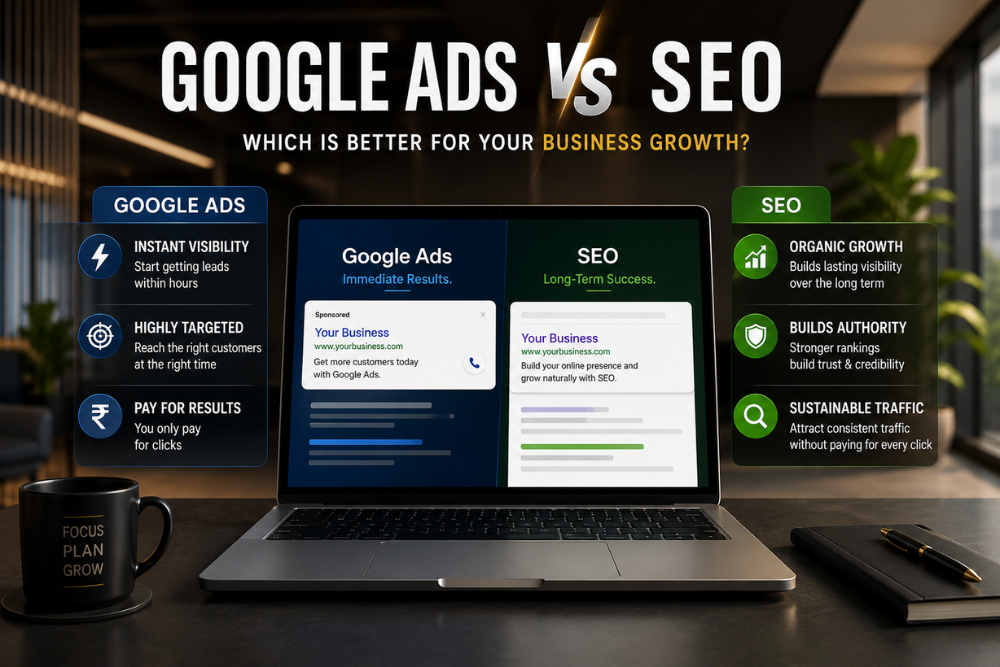
Google Ads vs SEO: Which Marketing Strategy Is Better?
28 Jul, 2026
Businesses today have more opportunities than ever to reach potential customers online, but choosing the right digital marketing strategy can often feel confusing. One of the biggest decisions business owners face is whether to invest in Google Ads or SEO. Both strategies are designed to increase your visibility in Google Search, attract qualified visitors, and generate enquiries, yet they achieve these goals in completely different ways. Understanding those differences is essential because the strategy you choose can directly influence your marketing costs, lead quality, and long-term business growth.
Google Ads helps businesses appear in prominent positions on Google through paid advertising, making it possible to reach potential customers almost immediately. SEO, on the other hand, focuses on improving your website's organic rankings by creating valuable content, enhancing website performance, and building trust with search engines over time. While Google Ads delivers speed and instant visibility, SEO is an investment that continues to generate value long after the initial optimisation work has been completed. Both have unique advantages, but neither is automatically the right choice for every business.
Many business owners assume they must choose one strategy over the other, but digital marketing is rarely that simple. The right decision depends on several factors, including your business goals, competition, industry, available budget, target audience, and how quickly you need results. A company launching a new service may prioritise immediate enquiries through Google Ads, while an established business looking to reduce long-term marketing costs may benefit more from a strong SEO strategy. In many cases, the most successful businesses combine both approaches to create a balanced marketing plan that delivers short-term leads while building sustainable organic growth.
Before investing your time and budget, it is important to understand how Google Ads and SEO differ in terms of cost, speed, return on investment, scalability, and long-term impact. Making an informed decision not only helps you avoid unnecessary marketing expenses but also ensures your business invests in a strategy that supports consistent growth, stronger online visibility, and better customer acquisition. Whether your business serves a local market or customers across multiple locations, understanding when to use Google Ads, when to focus on SEO, and when to combine both can provide a significant competitive advantage in today's digital landscape.
What Is Google Ads?
Google Ads is Google's online advertising platform that enables businesses to display paid advertisements across Google Search, Google Maps, YouTube, and millions of partner websites. Instead of waiting for a website to improve its organic rankings, businesses can bid on relevant keywords and appear when potential customers search for products or services they offer. Because advertisers pay only when someone clicks on their ad, this model is commonly known as Pay-Per-Click (PPC) advertising.
One of the biggest advantages of Google Ads is its ability to generate targeted traffic almost immediately. Businesses can control their advertising budget, target specific locations, choose the right audience, schedule campaigns during business hours, and measure every click, enquiry, and conversion. This makes Google Ads an effective marketing solution for businesses looking to increase brand visibility, generate qualified leads, promote new products, or drive more sales without waiting months for organic rankings to improve.
While Google Ads offers speed and flexibility, achieving profitable results requires more than simply creating an advertisement. Success depends on selecting the right keywords, writing compelling ad copy, improving Quality Score, optimising landing pages, and continuously monitoring campaign performance. Businesses that regularly analyse their campaigns and make data-driven improvements are more likely to reduce advertising costs while increasing conversions and return on investment.
If you're planning to run paid search campaigns, understanding how campaign structure, keyword targeting, bidding strategies, and conversion tracking work together is essential. Our detailed guide on Google Ads Services in Delhi explains how professionally managed PPC campaigns help businesses attract qualified customers, maximise advertising budgets, and achieve measurable business growth.
What Is SEO?
Search Engine Optimization (SEO) is the process of improving your website so it appears higher in Google's organic search results without paying for every visitor. Instead of relying on advertisements, SEO focuses on helping search engines understand your website while providing users with valuable, relevant, and trustworthy content. When your website matches what people are searching for, it has a better chance of earning higher rankings and attracting qualified traffic naturally.
Unlike paid advertising, SEO is not based on a single activity. It combines multiple strategies that work together to improve your website's visibility. These include keyword research, high-quality content creation, technical optimisation, internal linking, mobile responsiveness, website speed, user experience, and building authority through trusted backlinks. Each element plays an important role in helping search engines evaluate your website and determine whether it deserves to rank above competitors.
One of the biggest strengths of SEO is that it continues to deliver value long after the initial optimisation work is completed. A well-optimised page can generate organic traffic, enquiries, and potential customers for months or even years without paying for every click. As your website gains authority and trust, it becomes easier to rank for additional keywords, making SEO one of the most cost-effective long-term digital marketing strategies for businesses that want sustainable online growth.
However, achieving strong organic rankings is about much more than adding keywords to a page. Google evaluates hundreds of ranking signals, including content quality, website experience, technical performance, relevance, and user satisfaction before deciding where a website should appear in search results. If you'd like to understand these factors in more detail, read our guide on How Google Evaluates Business Websites Before Ranking Them, where we explain the key signals that influence search rankings and long-term SEO success.
Google Ads vs SEO: What's the Real Difference?
Although both Google Ads and SEO help businesses increase their visibility on Google Search, they work in completely different ways. Google Ads is a paid advertising platform that places your business at the top of search results almost instantly, whereas SEO focuses on improving your website's organic rankings through content, technical optimisation, and website authority. Both strategies can generate leads and increase website traffic, but they differ in cost, speed, sustainability, and long-term return on investment.
The biggest difference is how traffic is generated. With Google Ads, every click is paid for, allowing businesses to reach potential customers immediately after launching a campaign. SEO, on the other hand, earns traffic naturally by helping your website rank higher for relevant search queries. While SEO requires patience and continuous optimisation, it can continue driving qualified visitors long after the initial work has been completed, making it a valuable long-term investment for businesses focused on sustainable growth.
Feature
Google Ads
SEO
Traffic Type
Paid traffic through advertisements
Organic traffic from Google Search
Results
Usually within hours or days
Typically takes 3–6 months or longer
Cost Model
Pay for every click (PPC)
No cost per click after ranking
Long-Term Value
Stops when the budget ends
Continues generating traffic over time
Best For
Quick leads, promotions, new products
Long-term growth and brand authority
ROI
Fast but budget-dependent
Higher long-term return on investment
Trust Factor
Users recognise ads as sponsored
Organic rankings generally build greater trust
Maintenance
Continuous campaign optimisation
Regular content and SEO improvements
Scalability
Increase budget to reach more users
Increase content and authority to expand rankings
Ideal Choice
Businesses needing immediate enquiries
Businesses investing in sustainable online growth
Choosing between Google Ads and SEO should not be based solely on which strategy delivers faster results. Instead, the decision should reflect your business objectives, competition, available budget, and long-term growth plans. A business launching a new service or running a seasonal promotion may benefit from the instant visibility of Google Ads, while a company aiming to reduce customer acquisition costs over time is likely to gain greater value from SEO. In practice, the strongest digital marketing strategy often combines both approaches. Google Ads can generate immediate enquiries while SEO builds lasting organic visibility, helping businesses attract customers today without sacrificing future growth. When used together, these strategies create a balanced marketing approach that improves brand visibility, increases qualified traffic, and strengthens your online presence across both paid and organic search results.
Google Ads vs SEO: Which Strategy Delivers Better Business Growth?
Choosing between Google Ads and SEO isn't about finding a universal winner because every business has different goals, budgets, and growth plans. Some businesses need enquiries immediately to maintain a steady flow of customers, while others are focused on building a strong online presence that continues generating leads for years. The right decision depends on where your business stands today and what you want to achieve in the long run.
Google Ads is the better option when speed is the priority. It helps your business appear in front of people who are actively searching for your products or services, making it possible to generate enquiries, calls, and sales within a short period. This makes paid advertising an excellent choice for launching new products, promoting seasonal offers, entering competitive markets, or increasing enquiries during slower business periods. Since every campaign can be measured and optimised, businesses have complete control over their advertising budget and performance.
SEO, however, focuses on building a long-term digital asset instead of delivering short-term visibility. By improving website quality, publishing valuable content, strengthening technical performance, and earning Google's trust, SEO helps businesses achieve higher organic rankings that continue driving qualified visitors without paying for every click. Although it requires patience and consistent effort, the long-term benefits often outweigh the initial investment because strong organic rankings continue supporting business growth long after the optimisation work is completed.
Which Strategy Is Right for Your Business?
Business Goal
Recommended Strategy
Generate immediate enquiries
Google Ads
Launch a new product or service
Google Ads
Build long-term organic traffic
SEO
Increase brand authority and trust
SEO
Reduce long-term customer acquisition costs
SEO
Test a new market
Google Ads
Achieve both short-term and long-term growth
Google Ads + SEO
Many successful businesses don't depend on just one marketing strategy. They use Google Ads to attract customers quickly while continuously investing in SEO to strengthen their online presence and reduce their dependence on paid advertising over time. As organic rankings improve, businesses benefit from a steady flow of qualified traffic while paid campaigns continue supporting promotions, new launches, and competitive keywords. This combination creates a balanced marketing strategy that delivers immediate opportunities without compromising long-term growth. A well-optimised website also plays an important role in making both strategies successful, which is why Website Speed Optimization naturally becomes a key part of improving search visibility, user experience, and conversion rates across both organic and paid traffic. By combining the right marketing strategy with a high-performing website, businesses can generate more enquiries, improve return on investment, and create sustainable online growth that continues delivering value well into the future.
Google Ads vs SEO: Which Is More Cost-Effective?
For most business owners, marketing budget plays a major role in deciding between Google Ads and SEO. However, the real question isn't which strategy costs less, but which one delivers better value for your investment. Both require ongoing investment, but they generate results in completely different ways. Understanding this difference helps businesses choose a strategy that matches their goals instead of focusing only on the initial cost.
With Google Ads, your investment goes directly towards gaining immediate visibility in search results. Every time someone clicks on your advertisement, you pay a cost based on factors such as keyword competition, bidding strategy, Quality Score, and industry demand. Businesses have complete control over their daily and monthly budgets, making it easier to manage spending and scale campaigns based on performance. The advantage is speed, but the challenge is that traffic and enquiries usually stop once the advertising budget is paused.
SEO follows a long-term investment model. Instead of paying for every website visitor, businesses invest in improving website quality, publishing valuable content, enhancing technical performance, and building authority in search engines. While SEO generally takes longer to produce measurable results, well-optimised pages can continue generating qualified traffic without paying for every click. As more pages rank for relevant keywords, the cost of acquiring new customers often decreases, making SEO increasingly valuable over time.
Cost Comparison
Factor
Google Ads
SEO
Initial Investment
Flexible advertising budget
Investment in content and website optimisation
Cost Per Visitor
Pay for every click
No cost for each organic visitor
Ongoing Investment
Continuous advertising spend
Regular SEO improvements and content updates
Short-Term Value
Excellent for immediate enquiries
Limited while rankings are improving
Long-Term Value
Budget-dependent
Continues generating traffic over time
Overall ROI
Strong for short-term campaigns
Higher potential for long-term growth
Looking only at the monthly cost often leads businesses to the wrong decision. A campaign that generates qualified leads and profitable customers can provide excellent value even if the advertising budget is higher, while a low-cost strategy that fails to attract the right audience delivers little return. The most successful businesses focus on overall return on investment rather than simply reducing marketing expenses. Many start with Google Ads to generate immediate enquiries and gradually strengthen their SEO so that organic traffic becomes a reliable source of leads in the future. As search visibility grows, businesses often rely less on paid advertising while continuing to attract customers through organic search, creating a more balanced and cost-effective digital marketing strategy over the long term.
When Should You Choose Google Ads?
Google Ads is the right choice when your business needs quick visibility and faster lead generation. Instead of waiting for your website to improve its organic rankings, paid advertisements place your business in front of potential customers at the exact moment they are searching for your products or services. This makes Google Ads particularly effective for businesses launching a new service, promoting limited-time offers, entering a competitive market, or looking to increase enquiries within a short period.
Another major advantage of Google Ads is the level of control it offers. Businesses can decide where their ads appear, target specific locations, choose relevant keywords, define daily budgets, and monitor campaign performance in real time. This flexibility makes it easier to optimise campaigns, improve lead quality, and ensure that every advertising rupee is invested more effectively. When managed properly, Google Ads provides valuable insights into customer behaviour, helping businesses make better marketing decisions based on measurable data.
Google Ads is usually the right choice when you want to:
Generate enquiries or sales quickly.
Launch a new product or service.
Promote seasonal offers or limited-time campaigns.
Target customers in specific cities or service areas.
Reach people searching for high-intent keywords.
Test new products, services, or business opportunities before making larger marketing investments.
A successful Google Ads campaign doesn't end when someone clicks on your advertisement. The real results come from how effectively your website turns visitors into enquiries or customers. Clear landing pages, fast loading speeds, compelling calls to action, and a smooth user experience all play an important role in improving conversions. Businesses that focus on both advertising performance and reducing common website conversion mistakes are often able to generate more qualified leads while achieving a better return on their advertising investmen
When Is SEO the Better Investment?
SEO is the better investment for businesses that want to build sustainable growth instead of relying on paid advertising for every enquiry. Unlike Google Ads, where traffic depends on your advertising budget, SEO focuses on improving your website so it can rank higher in organic search results and attract qualified visitors naturally. As your website gains authority, it becomes easier to reach potential customers who are actively searching for your products or services, creating a steady source of traffic that supports long-term business growth.
While SEO takes time to produce measurable results, its value continues to increase as your website grows. Every well-optimised page becomes another opportunity to rank for relevant keywords, answer customer questions, and generate enquiries. Over time, this reduces your dependence on paid campaigns, strengthens your brand's online credibility, and lowers the overall cost of acquiring new customers.
SEO is usually the better investment when you want to:
Build consistent organic traffic over the long term.
Reduce dependence on paid advertising.
Increase brand trust and online authority.
Rank for multiple products, services, and customer search queries.
Generate enquiries throughout the year without paying for every click.
Create a stronger digital presence that supports future business growth.
Successful SEO is about much more than publishing content or adding keywords to a website. Search engines evaluate how well your website is organised, how easily visitors can navigate between pages, and whether they can quickly find the information they're looking for. A clear website structure not only improves the user experience but also helps search engines understand your content more effectively, making it an important part of any long-term SEO strategy.
Why Using Google Ads and SEO Together Delivers Better Results
Many businesses assume they have to choose between Google Ads and SEO, but the most successful businesses rarely depend on just one marketing channel. Instead, they combine both strategies to create a balanced approach that delivers immediate results while building long-term growth. Google Ads helps generate enquiries as soon as campaigns go live, while SEO works in the background to improve organic rankings, increase website authority, and attract qualified traffic without paying for every click.
Using Google Ads and SEO together also helps businesses make smarter marketing decisions. Paid campaigns provide valuable data about the keywords, search intent, and landing pages that generate the highest conversions. These insights can then be used to strengthen your SEO strategy by creating content around proven search terms and improving pages that already perform well. At the same time, strong organic rankings increase brand visibility and credibility, making potential customers more likely to trust and click on your paid advertisements.
A business that invests in both strategies is less dependent on a single source of traffic and is better prepared to adapt as customer behaviour and search trends change. While Google Ads delivers the speed needed to capture immediate opportunities, SEO builds a stronger online presence that continues supporting business growth over time. Together, they create a marketing strategy that improves visibility, generates consistent enquiries, and delivers better long-term value. Businesses that combine these channels with a professional website usually achieve the strongest results because every marketing effort directs customers to an online platform they fully own and control, rather than relying entirely on third-party platforms
Common Mistakes Businesses Make When Choosing Between Google Ads and SEO
Choosing between Google Ads and SEO isn't simply about selecting one marketing strategy over another. Many businesses struggle to generate consistent results because they invest without a clear plan or overlook the factors that influence long-term success. Avoiding these common mistakes can help you make better marketing decisions, maximise your budget, and achieve stronger business growth.
1. Expecting SEO to Deliver Instant Results
SEO is a long-term investment that requires time to build authority and improve search rankings. Businesses that expect first-page rankings within a few weeks often become discouraged and stop investing too early. Consistent optimisation, valuable content, and regular website improvements are essential for long-term success.
2. Depending Only on Google Ads
Google Ads can generate traffic quickly, but the results usually stop when the advertising budget ends. Relying entirely on paid campaigns without investing in SEO can make customer acquisition more expensive over time. A balanced strategy helps businesses generate immediate enquiries while building sustainable organic traffic.
3. Ignoring Website Quality
Driving visitors to a website is only the first step. If your website loads slowly, looks outdated, or makes it difficult for visitors to contact you, both Google Ads and SEO will deliver weaker results. Fixing common website design mistakes can improve user experience, increase conversions, and help every marketing campaign perform more effectively. (Internal Link)
4. Targeting the Wrong Keywords
Many businesses focus on keywords with high search volume instead of those that match customer intent. Whether you're investing in Google Ads or SEO, targeting the right audience is far more important than simply attracting more traffic. Qualified visitors are much more likely to become enquiries and paying customers.
5. Treating Google Ads and SEO as Competitors
One of the biggest mistakes is believing that you must choose one strategy and ignore the other. Google Ads and SEO work best when they support each other. Paid campaigns generate immediate visibility, while SEO builds long-term authority and consistent organic traffic, creating a stronger and more reliable marketing strategy.
6. Measuring Success Only by Traffic
Higher website traffic doesn't always mean better business results. What matters most is attracting visitors who are genuinely interested in your products or services and converting them into enquiries or customers. Businesses should focus on meaningful metrics such as lead quality, conversion rate, customer acquisition cost, and return on investment rather than traffic alone.
Businesses that avoid these common mistakes are more likely to get the best results from both Google Ads and SEO. By choosing the right strategy, investing in a high-quality website, and focusing on long-term business goals instead of short-term wins, you can build a stronger online presence that continues generating qualified leads and supporting business growth year after year.
Closing Thoughts
Choosing between Google Ads and SEO isn't about deciding which strategy is better—it's about choosing the right approach for your business goals. If you need enquiries quickly, Google Ads can deliver immediate visibility and measurable results. If your focus is building long-term online growth, SEO helps create a stronger digital presence that continues attracting qualified customers over time. Each strategy has its own strengths, and the best choice depends on your business objectives, budget, competition, and growth plans.
Many successful businesses don't rely on just one marketing channel. They use Google Ads to generate immediate opportunities while investing in SEO to build sustainable organic traffic and reduce their dependence on paid advertising in the future. This balanced approach creates consistent visibility, improves brand credibility, and helps businesses attract customers at different stages of the buying journey.
No matter which strategy you choose, your website remains the foundation of your digital marketing success. A fast, professional, and conversion-focused website supports better search rankings, improves advertising performance, and encourages more visitors to become customers. Investing in the right website is often the first step towards achieving better results from both SEO and Google Ads. Businesses planning to strengthen their online presence should also understand the importance of corporate website design, as a well-designed business website supports higher conversions, stronger brand credibility, and long-term digital growth.
Google Ads is ideal for businesses that need immediate traffic and leads, while SEO focuses on building long-term organic visibility. The best choice depends on your budget, goals, competition, and how quickly you need results. Many businesses achieve the best outcome by combining both strategies.
Google Ads is a paid advertising platform where you pay for clicks to appear at the top of Google search results. SEO improves your website's organic rankings through content, technical optimization, and authority, helping you generate free traffic over time.
SEO usually provides a better long-term return on investment because organic traffic continues without paying for every click. Google Ads can generate faster results, but you must keep spending to maintain visibility and traffic.
Yes. Google Ads delivers immediate traffic while SEO builds long-term organic growth. Running both together increases search visibility, improves brand trust, captures more qualified leads, and reduces dependence on a single marketing channel.
Google Ads can start driving traffic within hours after your campaign is approved. SEO typically takes three to six months to show significant improvements, depending on your industry, website quality, competition, and optimization efforts.
If you need leads quickly, Google Ads is usually the better starting point. If your goal is sustainable business growth and lower customer acquisition costs over time, SEO is the smarter long-term investment. Businesses with sufficient marketing budgets often benefit from investing in both.
Grow Your Local Business
Get a Professional Website From a Web Designing Company in Delhi