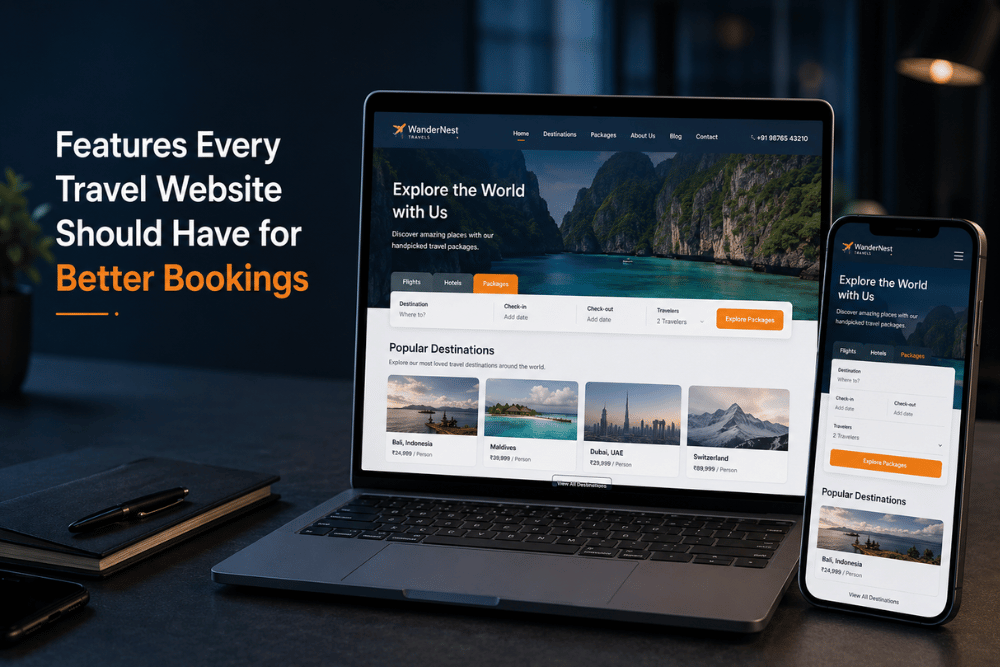
Features Every Travel Website Should Have for Better Bookings
18 May, 2026
A travel website is often the first serious interaction a customer has with a travel business. Before making an enquiry or booking, visitors may compare destinations, tour packages, hotel options, inclusions, images, reviews, and prices across several websites. This means the website has to do more than look attractive. It needs to help visitors understand the business quickly, explore travel options comfortably, and feel confident enough to take the next step. If pages are slow, information is difficult to find, or the booking journey feels complicated, potential customers can easily leave and continue comparing other travel companies.
This is why the features of a travel website can directly influence how customers browse, evaluate, and enquire about travel services. Mobile-friendly design, fast loading speed, clear package categories, simple navigation, professional destination presentation, useful travel information, and an easy enquiry process all contribute to a smoother customer journey. A well-planned website should allow someone to move naturally from discovering a destination to understanding the package and finally contacting the business, without unnecessary clicks or confusing page structures.
For businesses planning professional travel website development, the focus should therefore be on useful functionality rather than adding features simply because they look impressive. Every element should have a clear purpose: helping visitors discover travel options, answer important questions, build trust, or take a meaningful action. When design, usability, performance, content, and enquiry flow are planned together, the website becomes a stronger business tool rather than simply an attractive online brochure.
Important Features Every Modern Travel Website Should Include
A modern travel website is no longer only about attractive destination images or package listings. Today, customers compare multiple travel businesses online before making any booking decision, which means the quality of the website experience directly affects customer trust, engagement, and enquiry generation. People expect travel websites to feel smooth, professional, easy to browse, and properly optimized across all devices because even small usability problems can quickly reduce interest and push visitors toward competing businesses. A professionally structured travel website should help users explore destinations naturally, compare packages comfortably, and contact the business without confusion while also supporting SEO visibility and long-term online growth.
Many travel businesses still focus mainly on visual appearance without paying enough attention to the features that actually improve customer interaction and booking performance. Things like mobile responsiveness, website speed, navigation structure, enquiry flow, SEO optimization, and user experience often influence conversions much more than design aesthetics alone. The features below are some of the most important elements that help travel websites perform better in terms of usability, customer engagement, and long-term business growth.
Feature
Why It Matters
Mobile-Friendly Design
Helps users browse travel packages smoothly across smartphones and tablets
Fast Website Speed
Reduces bounce rates and improves overall browsing experience
Clear Tour Package Structure
Makes destinations and travel services easier to explore and compare
Easy Enquiry Process
Helps visitors contact the business quickly without confusion
SEO-Friendly Website Structure
Improves Google visibility and long-term organic traffic growth
Professional Destination Images
Creates stronger engagement and emotional connection with travel experiences
Simple Navigation
Helps users move naturally between packages, blogs, and enquiry pages
Responsive Layout
Improves usability across different screen sizes and devices
Trust-Building Elements
Increases customer confidence through reviews, branding, and clear business information
Optimized User Experience
Improves engagement, customer interaction, and booking potential
Travel businesses that combine these features properly usually create much stronger online presence because users today expect websites to feel fast, organized, and professionally managed from the very first interaction. A website that supports smooth browsing experience, comfortable navigation, mobile responsiveness, and clear enquiry flow not only improves customer trust but also helps businesses perform better in terms of SEO visibility and long-term booking generation. In highly competitive industries like travel and tourism, these usability and performance factors often become the biggest difference between websites that successfully generate enquiries and websites that struggle to keep visitors engaged.
Mobile-Friendly Design
Mobile-friendly design is one of the most important features a modern travel website can have because customers often begin their travel research on smartphones. They may search for destinations during a commute, compare holiday packages between activities, check hotel details from home, or contact a travel company after seeing an offer online. The website therefore needs to remain easy to read, navigate, and interact with regardless of the screen being used. A layout that looks excellent on a desktop but becomes difficult to use on a phone can quickly create a poor first impression.
A weak mobile experience can also interrupt the customer's decision-making process. Visitors do not want to pinch and zoom to read package details, struggle with small buttons, wait for heavy pages to load, or search through a menu that was designed only for a large screen. When several travel companies are available in Google results, there is little reason for a visitor to tolerate these problems. They can simply return to the search results and choose another website that makes browsing easier. For a travel business, that means a mobile usability problem can become a lost enquiry before the visitor has even had a chance to understand the package.
A properly responsive travel website should make the important parts of the customer journey comfortable on smaller screens. Readable typography, touch-friendly buttons, well-spaced sections, responsive images, simple navigation, fast-loading pages, and properly structured package information should work together rather than being treated as separate design details. Visitors should be able to open a destination page, review the important information, view images, understand the package, and reach the enquiry option without fighting with the interface. These details may seem small individually, but together they determine whether the website feels polished and trustworthy.
Older travel websites often struggle because they were designed around desktop browsing and later adapted for mobile without properly reconsidering the user experience. This can lead to overlapping sections, oversized images, difficult menus, tiny text, awkward forms, and unnecessary scrolling. A better approach is to design the mobile experience as an important part of the website from the beginning. Businesses can also review principles covered in responsive website design when planning how pages should adapt across different devices. The goal is simple: visitors should be able to explore travel options comfortably whether they are using a phone, tablet, or desktop computer.
Fast Website Loading Speed
Website loading speed has become one of the most important factors affecting both customer experience and online visibility, especially for travel businesses where users constantly browse multiple websites before making any booking decision. Travel websites usually contain destination galleries, package images, sliders, videos, hotel visuals, and detailed travel sections, which means performance can quickly become slow if the website is not properly optimized. Many businesses focus heavily on visual appearance while completely ignoring speed optimization, but even a visually attractive travel website struggles to perform if pages take too long to load.
Modern users expect websites to open almost instantly. People browsing travel packages usually move very quickly between different companies while comparing destinations, pricing, reviews, and services at the same time. If a travel website feels slow, unresponsive, or laggy during browsing, most visitors leave before even exploring the packages properly. This creates a major problem because businesses often spend money on SEO, ads, or social media campaigns to attract traffic, but poor loading speed prevents users from staying engaged after landing on the website.
Fast-loading travel websites create a much smoother browsing experience by helping visitors move comfortably between package pages, image galleries, destination sections, and enquiry forms without unnecessary delays. A properly optimized website also feels more professional and trustworthy because users naturally associate speed and smoothness with better business quality. On the other hand, websites that freeze, lag, or take several seconds to open pages usually reduce customer confidence very quickly, especially on mobile devices where patience levels are much lower.
Website speed also affects SEO performance directly because Google now prioritizes websites that provide better user experience across devices. Slower websites often create higher bounce rates and weaker engagement signals because users leave quickly before interacting properly with the content. Over time, this can gradually reduce visibility in search results even if the website contains good travel packages or useful information. This is one of the reasons businesses investing in proper website speed optimization usually create much smoother browsing experience and better customer engagement over time.
Clear Tour Package Structure
A travel website can quickly become difficult to use when it offers many destinations, holiday packages, hotel options, visa services, seasonal deals, and customised trips without a clear structure. Visitors usually come to a travel website with a particular idea in mind, such as finding an international holiday, comparing honeymoon packages, planning a family trip, or looking for a short weekend getaway. If all of these options are mixed together, users have to spend extra time figuring out where to begin. A well-organised package structure gives visitors a clear starting point and helps them move through the website without feeling overwhelmed.
The structure should reflect the way customers actually search for travel services. Domestic tours, international holidays, honeymoon packages, family vacations, adventure trips, luxury travel, weekend getaways, and customised tours can be separated into meaningful categories when these are part of the business offering. Individual destination and package pages can then provide the detailed information visitors need, including itinerary highlights, duration, inclusions, exclusions, accommodation details, important travel information, and an enquiry option. This makes it much easier for someone to compare suitable options instead of opening unrelated pages simply to find the right package.
Clear organisation also has a direct effect on the customer journey. When visitors can quickly identify the category that matches their requirements, they are more likely to continue exploring instead of returning to Google. The same structure can support search visibility when each important destination or travel category has a useful, focused page rather than several overlapping pages competing for the same purpose. Internal linking can then connect related destinations, packages, and supporting information where the connection is genuinely useful. For example, a broader travel category can guide visitors towards a specific destination or package page, while a detailed package page can lead them to relevant travel information before they make an enquiry.
The technical structure matters as well, particularly when a travel website is expected to grow over time. New destinations, seasonal packages, travel guides, and specialised services should be added without making the existing navigation confusing. A logical hierarchy makes this expansion easier while keeping the website understandable for both visitors and search engines. Businesses planning a larger website can also review what pages every business website must have to understand how important pages and supporting content can be organised into a clearer overall structure. The goal is not to create the largest number of categories; it is to create a package system where the right travel option is easy to find, understand, compare, and enquire about.
Easy Enquiry and Contact Process
A travel website can have excellent destinations and attractive packages, but those features have limited value if an interested visitor cannot contact the business easily. Travel customers often have questions before they are ready to book, such as whether a package can be customised, what is included, which hotels are available, or whether particular travel dates can be accommodated. The website should make it simple to start that conversation instead of making visitors search through several pages for a phone number or enquiry form.
The contact journey should be designed around reducing unnecessary effort at the moment of interest. A clear enquiry button, short contact form, visible phone number, WhatsApp option where appropriate, and easy-to-find contact page can give visitors several convenient ways to reach the business. Forms should ask only for information that is genuinely needed at the first stage, because a long form can discourage someone who simply wants to ask about a package. On package and destination pages, the enquiry option should also be placed where it feels like a natural next step rather than appearing as an unrelated sales message.
The quality of the enquiry experience can influence how professionally customers perceive the travel company. Someone planning a holiday may be comparing several providers and paying attention to how easily each business communicates. If one website makes it simple to ask a question while another hides its contact details or uses a complicated form, the easier option can feel more reliable and better organised. This is particularly important for customised tours, honeymoon packages, international travel, and other services where customers may need clarification before making a final decision.
Professional Destination Images
Travel is highly visual, so destination imagery should do more than make a website look attractive. Good images help visitors imagine the experience they are considering, whether that means seeing a hotel, exploring a destination, understanding a sightseeing experience, or getting a better sense of a particular tour package. When images are relevant to the content around them and presented in a clean layout, they can make package pages easier to understand and keep visitors engaged while they evaluate their options.
However, quality should not mean simply using the largest possible images. Large, uncompressed photographs can make an otherwise professional travel website slow, particularly when several galleries, banners, sliders, and destination images appear on the same page. A better approach is to use appropriately sized and compressed images while maintaining enough visual quality for visitors to appreciate the destination. Responsive image handling is also important so that the website does not unnecessarily load desktop-sized media on smaller devices.
The placement of images matters as well. A destination page should use visuals where they help explain or strengthen the information rather than filling every available space with photographs. Package highlights, hotel information, sightseeing details, and important travel sections can be supported with relevant imagery, while unnecessary sliders and repetitive galleries can be avoided. This creates a cleaner experience and allows visitors to focus on the information that actually helps them decide.
Professional imagery should ultimately work together with speed, layout, accessibility, and content. When destination photos load efficiently and appear in the right context, they can strengthen the emotional side of travel research without creating performance problems. Combined with clear package information and a straightforward enquiry path, strong visual presentation helps turn a travel website from a basic information page into a more convincing digital experience for potential customers.
SEO-Friendly Website Structure
A travel website may look visually attractive and still struggle to generate consistent traffic if the SEO structure behind the website is weak. Today, most customers search directly on Google before contacting any travel business. People regularly search for holiday packages, honeymoon destinations, visa services, tour operators, hotel bookings, international trips, and travel deals while comparing multiple companies online at the same time. If a travel website is not properly optimized for search engines, even good travel services may remain practically invisible because users simply never discover the website during their search process.
This is one of the biggest reasons modern travel websites now require much more than attractive design alone. A professionally structured travel website should help both users and search engines understand the website clearly. Elements like clean URL structure, mobile responsiveness, fast loading speed, proper internal linking, organized content hierarchy, destination pages, and SEO-friendly navigation all work together to improve visibility over time. Individually these things may seem technical, but together they strongly affect how easily Google can crawl, understand, and rank the website for relevant travel-related searches.
User experience also plays a major role in SEO performance now. If visitors land on a website and quickly leave because the browsing experience feels confusing, slow, or poorly organized, search visibility gradually weakens over time because Google closely monitors engagement behavior. On the other hand, websites with smoother navigation, clear package structure, responsive design, and comfortable browsing experience usually create stronger engagement signals that indirectly support better rankings. This is why businesses investing in SEO-friendly travel website development often focus heavily on usability and content organization instead of only visual presentation.
Another important factor is how properly structured travel websites support long-term growth. Destination pages, travel blogs, package categories, and internal linking systems help businesses expand search visibility gradually across multiple travel-related topics instead of depending only on advertisements or social media campaigns. This becomes much easier when websites follow proper SEO structure and user flow practices that support both rankings and conversions together because user experience, page organization, and search visibility now work closely together in modern SEO.
Trust-Building Elements
Trust is particularly important when someone is considering a travel service because the customer may be making a significant financial commitment before experiencing anything in person. Visitors often compare several companies before contacting one, so the website needs to answer an important question quickly: “Does this business look reliable enough for me to trust with my travel plans?” Clear business information, professional presentation, genuine customer feedback, well-presented destinations, and straightforward communication can all help reduce uncertainty during that decision.
A trustworthy travel website should make important information easy to verify rather than hiding it behind vague claims or unnecessary design elements. Customer reviews, testimonials, company information, package details, destination photographs, contact information, terms, and clear service descriptions can give visitors a better understanding of who they are dealing with and what they can expect. Consistent branding and a polished page structure also matter because small details such as broken layouts, outdated information, difficult navigation, or missing contact details can create doubt even when the actual travel service is good.
Trust also develops through the overall experience. A visitor who can comfortably browse packages, understand what is included, view relevant destination information, and reach the business without confusion is more likely to feel that the company is organised and professional. This is why website quality should not be separated from business credibility. A strong travel website does not need exaggerated claims to appear trustworthy; it should provide clear information, genuine proof, transparent communication, and a consistent user experience that allows customers to make an informed decision.
Simple Navigation Experience
Travel websites can contain a large amount of information, including destinations, tour packages, hotels, visa services, travel guides, offers, galleries, and enquiry options. Without a clear structure, all of this information can quickly become difficult to navigate. Visitors should not have to open several unrelated pages or repeatedly return to the homepage just to find another package or piece of travel information. A simple navigation system gives users a clear route through the website and helps them focus on comparing travel options rather than figuring out how the website works.
The navigation should give priority to the sections customers are most likely to need. Destinations, tour packages, key travel services, useful information, and contact options should be easy to locate, while less important resources can be organised through supporting pages or contextual links. Categories should be meaningful rather than created simply to make the menu appear larger. On mobile devices, the same principle becomes even more important because limited screen space means visitors need a focused menu that is easy to open, scan, and use.
Good navigation should also support the booking journey. A visitor might discover a destination first, explore suitable packages next, check what is included, and then decide to enquire. The website should make each of those steps feel connected. Relevant links, clear calls to action, well-organised package categories, and consistent page structures can help visitors move forward without unnecessary friction.
The objective is not to place every feature and every page inside the main menu. The best travel website navigation makes the most useful choices obvious while keeping the deeper information accessible when visitors need it. When customers can find destinations, understand packages, explore supporting information, and reach the enquiry option naturally, the website feels more professional and gives potential travellers a much clearer path from initial interest to booking.
Why Many Travel Websites Still Fail to Generate Bookings
Having a travel website does not automatically mean that it will generate enquiries or bookings. A business may have attractive packages, competitive offers, and good destinations, but visitors still need to feel comfortable using the website before they take the next step. When customers compare several travel companies online, they quickly notice whether a website is easy to browse, whether package information is clear, and whether contacting the business feels simple. If the experience is slow, confusing, outdated, or difficult to use, visitors can leave before they even discover what the business offers.
One common problem is that many travel websites were built around older browsing habits. They may contain crowded layouts, weak mobile responsiveness, slow-loading images, complicated menus, unclear package categories, or lengthy enquiry forms. These issues are particularly damaging on smartphones, where visitors usually want to find information quickly rather than spend time working out how a website operates. A website can still look acceptable to its owner while creating considerable friction for a first-time visitor who has never used it before.
Another issue is the difference between visual appeal and practical usability. Large sliders, animations, image-heavy pages, and elaborate effects can make a travel website look impressive, but they do not necessarily help someone choose a package or make an enquiry. If these elements slow the page down or push important information too far below the fold, they can actually make the booking journey harder. This is why reviewing common website design mistakes can be useful when evaluating why a website receives visitors but fails to turn enough of them into enquiries.
The strongest travel websites focus on what the customer needs at each stage of the decision. Visitors should be able to discover a destination, understand the package, check important details, build confidence, and contact the business without unnecessary obstacles. The problem is often not that the website needs more features; it needs better organisation and a clearer customer journey. When speed, mobile usability, package presentation, navigation, trust signals, and enquiry options work together, the website has a much better chance of turning genuine travel interest into meaningful business enquiries.
Choosing the Right Travel Website Design Company
Choosing a travel website design company should not be based only on the appearance of its previous websites or the lowest quotation. A travel website has to handle several parts of the customer journey at the same time. Visitors may arrive looking for a destination, compare packages, check hotel or itinerary details, view photographs, ask questions, and eventually submit an enquiry. The company developing the website should therefore understand responsive design, website performance, SEO structure, navigation, package organisation, enquiry flow, and future scalability rather than treating the project as a simple collection of attractive pages.
Before making a decision, businesses should look at how a development company approaches the practical side of travel website development. Ask whether the website will be easy to manage when new destinations or packages are added, whether important pages will have a logical structure, how mobile performance will be handled, and how visitors will move from discovering a package to making an enquiry. It is also worth considering how the developer approaches content structure, image optimisation, technical SEO, security, and ongoing maintenance. A company that understands these areas can build a website around the actual needs of a travel business rather than simply delivering a visually impressive homepage. Businesses comparing providers can also review this guide on how to choose the right website designing company before making their final decision.
Price is another factor, but it should be considered alongside the quality and scope of the work rather than treated as the deciding factor. A cheaper website may appear attractive initially but become expensive later if the structure is difficult to expand, the mobile experience is weak, or important functionality has to be rebuilt. For a travel business planning to add destinations, packages, blogs, enquiry features, or other services over time, scalability should be considered from the beginning. The right development partner should create a foundation that can grow with the business without forcing a complete redesign every time new requirements are introduced.
Ultimately, the best travel website design company is one that understands that the website has a business purpose beyond looking good. It should help visitors discover travel options, understand packages, trust the company, and take the next step comfortably. When design, usability, performance, SEO, content structure, and conversion paths are planned together, the website becomes a stronger long-term asset for attracting and converting travel customers.
Need a Professional Travel Website for Better Bookings?
If your travel website looks outdated, takes too long to load, feels difficult to use on mobile, or receives visitors without generating enough enquiries, the problem may not be your travel packages. The website experience itself can influence whether a visitor stays, explores your destinations, and decides to contact you. Travel customers often compare several companies before making a decision, so a website that makes it difficult to understand packages, view important details, or reach the business can lose potential customers even when the underlying travel services are strong.
A professionally developed travel website should make the entire journey easier. Visitors should be able to discover destinations, compare suitable packages, understand what is included, view relevant images, find important information, and enquire without unnecessary steps. Responsive design, fast performance, clear navigation, organised package pages, mobile-friendly forms, and a logical SEO structure should work together rather than being treated as separate improvements. When these elements are planned properly, the website becomes much more useful for both customers and the business.
For travel companies operating in competitive markets, this becomes even more important because customers have plenty of alternatives available online. A modern website should not simply compete on appearance; it should communicate professionalism through the quality of the entire experience. If you are planning a new website or considering a redesign, the right approach is to build around customer needs, business goals, search visibility, and future growth from the beginning. This gives the website a stronger foundation for generating enquiries rather than relying only on advertising to bring visitors.
Final Thoughts
A successful travel website is more than a collection of destination photographs and tour packages. It is an important part of how customers discover a travel company, evaluate its services, build confidence, and decide whether to make an enquiry. When the website is fast, responsive, well organised, visually professional, and easy to navigate, visitors can spend their time evaluating the travel experience instead of dealing with technical or usability problems. That difference can have a meaningful impact on how the business is perceived online.
The most effective travel websites bring several elements together: mobile-friendly design, fast loading performance, clear package organisation, useful destination information, simple navigation, trust-building content, and an easy enquiry process. Each feature serves a different purpose, but they become much more valuable when they work as one connected customer journey. A visitor should be able to move from discovering a destination to understanding the offer and contacting the business without unnecessary friction.
For travel businesses planning long-term online growth, website development should therefore be treated as a business investment rather than simply a design project. A professionally structured website can provide a stronger foundation for SEO, customer trust, enquiries, and future expansion while giving the business greater control over its online presence. The goal is not simply to create a website that looks good; it is to create a website that helps the right visitors confidently take the next step.
A professional travel website should include mobile-friendly design, clear tour package categories, destination pages, fast loading speed, simple navigation, enquiry or booking options, professional images, trust-building information, and an SEO-friendly website structure. These features help visitors explore travel services comfortably and make it easier for businesses to generate enquiries and bookings.
Mobile-friendly design allows visitors to browse destinations, compare packages, view images, and contact the travel business comfortably from smartphones and tablets. Since many customers research travel services on mobile devices, responsive design helps create a smoother experience and reduces usability problems that can cause visitors to leave.
Website speed affects how quickly visitors can access destinations, package information, images, and booking or enquiry options. A slow website can create frustration and cause potential customers to leave before completing an enquiry. Faster pages provide a smoother browsing experience and can also support better overall website performance.
A travel website can improve booking opportunities by making packages easy to understand, providing high-quality destination information, simplifying navigation, displaying clear calls to action, offering convenient enquiry options, and creating a trustworthy mobile experience. SEO and useful travel content can also help attract people who are actively researching destinations and travel services.
Yes. SEO can help a travel website become discoverable when people search for destinations, tour packages, travel services, and related information. A strong SEO foundation includes useful content, logical website structure, relevant internal links, mobile usability, technically accessible pages, and clear information that matches what potential customers are searching for.
A professional travel website should have clear package information, high-quality but optimized images, consistent branding, easy navigation, transparent business information, accessible contact options, responsive design, and a smooth overall browsing experience. Customer reviews and useful travel information can also help visitors feel more confident when evaluating the business.
Grow Your Local Business
Get a Professional Website From a Web Designing Company in Delhi