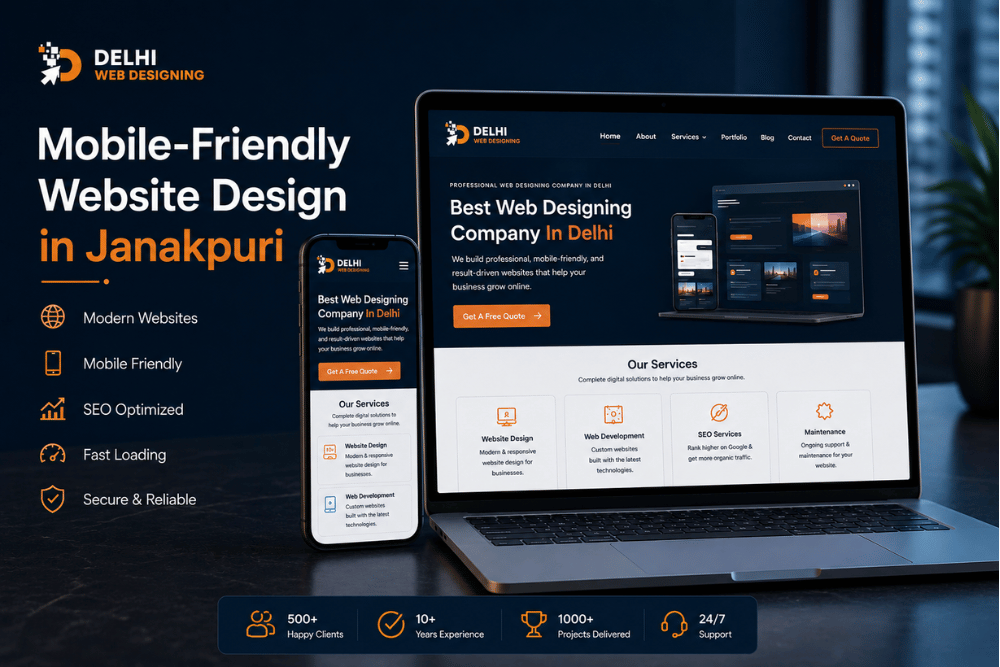
Most businesses in Janakpuri already have websites, but a large number of them still struggle to generate proper enquiries online. In many cases, the problem is not the business itself — the real issue is the mobile experience. Today, people search for local services directly through smartphones, compare multiple companies within minutes, and quickly decide which business feels more professional and trustworthy. If a website feels slow, confusing, outdated, or difficult to use on mobile devices, most visitors leave immediately without taking any action.
This shift has changed website performance completely. A few years ago, businesses could still manage with websites designed mainly for desktop users because mobile browsing was lower and competition online was not as aggressive. But today, most local searches in areas like Janakpuri, Janakpuri West, Janakpuri East, and nearby locations such as Tilak Nagar, Vikaspuri, and Dwarka happen directly through smartphones while users are traveling, working, comparing services, or searching for nearby businesses. People now expect websites to load quickly, work smoothly across devices, explain services clearly, and create trust within seconds.
Because of this, mobile-friendly website design is no longer only about appearance — it directly affects customer engagement, Google rankings, enquiry generation, and overall business growth. Businesses investing in professional Website Designing Company in Janakpuri services now focus much more on responsiveness, usability, speed, and user experience because modern websites need to perform properly for both users and search engines together.
Why Mobile Experience Has Become So Important
Mobile browsing has completely changed how people interact with businesses online. A few years ago, users mostly searched through desktop computers, and businesses could still manage with websites designed mainly for larger screens. But today, most local searches happen directly through smartphones while people are traveling, comparing services, checking reviews, or quickly searching for nearby businesses. Whether someone is looking for a clinic, restaurant, coaching institute, gym, website designer, or digital marketing company in Janakpuri, the first interaction usually happens on a mobile device.
Because of this shift, customer expectations have become much higher than before. People now expect websites to:
load quickly
feel smooth while browsing
display properly on smaller screens
explain services clearly without confusion
Users no longer spend time trying to “understand” complicated websites because they already have many other options available within seconds on Google. If the mobile experience feels frustrating, slow, cluttered, or difficult to navigate, most visitors simply leave and move toward another business that feels easier and more professional to browse.
This has become a major challenge for many local businesses because competition in Janakpuri is already strong and users compare multiple companies very quickly before making any enquiry decision. In many cases, even small usability problems reduce trust immediately. A website may look visually fine from the business owner’s perspective, but users experience the website very differently on mobile devices where speed, readability, scrolling comfort, and navigation flow matter much more.
Many older websites still create common mobile browsing problems such as slow loading speed, unreadable text, broken layouts, overcrowded sections, confusing navigation, difficult enquiry forms, and poor responsiveness across different screen sizes. Individually these issues may look small, but together they create friction throughout the browsing experience and reduce engagement far more than most businesses realize. Visitors usually do not complain about these problems directly — they simply leave the website without taking any action.
Mobile experience now affects much more than just usability. It directly influences customer trust, enquiry generation, engagement, local SEO visibility, and even how Google evaluates website quality overall. Businesses investing in smoother mobile experience and better responsiveness usually build stronger long-term visibility because modern website performance now depends heavily on how comfortable and user-friendly the browsing experience feels across all devices.
How Mobile-Friendly Websites Support SEO Performance
Google now uses the mobile version of most websites for indexing, which makes mobile usability an important part of a modern website strategy. This does not mean that simply making a website responsive will automatically move it higher in search results. Instead, the mobile version needs to provide the same important content, navigation, links, and functionality while remaining easy to use on smaller screens. For a business competing in local search, that creates a stronger technical and user-experience foundation for SEO.
A mobile-friendly website also makes it easier for visitors to read service information, move between relevant pages, understand the business, and complete important actions. If the mobile layout hides content, breaks navigation, makes buttons difficult to use, or creates unnecessary friction, the website can lose valuable opportunities after receiving search traffic. This is why mobile optimization should be considered alongside site structure, content, performance, and conversion strategy rather than treated as a visual design adjustment.
Mobile Website Element
What It Improves
Why It Matters
Responsive layout
Screen compatibility
Keeps pages usable across different devices
Readable content
Content accessibility
Helps visitors understand services without zooming
Simple navigation
Page discovery
Makes important sections easier to reach
Touch-friendly buttons
Mobile interaction
Reduces difficulty when users tap links and CTAs
Optimized images
Page performance
Helps pages load more efficiently
Consistent content
Mobile-first indexing
Ensures important information remains available to search engines
Clear internal links
Website structure
Helps users and search engines discover related pages
Mobile optimization should also be part of the wider development workflow rather than something added immediately before launch. Planning the structure, responsive layouts, content hierarchy, navigation, and functionality together creates a more reliable website. Businesses can learn more about this structured approach through the website development process, particularly when planning a website that needs to support both users and organic search over the long term.
The key is to avoid treating mobile responsiveness as an isolated SEO trick. A strong mobile website should make important information accessible, keep navigation understandable, present content clearly, and allow visitors to complete meaningful actions without unnecessary obstacles. When these elements are built into the website from the beginning, mobile usability becomes a natural part of a stronger overall website structure rather than another technical task added after development.
What Makes a Website Truly Mobile-Friendly
Many businesses still assume that a mobile-friendly website simply means making a desktop website smaller. In reality, proper mobile optimization is about creating an experience that feels natural on smartphones from the moment a visitor lands on the page. The content should remain easy to read, navigation should feel simple, buttons should be comfortable to tap, and important information should not become difficult to find. A website can technically open on a phone and still provide a poor experience if visitors have to zoom, scroll excessively, deal with broken layouts, or struggle to understand where they should go next.
A truly mobile-friendly website brings design, usability, content structure, and performance together. Pages should load efficiently, images should be handled carefully, sections should have comfortable spacing, and navigation should make sense on smaller screens. Service information, contact details, enquiry forms, and calls to action should remain accessible without making the page feel crowded. These details matter because mobile visitors are often searching with a specific purpose. They may want to check a service, compare businesses, understand an offering, or contact a company within a few minutes. If the website creates unnecessary friction, they have little reason to stay and work through it.
The customer journey also needs to be considered when designing for mobile. A visitor landing on a service page should be able to understand the offering and discover genuinely useful supporting information without repeatedly returning to the homepage or searching Google again. This is where a well-planned website structure becomes important. Businesses can also explore What Pages Every Website Must Have to understand how essential pages can be organised around visitor needs, business goals, and a smoother browsing experience.
Older websites often struggle because they were designed around desktop behaviour first and adapted for mobile later. This can leave behind oversized sections, difficult menus, tiny buttons, awkward spacing, slow-loading images, or layouts that do not work comfortably across different screen sizes. A modern responsive approach considers these issues from the beginning and makes sure the website remains usable rather than simply technically functional.
Mobile-friendly design should also support the wider performance of the website. When visitors can comfortably read content, move between relevant pages, understand services, and complete an enquiry without frustration, the website becomes more useful as a business asset. The goal is not simply to make a website “fit” a smartphone screen. The goal is to create a smooth digital experience where responsive design, usability, content, navigation, performance, and conversion paths work together naturally.
Why Many Business Websites Still Perform Poorly on Mobile
Many businesses have websites that look acceptable on a desktop screen but provide a completely different experience on smartphones. Older websites were often designed around larger screens and later adjusted for mobile, which can leave important usability problems behind. A page may technically open on a phone while still feeling difficult to read, navigate, or interact with. For local businesses, this matters because visitors often compare several companies before deciding where to enquire, and a poor mobile experience can make a business appear less professional even when its actual services are strong.
Some of the most common problems found on older or poorly optimized mobile websites include:
Slow-loading pages caused by heavy images, unnecessary scripts, or outdated website structures.
Difficult navigation that makes important services, contact details, or enquiry options hard to find.
Unreadable content because text, spacing, or page sections have not been properly adapted for smaller screens.
Poorly designed buttons and forms that make tapping, calling, or submitting an enquiry unnecessarily difficult.
Broken or crowded layouts where images, sections, menus, or other elements do not display correctly.
Weak mobile page structure where visitors cannot easily understand what the business offers or what they should do next.
These issues become especially noticeable when users are searching for local businesses and comparing options quickly. Someone may arrive from Google with genuine interest, but if the website takes too long to load or makes basic information difficult to access, they can easily return to the search results and consider another company. This means a business may believe it needs more traffic when the bigger problem is actually what happens after visitors arrive. A smoother mobile experience can help the existing traffic become more useful by making services easier to understand and enquiries easier to complete.
Visual design alone cannot solve these problems. A website can have attractive colours, animations, and professional graphics while still creating a frustrating experience on smartphones. Common issues such as overcrowded sections, confusing menus, weak page hierarchy, and difficult interaction are also among the website design mistakes that can reduce engagement and make it harder for visitors to move towards an enquiry.
Another concern is performance. Unoptimized images, outdated code, unnecessary functionality, and poorly structured pages can all contribute to a slower mobile experience. Visitors generally expect a website to respond quickly and behave predictably, particularly when they are browsing from a smartphone. When the website consistently feels slow or uncomfortable, trust can decline before the visitor has even had an opportunity to understand the business properly.
For businesses in competitive local markets, mobile optimization should therefore be treated as a core part of website quality rather than a final design adjustment. The aim is to create a website that remains fast, readable, accessible, easy to navigate, and comfortable to use across different devices. When the technical foundation and user experience are handled properly, the website can do a much better job of supporting engagement, enquiries, and long-term organic visibility.
Mobile-Friendly Websites Build More Trust
People often form an opinion about a business before they ever make a call or submit an enquiry, and the website experience can strongly influence that first impression. When visitors open a website on their smartphone, they quickly notice whether the pages feel modern, organised, readable, and easy to use. A clean mobile experience makes the business appear more professional, while slow loading, awkward navigation, cluttered layouts, or difficult interactions can create doubt before visitors have even explored the actual services. For a service-based company, this first impression matters because customers are not only evaluating what the business offers—they are also judging how confidently and professionally the business presents itself online.
Trust becomes even more important when visitors are comparing several businesses at the same time. A potential customer may check a service page, look at the company's information, explore a few additional pages, and then decide whether it feels safe to make an enquiry. If everything works smoothly on mobile, the visitor can focus on understanding the service rather than dealing with the website itself. Clear information, comfortable reading, simple navigation, properly placed contact options, and a consistent design all reduce unnecessary friction and make the business feel easier to deal with. This is particularly valuable for companies operating in competitive local markets, where a visitor can quickly return to Google and consider another option if the website creates a poor experience.
A professional mobile experience therefore supports more than visual appeal. It helps create consistency between the quality of the website and the quality visitors expect from the business behind it. Businesses investing in responsive design, usability, performance, and clear content structure can create a stronger foundation for customer confidence and enquiries. This is also why modern Business Website Design in Delhi needs to consider how visitors actually use a website across different devices rather than focusing only on how the desktop version looks. When the mobile experience feels reliable from the first interaction, visitors have fewer reasons to hesitate and more reasons to continue exploring the business.
Why Mobile Website Performance Affects Conversions
Bringing visitors to a website is only one part of online marketing. The bigger challenge is getting those visitors to take the next step—whether that means calling the business, submitting an enquiry, requesting a quotation, booking a service, or simply exploring the company further. A website can receive traffic from Google, social media, paid advertising, or local searches, but that traffic has limited value if visitors arrive on a mobile page that feels slow, confusing, or difficult to use. People usually do not wait around to work through a frustrating website when several competing businesses are only one search away.
Mobile users also tend to make quick judgments about whether a website is worth their time. They want to understand the service, find important information, and decide what to do next without fighting with the layout. If buttons are difficult to tap, contact details are hidden, forms are uncomfortable to complete, or pages take too long to load, the customer journey starts breaking down. A well-structured mobile website removes these small obstacles and makes it easier for visitors to move from interest to understanding and then towards an enquiry. For local businesses, this can be particularly important because customers often compare several providers before deciding who appears most reliable and convenient to contact.
Conversion performance is therefore closely connected with the overall mobile experience, not just the wording of a call-to-action button. Clear service information, simple navigation, readable content, fast-loading pages, and easy-to-use enquiry options all contribute to a smoother journey. Businesses should also pay attention to the technical side of performance because heavy images, unnecessary scripts, and poorly optimized pages can make an otherwise attractive website frustrating to use. A useful next step is understanding website speed optimization as part of the wider effort to improve mobile performance rather than treating speed as a separate issue.
When these elements work together, visitors can focus on the business instead of the website itself. They can understand what is being offered, find answers to their questions, explore relevant pages, and contact the company when they feel ready. That is the real value of mobile optimization: it reduces friction throughout the customer journey and gives existing website traffic a better opportunity to become genuine business enquiries.
Why Local Businesses in Janakpuri Need Better Website Experience
For a local business, the website is often one of the first places a potential customer evaluates before deciding whether to make contact. Someone searching for a service may compare several businesses in a short time, checking their websites to understand what they offer, how professional they appear, and how easy it is to find important information. If one website feels fast, clear, and comfortable on mobile while another feels outdated or difficult to navigate, the difference can influence which business receives the next enquiry.
A better website experience is not simply about having attractive graphics. Visitors need to understand the service quickly, move between relevant pages without confusion, find contact information easily, and feel confident that the business is worth considering. Clear navigation, readable content, responsive layouts, sensible page structure, and convenient enquiry options all contribute to that experience. Businesses that improve these areas can make better use of the traffic they already receive instead of relying entirely on generating more visitors.
This is why better website experience matters for both customer engagement and the wider performance of a business website. When visitors can comfortably explore services and find useful information, the website becomes more effective at supporting the customer journey. Poor navigation, slow pages, cluttered layouts, or weak mobile usability can have the opposite effect by creating friction before visitors have properly understood the business.
For businesses serving local customers, the experience also needs to work consistently across devices. A visitor may discover the company through a smartphone, return later from a laptop, and eventually contact the business after reviewing several pages. If the website structure remains clear throughout that journey, it becomes easier to build familiarity and confidence. This is particularly important for service businesses where customers often need to research before they are ready to enquire.
There is also an important SEO consideration, but it should be handled carefully. A better user experience does not mean that Google automatically rewards a page simply because visitors spend more time on it. Search visibility depends on many factors, including relevance, content quality, technical accessibility, page experience, and the overall quality of the website. The practical goal should therefore be to build a website that genuinely helps visitors first while maintaining a technically sound foundation for search engines.
For local businesses, that approach creates a more sustainable website strategy. Instead of treating mobile design, navigation, speed, content, and SEO as separate tasks, they can be developed as connected parts of the same customer experience. When a visitor can arrive from search, understand the business, explore the right information, and comfortably take the next step, the website becomes a much stronger part of the business's online presence.
Choosing the Right Mobile-Friendly Website Design Company in Janakpuri
Choosing a website design company should involve more than comparing quotations or selecting the agency with the most attractive portfolio. A website can look impressive and still perform poorly if its mobile layout is uncomfortable, pages load slowly, navigation is confusing, or the structure was not planned around real customer journeys. Before making a decision, businesses should look at how the company approaches responsive design, usability, performance, SEO structure, content organisation, and enquiry generation. The right development approach should create a website that works as a business asset rather than simply looking good when it launches.
A reliable website design company should be able to explain how the website will perform across smartphones, tablets, laptops, and desktops, while also showing how important pages will be organised for visitors and search engines. Businesses should consider whether the development process includes responsive layouts, clear navigation, fast-loading pages, readable content, secure functionality, straightforward enquiry paths, and room for future expansion. Pricing is naturally important, but the cheapest option is not necessarily the most cost-effective if the website later requires major changes because important technical and usability decisions were overlooked during development.
It is also worth looking beyond the initial design and asking how the website will be maintained and improved after launch. A business may add new services, publish supporting content, expand into new areas, or change its conversion goals over time. A well-planned website should be flexible enough to accommodate these changes without constantly requiring a complete rebuild. This is where understanding how to choose the right website designing company in Janakpuri can help businesses evaluate providers based on their approach, not just their quoted price.
Ultimately, the best choice is a company that understands the connection between design, mobile usability, website performance, SEO, and business goals. A professionally structured website should make it easy for visitors to understand the services, explore relevant information, and take the next step when they are ready. For businesses competing for local customers, that combination is far more valuable than a website that simply looks attractive on the day it goes live.
Need a Mobile-Friendly Website for Your Business in Janakpuri?
If your current website feels outdated on smartphones, loads slowly, creates navigation problems, or is not generating proper enquiries, improving the mobile experience can create a major difference in how customers interact with your business online. Today, most people search for local services directly through mobile devices and compare multiple businesses within minutes before making any decision, which means users immediately notice when a website feels confusing, cluttered, difficult to browse, or uncomfortable on smaller screens. In many cases, businesses continue spending money on SEO, ads, and digital marketing without realizing that the actual issue exists inside the website experience itself. A professionally optimized mobile-friendly website helps improve responsiveness, readability, navigation flow, page speed, and overall usability so visitors can comfortably understand services and move through the website without frustration or confusion.
This becomes even more important in competitive local areas like Janakpuri, Vikaspuri, Tilak Nagar, and nearby parts of Dwarka where customers already have many alternatives available on Google and quickly compare businesses before deciding whom to contact. Websites that feel smooth, modern, and easy to use naturally create stronger trust and better engagement compared to outdated websites that still rely on older layouts or poor mobile structure. Modern website performance is no longer only about appearance because Google also prioritizes websites that provide better browsing experiences for users across all devices. Businesses investing in proper mobile optimization usually build stronger local visibility, higher customer confidence, and more consistent enquiry generation because the website itself starts supporting both user experience and long-term SEO performance together.
Final Thoughts
Mobile-friendly website design is no longer just an additional feature for businesses — it has become one of the biggest factors influencing how people judge and interact with companies online. In competitive local areas like Janakpuri where users compare multiple businesses very quickly through smartphones, even small usability problems can affect customer trust, engagement, and enquiry decisions immediately. A website that feels slow, outdated, or difficult to use often pushes visitors toward competitors that provide a smoother browsing experience.
This is one of the main reasons modern websites now need much more than attractive design alone. Businesses growing successfully online usually focus on responsiveness, loading speed, user experience, SEO-friendly structure, and clear navigation together because all these elements directly affect how users behave after landing on the website. Google also prioritizes websites that create better browsing experiences for users, which means mobile performance now influences both customer engagement and local search visibility at the same time.
Businesses investing in better mobile website experience generally build stronger long-term visibility, higher trust, and more consistent enquiry generation compared to websites still relying on outdated structures. As mobile browsing continues increasing and user expectations become higher every year, professionally optimized mobile-friendly websites will play an even bigger role in helping businesses grow online across Janakpuri and nearby areas.
Mobile-friendly website design creates a website that works comfortably across smartphones, tablets, laptops, and desktop computers. The layout, text, images, buttons, menus, and forms adjust to different screen sizes so visitors can browse and interact with the website without unnecessary difficulty.
Responsive website design provides a consistent browsing experience across different devices. It helps visitors read content, explore services, use navigation, and complete actions such as calling or submitting an enquiry without dealing with broken layouts or uncomfortable mobile interfaces.
A mobile-friendly website should have a responsive layout, readable typography, properly sized images, touch-friendly buttons, simple navigation, comfortable spacing, and forms that work properly on smaller screens. Performance and the overall ease of browsing are also important parts of mobile usability.
It can. When visitors can comfortably browse services, understand information, find contact details, and complete enquiry forms, there are fewer usability barriers between the visitor and the business. A smoother mobile experience can therefore support better engagement and conversion opportunities.
Common warning signs include text that is difficult to read, buttons that are difficult to tap, horizontal scrolling, slow-loading pages, broken layouts, difficult menus, poorly displayed images, and forms that are uncomfortable to complete on smartphones. Testing important pages on multiple devices can help identify these problems.
If an older website has poor responsiveness, outdated navigation, slow performance, or mobile usability problems, a redesign can provide a stronger foundation for current users. The redesign should improve structure, responsiveness, content presentation, navigation, performance, and conversion paths rather than focusing only on visual changes.
Grow Your Local Business
Get a Professional Website From a Web Designing Company in Delhi