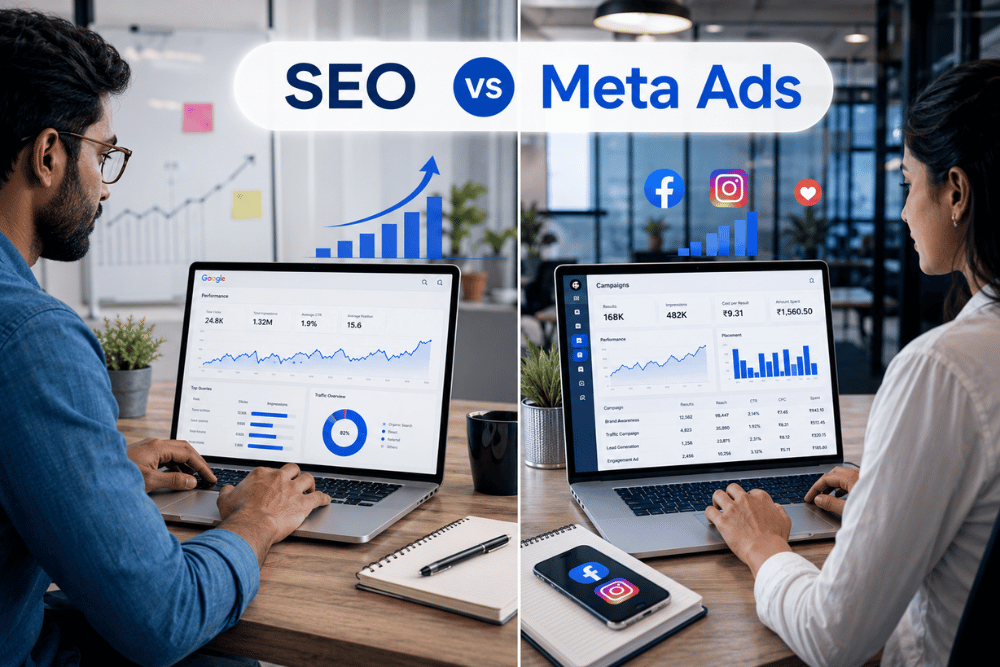
SEO vs Meta Ads: Which Is Better for Business Growth?
20 May, 2026
SEO and Meta Ads can both bring customers to a business, but they work in very different ways. SEO builds organic visibility on Google over time, while Meta Ads use paid campaigns on platforms such as Facebook and Instagram to reach targeted audiences quickly. The better option depends on whether a business needs immediate exposure, consistent search traffic, long-term visibility, or a combination of these goals.
The biggest difference is customer intent. A person searching Google for a specific product or service is often already looking for a solution, while someone seeing an ad while scrolling social media may not have the same immediate intent. Meta Ads can therefore be valuable for promotions, launches, remarketing, and building awareness, whereas SEO can be particularly effective for capturing people actively searching for what a business offers. For businesses targeting local customers, understanding how local SEO helps businesses grow can also help put the difference between paid reach and search visibility into perspective.
However, generating traffic is only part of the equation. Visitors still need a website that loads quickly, explains the offer clearly, works well on mobile devices, and makes it easy to enquire or purchase. A strong marketing strategy therefore connects visibility, website experience, and conversion rather than treating SEO or advertising as an isolated activity. The real question is not simply whether SEO or Meta Ads is better, but which channel best matches the business's goals, audience, budget, and stage of growth.
Why Businesses Use Meta Ads
Many businesses turn to Meta Ads because they want to reach potential customers quickly rather than waiting for organic search visibility to develop. Facebook and Instagram allow businesses to put offers, products, services, and brand messages in front of targeted audiences, making paid social advertising useful for generating awareness, enquiries, website visits, and engagement within a relatively short campaign period.
Another major advantage is audience targeting. Businesses can tailor campaigns around factors such as location, interests, demographics, and previous interactions, helping them present relevant offers to people who may be more likely to engage. This can be particularly useful for local businesses running promotions, launching a service, building brand awareness, or reconnecting with people who have already interacted with the business online.
Meta Ads are especially useful for visually driven campaigns because businesses can use images, videos, Reels, and other creative formats to capture attention. Common applications include:
Brand awareness campaigns
New product or service launches
Seasonal and promotional offers
Lead generation campaigns
Remarketing
Local audience campaigns
Website traffic campaigns
However, getting people to click an advertisement is only the beginning. If visitors arrive on a website that is slow, difficult to navigate, poorly optimized for mobile devices, or unclear about the next step, paid traffic can be difficult to convert effectively. Businesses that want to get more value from their advertising therefore need to consider both campaign quality and website experience. For businesses looking for a dedicated paid-social strategy, Meta Ads Services in Delhi can be explored alongside improvements to landing pages, website usability, and conversion flow.
How Meta Ads Work for Brand Awareness
Meta Ads are particularly effective for building brand awareness because they allow businesses to introduce their products or services to targeted audiences before those people actively search for them. Instead of waiting for a potential customer to type a query into Google, businesses can appear naturally in Facebook and Instagram feeds through sponsored posts, videos, Reels, and other creative formats. This makes paid social advertising useful for businesses that want to increase recognition, introduce a new service, promote an offer, or stay visible within a competitive market.
Brand awareness is not only about getting immediate clicks or enquiries. Repeated exposure can help people become familiar with a business, especially when the advertising consistently communicates a clear offer and recognizable brand identity. A restaurant might showcase its menu, a gym can promote membership benefits, a travel company can highlight destinations, and a coaching institute can introduce its courses through engaging visual campaigns. The objective is to put the business in front of relevant audiences and create familiarity that can support future consideration.
However, visibility alone does not guarantee conversions. When someone clicks an advertisement, the website or landing page needs to continue the experience with clear information, strong presentation, fast performance, and an obvious next step. A campaign may generate attention, but a weak website can still lose potential customers after the click. For this reason, businesses using Meta Ads for brand awareness should treat advertising, website experience, and long-term search visibility as connected parts of the overall digital marketing strategy rather than relying on paid reach alone.
Biggest Limitation of Meta Ads
Meta Ads can be an effective way to generate visibility quickly, but their biggest limitation is that paid visibility depends on continued advertising investment. When a campaign is paused, the paid reach and traffic generated by that campaign generally stop as well. This makes Meta Ads useful for immediate campaigns and promotions, but businesses that rely on them exclusively may find it difficult to maintain consistent visibility without an ongoing budget.
Another consideration is customer intent. People browsing Facebook or Instagram are not always looking for a product or service at that moment. An advertisement therefore has to earn attention through relevant targeting, strong creative content, and a clear offer. Even when someone clicks, the landing page and website experience still need to convince the visitor to take the next step.
Common challenges businesses may face with Meta Ads include:
Ongoing advertising costs to maintain paid reach
Lower purchase intent for audiences who are not actively searching
Creative fatigue when the same advertisements are shown repeatedly
Strong competition for audience attention
Clicks without conversions when the offer or landing page is weak
Dependence on campaign performance for continued paid traffic
Remarketing requirements for customers who need more time before deciding
This does not mean Meta Ads are ineffective. Their value depends on how well they match the business objective, audience, offer, and campaign strategy. For businesses seeking immediate reach, Meta Ads can be highly useful; however, relying on paid social traffic alone can limit long-term visibility. Combining paid campaigns with SEO, useful content, and a well-optimized website gives businesses another source of traffic that can continue developing beyond individual advertising campaigns.
How SEO Creates Long-Term Visibility
SEO takes a different approach from Meta Ads. Instead of paying continuously for reach or clicks, businesses optimize their website so relevant pages can earn visibility in organic search results. This process can take time, particularly in competitive markets, but a well-developed SEO strategy can create an ongoing source of targeted traffic, enquiries, and brand discovery without requiring a separate advertising payment for every visitor.
The real value of SEO goes beyond rankings. A strong strategy improves the website as a whole by aligning content with search intent, making important pages easier to discover, strengthening internal connections, and improving the experience for visitors. Key areas include:
Useful, search-focused content that answers genuine customer questions
Technical SEO that helps search engines crawl and understand the website
Mobile performance and page speed that make browsing more comfortable
Internal linking that connects related topics and helps users discover deeper information
Clear website structure that supports both navigation and search visibility
Local SEO signals for businesses serving specific locations
Trust and authority developed through useful content and a consistent online presence
This is where a broader content strategy becomes especially valuable. A business website can use informational articles to answer early-stage questions, comparison content to support purchasing decisions, and relevant service pages to capture commercial intent. For example, a detailed guide about how website structure affects SEO and lead generation can naturally help readers understand why technical structure, navigation, content organization, and conversion paths matter beyond simply adding keywords to a page.
SEO also works best when the website remains technically healthy after the initial optimization. Broken links, outdated information, slow pages, security problems, or neglected content can gradually weaken the experience for both visitors and search engines. Regular website maintenance helps businesses keep important pages functional, secure, updated, and ready to support ongoing marketing efforts.
The biggest advantage is that SEO can build an asset rather than only buying temporary exposure. A useful service page, well-researched guide, or strong location page can continue attracting relevant searches after it has been published, provided it remains useful and competitive. That makes SEO particularly valuable for businesses looking to develop consistent organic visibility, stronger website authority, and sustainable lead generation rather than depending entirely on continuous paid campaigns.
SEO vs Meta Ads: Quick Comparison
SEO and Meta Ads can both help a business attract customers, but they do so through very different channels. SEO is built around organic search visibility and long-term demand capture, while Meta Ads are designed to deliver paid reach and targeted exposure quickly. Understanding this difference makes it easier to choose the right strategy instead of judging both channels only by clicks or traffic.
The biggest distinction is how and when customers discover the business. SEO can connect a company with people actively searching for a product, service, or solution on Google. Meta Ads can introduce a business to targeted audiences while they are browsing Facebook or Instagram, making paid social particularly useful for promotions, awareness, launches, and remarketing. SEO generally takes longer to build, while Meta Ads can produce visibility soon after campaigns begin.
SEO
Meta Ads
Builds organic search visibility
Provides paid social media visibility
Targets people searching on Google
Targets selected audiences on social platforms
Usually takes longer to develop
Can generate reach quickly
Can create long-term organic traffic
Requires ongoing ad spend for continued paid reach
Builds search presence and topical authority
Strong for awareness and audience engagement
Improves website content and structure
Relies heavily on campaign creative and targeting
Useful for long-term lead generation
Useful for promotions and faster campaigns
Can support local search visibility
Can target specific locations and audiences
Captures existing search demand
Helps create and stimulate demand
Does not require payment for every organic click
Paid visibility depends on campaign budget
The two channels also differ in what happens after the initial investment. With Meta Ads, businesses generally continue paying to maintain campaign exposure. With SEO, investment goes into improving pages, content, technical performance, and website authority, allowing successful pages to continue attracting relevant organic searches. Neither approach guarantees results, and performance depends on competition, execution, website quality, targeting, content, and the specific business model.
For that reason, SEO and Meta Ads do not necessarily need to compete with each other. A business can use Meta Ads for immediate reach and campaign-driven opportunities while developing SEO as a longer-term source of organic visibility. The right balance depends on whether the priority is immediate leads, brand awareness, search demand, long-term traffic, or a combination of these objectives.
Which Is Better for Local Businesses?
For local businesses, the better choice depends on how customers discover the business and how quickly the business needs results. Meta Ads can be useful when a company wants immediate local exposure for an offer, new service, event, or seasonal promotion. Businesses can target specific audiences and locations, making paid social campaigns useful for generating attention quickly. However, this visibility depends on ongoing campaign activity and advertising budget, so it does not create the same type of lasting search presence as organic SEO.
SEO becomes especially valuable when potential customers are already searching Google for a specific local service. Someone looking for a website designer, clinic, gym, restaurant, or other nearby provider already has a defined need, giving search traffic a different level of intent. Building strong local visibility involves more than adding location keywords; it also requires useful content, relevant service pages, clear website structure, and a good user experience. A deeper look at how local SEO helps businesses grow fits naturally here because it explains why local search visibility can become an important part of a broader growth strategy.
For most local businesses, the decision does not have to be SEO versus Meta Ads. Meta Ads can support short-term campaigns and audience reach, while SEO can build a stronger foundation for ongoing organic discovery. The most suitable approach depends on the business's goals, competition, budget, customer journey, and timeframe. When paid campaigns and organic search are supported by a fast, well-structured website and clear conversion paths, both channels can contribute to growth without forcing one strategy to do the job of the other.
When Should Businesses Use Meta Ads?
Meta Ads are a strong option when a business needs faster visibility, targeted audience reach, or immediate promotion rather than waiting for organic search visibility to develop. They can be particularly useful for businesses launching a new product or service, promoting a limited-time offer, reaching customers in a specific area, or building awareness around a brand. Because Facebook and Instagram are highly visual platforms, businesses can use images, videos, Reels, and other creative formats to capture attention and encourage users to explore an offer.
Meta Ads can be especially useful for:
Product and service launches — Introduce something new to a targeted audience.
Seasonal promotions — Promote festivals, discounts, events, or limited-time offers.
Brand awareness — Reach potential customers who may not yet know the business.
Lead generation — Encourage interested users to submit enquiries or contact the business.
Remarketing — Reconnect with people who have already visited the website or interacted with the brand.
Local campaigns — Promote services, offers, or events to audiences within selected locations.
Engagement campaigns — Build interaction around useful or visually engaging content.
The important point is that Meta Ads should not be viewed separately from the website experience. A successful advertisement can bring a visitor to the website, but the website still needs to explain the offer clearly, load quickly, work properly on mobile devices, and make the next step obvious. A slow landing page or confusing enquiry process can waste valuable paid traffic even when the campaign itself is well targeted.
For this reason, businesses running paid campaigns should also pay attention to their landing pages, website structure, mobile experience, and conversion flow. This creates a more complete journey from advertisement → website visit → trust → enquiry or purchase and gives Meta Ads a better chance of contributing to measurable business growth.
Can SEO and Meta Ads Work Together?
Yes. SEO and Meta Ads can work together very effectively because they help businesses solve different parts of the customer journey. Meta Ads are useful when a business wants to reach a specific audience quickly, promote a new service, generate attention around an offer, or bring visitors to a website without waiting for organic rankings to develop. SEO takes a different approach by gradually building the website’s visibility in Google through useful content, strong page structure, technical optimization, and a better overall user experience. Instead of treating these strategies as competing options, businesses can use Meta Ads for immediate visibility while building SEO as a long-term source of organic traffic and enquiries.
For example, a business launching a new service may use Meta Ads to introduce that service to a targeted audience and start generating visits and enquiries quickly. At the same time, the business can optimize the relevant service page, publish supporting content, improve internal links, and strengthen the website’s overall SEO structure. The paid campaign can create attention while the SEO work continues in the background. As the website begins gaining organic visibility, the business can gradually attract visitors from Google as well, reducing its dependence on a single marketing channel.
There is also a practical benefit to using information from paid campaigns when planning future marketing activities. Meta Ads can help businesses understand which offers, services, messages, or creative approaches receive stronger responses from their target audience. Those insights can then help improve website pages and content so they address real customer interests more clearly. At the same time, SEO data can show which search terms and topics are bringing visitors to the website, giving the business additional opportunities to refine its advertising messages and landing pages. When these channels are managed together, the marketing strategy becomes more connected rather than operating as separate campaigns.
However, both strategies still depend heavily on the quality of the website where visitors eventually arrive. Someone clicking a Meta advertisement and someone finding a page through Google both need a website that loads properly, works comfortably on mobile devices, explains the service clearly, and makes it easy to take the next step. A well-organized website structure that supports SEO and lead generation can therefore benefit both paid and organic traffic because visitors are not forced to figure out where to go or how to contact the business.
Over the longer term, this combination can create a more balanced digital marketing strategy. Meta Ads can provide the speed and targeting needed for promotions, launches, remarketing, and short-term campaigns, while SEO steadily builds the business’s organic presence in Google. The objective is not simply to run more campaigns or generate more clicks; it is to create a system where paid traffic, organic visibility, website experience, and conversion opportunities support one another. For businesses looking beyond temporary traffic spikes, combining both channels can provide a stronger foundation for consistent visibility and lead generation.
Why Website Quality Still Matters
Driving traffic is only half of the digital marketing equation. Whether visitors arrive through Google, Meta Ads, social media, or another channel, the website ultimately has to convince them to stay, explore, and take the next step. A slow, outdated, confusing, or poorly structured website can waste otherwise valuable traffic because visitors may leave before they properly understand the business, services, or offer.
A strong website should make every visit feel simple and purposeful. Fast loading, mobile responsiveness, clear navigation, readable content, strong page structure, and obvious enquiry options help visitors find what they need without unnecessary friction. These improvements also support the broader principles covered in 10 Essential Features Every Business Website Must Have, where usability and website functionality are considered alongside visual presentation.
The bigger picture is that SEO and Meta Ads cannot compensate indefinitely for a poor website experience. SEO can bring relevant search traffic, and Meta Ads can introduce the business to new audiences, but the website is where that attention needs to turn into meaningful engagement. Businesses that combine a well-optimized website with the right marketing channels create a stronger foundation for trust, enquiries, conversions, and sustainable online growth.
Why SEO Usually Wins Long-Term
For businesses focused on sustainable growth, SEO has one major advantage over paid advertising: the work can continue creating value after the initial optimization is completed. Meta Ads can generate visibility quickly, but their traffic depends on an active campaign and ongoing budget. SEO takes longer to build, yet strong rankings can continue bringing relevant visitors to important pages without paying separately for every click.
SEO also improves more than search visibility alone. As a business develops useful content, stronger website structure, better page experience, faster performance, and clearer service information, the entire website becomes more useful to both visitors and search engines. This is why businesses serious about organic growth often invest in a broader SEO strategy for long-term business growth rather than treating rankings as a short-term marketing campaign.
The biggest difference is sustainability. A business depending entirely on paid campaigns must continue spending to maintain that source of traffic, while an SEO-focused strategy gradually builds an organic presence that can support future searches, enquiries, and brand discovery. SEO is not instant and rankings are never guaranteed, but for businesses planning to build lasting online visibility, it can become a valuable part of a broader digital marketing strategy.
Final Thoughts
SEO and Meta Ads should not be treated as direct competitors because they serve different purposes. Meta Ads are useful when a business needs quick reach, targeted promotion, remarketing, or immediate campaign visibility, while SEO is better suited to businesses building organic search visibility and long-term digital authority. The right choice ultimately depends on the business objective, budget, competition, customer journey, and expected timeframe.
For many businesses, the strongest approach is to use both strategically. Meta Ads can bring attention to a new offer or service while SEO builds the website's organic presence in the background. At the same time, improving the website itself is essential because paid and organic visitors both need a fast, clear, mobile-friendly, and trustworthy experience before they are likely to enquire or purchase.
The key is to avoid measuring digital marketing only by short-term traffic. A strong strategy should consider visibility, relevant visitors, website experience, enquiries, customer trust, and long-term growth together. Businesses that balance paid promotion with SEO, useful content, and a professionally structured website can create a much more resilient online presence instead of depending entirely on one traffic source.
SEO is generally better for long-term business growth because it can build organic search visibility, targeted traffic, and website authority over time. Meta Ads are more suitable for immediate reach, promotions, remarketing, and audience targeting. Businesses often get the best results by using Meta Ads for short-term opportunities while building SEO for sustainable growth.
Meta Ads can be better for generating quick leads because campaigns can reach targeted audiences shortly after they are launched. SEO usually takes longer to produce significant results because rankings develop over time. However, the quality and cost of leads depend on factors such as targeting, competition, offer, landing page quality, and campaign management.
SEO can become more cost-effective over the long term because businesses can continue receiving organic traffic without paying for every click. Meta Ads require an ongoing advertising budget to maintain paid visibility. However, the actual cost-effectiveness of either strategy depends on the industry, competition, website quality, conversion rate, and business goals.
Yes. SEO and Meta Ads can work together effectively because they support different stages of the customer journey. Meta Ads can generate immediate visibility, traffic, promotions, and remarketing opportunities, while SEO builds long-term Google visibility and organic traffic. Using both strategically can reduce dependence on a single marketing channel.
SEO is often more valuable for long-term local business growth because it helps businesses reach people actively searching for their services on Google. Meta Ads can complement local SEO by promoting offers, reaching specific audiences, and generating faster awareness. The right combination depends on the business, competition, budget, and customer buying journey.
A new business can use Meta Ads when it needs immediate visibility, audience reach, or promotional traffic, while starting SEO early to build long-term search visibility. Using both can be effective because paid campaigns can support short-term growth while SEO gradually develops organic traffic, authority, and sustainable lead generation.
Grow Your Local Business
Get a Professional Website From a Web Designing Company in Delhi