Website vs Landing Page: Which Generates More Leads for Small Businesses?
29 May, 2026
When small businesses start marketing online, one question comes up repeatedly: should they invest in a full website or focus on a landing page? Both options can help attract customers, but they work very differently. While some businesses generate quick enquiries through landing pages, others rely on complete websites to build trust, improve Google visibility, and generate consistent leads over time.
Choosing the right option is important because it directly affects lead generation, marketing performance, and long-term business growth. A landing page may deliver strong results for a specific campaign, but a professional website often provides broader benefits by supporting SEO, credibility, and customer engagement at the same time.
Understanding the differences between a website and a landing page can help business owners make smarter decisions based on their goals, budget, and growth plans. In this guide, we'll compare both options and explore which one is more effective for generating leads and supporting long-term business success.
Understanding What a Landing Page Actually Does
A landing page is a dedicated web page designed to achieve one specific objective. Unlike a traditional website that contains multiple pages and navigation options, a landing page focuses on a single action that the business wants visitors to take. This action could be submitting an enquiry form, requesting a callback, downloading a brochure, registering for an event, or getting a quotation.
The main purpose of a landing page is to reduce distractions and guide visitors toward one clear goal. Instead of asking users to explore different sections, services, or pages, a landing page keeps their attention focused on a specific offer or message. This is why businesses often use landing pages for advertising campaigns where the goal is to generate leads quickly and efficiently.
For example, if a business is running Google Ads for website design services, sending visitors to a dedicated landing page usually works better than sending them to a homepage with multiple options. The visitor immediately sees the service, benefits, and enquiry form without needing to search for information. This focused approach often improves conversion rates because users are guided toward taking action without unnecessary confusion.
Landing pages are commonly used for:
Google Ads campaigns
Facebook and Instagram advertising
lead generation campaigns
product launches
event registrations
free consultation offers
special promotions and discounts
Because they are designed around a single objective, landing pages can be highly effective for generating enquiries and leads in a short period. However, they are usually most effective when used alongside a business website rather than replacing it completely.
What Makes a Business Website Different?
A business website is designed to provide visitors with complete information about a company rather than focusing on just one action. When potential customers visit a business website, they often want to learn more about the company, explore services, compare options, check credibility, and understand whether the business is the right fit for their needs. A website allows them to do all of this in one place.
Unlike a landing page, a business website is built for long-term growth. It helps businesses establish a professional online presence while creating multiple opportunities for visitors to engage with the brand. Customers can browse different services, read helpful content, view past work, and contact the business whenever they are ready. This flexibility makes websites much more effective for building trust and supporting long-term marketing efforts.
Most professional business websites include:
homepage
about us page
service pages
contact page
blog section
portfolio or case studies
FAQ pages
A well-structured website also provides significant SEO advantages because search engines can index multiple pages and understand the business more effectively. This helps businesses rank for a wider range of keywords and attract visitors from different search queries. Many companies invest in business website design because a professional website not only generates enquiries but also strengthens credibility, improves search visibility, and supports sustainable business growth over the long term.
The Biggest Difference Between a Website and a Landing Page
Many business owners assume that a website and a landing page serve the same purpose, but they are actually designed for very different goals. Understanding this difference can help businesses choose the right strategy for lead generation, SEO, and long-term growth.
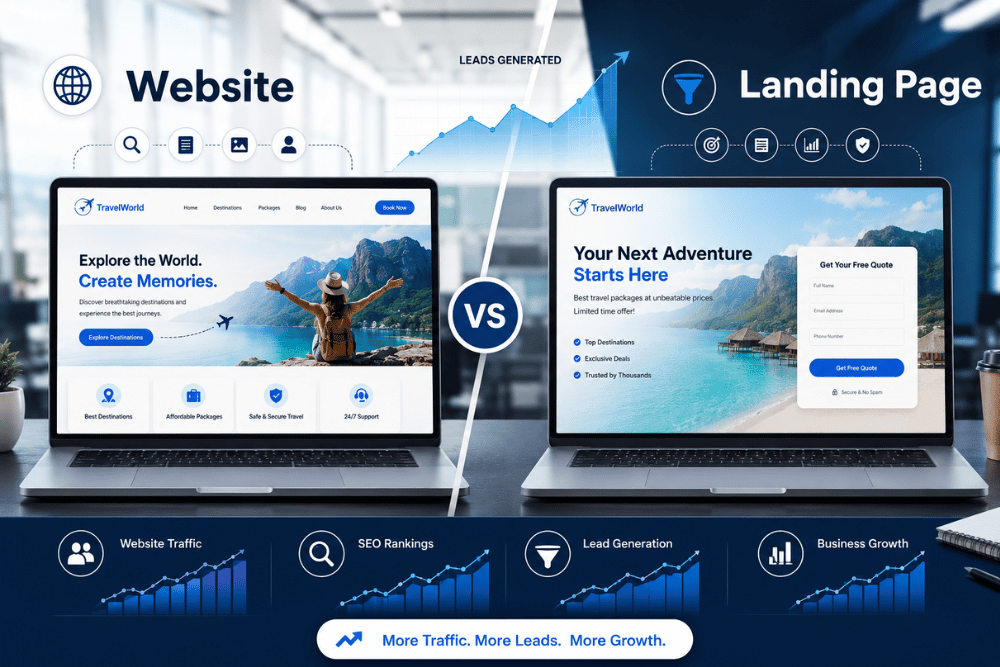
A landing page is focused on one specific action. Its goal is to encourage visitors to take immediate action, such as filling out a form, requesting a quote, or making an enquiry. A website, on the other hand, is designed to provide complete information about the business, build trust, improve search visibility, and support customer decision-making over time.
Feature
Landing Page
Business Website
Main Goal
Generate immediate leads or enquiries
Build trust and long-term business growth
Number of Pages
Usually one page
Multiple pages
SEO Potential
Limited
Strong
User Experience
Focused on one action
Provides complete business information
Best For
Advertising campaigns
Long-term online presence
Content
Short and conversion-focused
Detailed and informative
Search Visibility
Limited keyword targeting
Can rank for multiple keywords
Scalability
Limited
Easy to expand as business grows
Trust Building
Moderate
Strong
Long-Term Value
Campaign-specific
Continuous business asset
A simple way to understand the difference is that a landing page is built to convert visitors quickly, while a website is built to attract, educate, and convert customers over a longer period. This is similar to how businesses compare different marketing strategies before investing their budget. For example, many companies evaluate approaches like SEO vs Google Ads because one delivers faster results while the other supports long-term visibility and sustainable growth.
Both websites and landing pages have their place in digital marketing. The right choice depends on whether the goal is generating quick campaign leads or building a stronger online presence that continues generating enquiries for years to come.
Which Option Generates More Leads?
This is one of the most common questions small business owners ask when comparing a website and a landing page. While both can generate enquiries, the results often depend on how visitors find your business and what actions you want them to take. Understanding the difference is important because many businesses invest in online marketing without first choosing the right foundation for lead generation.
Landing pages are designed to achieve one specific objective. Whether the goal is collecting enquiries, generating quote requests, or promoting a particular offer, every element on the page is focused on encouraging users to take immediate action. Because there are fewer distractions, landing pages often achieve higher conversion rates, especially when used with paid advertising campaigns.
A business website works differently. Instead of focusing on a single campaign, it attracts visitors from multiple channels and provides more opportunities for users to learn about the company before making contact. This helps build trust and supports long-term customer acquisition.
Common lead sources for a business website include:
Google search results
local SEO traffic
blog content
social media visitors
referrals and recommendations
direct website visits
One of the biggest advantages of a website is that it can continue generating enquiries long after marketing campaigns end. Businesses that struggle to generate leads often discover that the issue is not traffic but the overall website experience, which is why many companies investigate why their website is not generating leads before investing more money into advertising.
In simple terms, landing pages can generate more leads during a specific campaign because they focus entirely on conversions. However, a professionally developed website usually creates a more sustainable lead generation system by combining SEO, trust-building content, and multiple traffic sources that continue delivering results over the long term.
Why Websites Perform Better for SEO
One of the biggest advantages a website has over a landing page is its ability to support long-term SEO growth. While landing pages are designed primarily for conversions, websites are built to attract visitors through search engines by providing detailed information across multiple pages. Search engines prefer websites that demonstrate expertise, cover topics in depth, and offer valuable content that helps users find answers to their questions.
A single landing page can rank for a few targeted keywords, but it usually lacks the depth needed to compete across a broader range of searches. A website, on the other hand, can create multiple service pages, location pages, blog articles, and informational content that collectively improve search visibility and authority over time.
A website allows businesses to target:
service-related keywords
local search terms
informational queries
long-tail keywords
industry-specific topics
This approach helps businesses attract visitors at different stages of the buying journey. Some users may be searching for a service provider, while others are researching solutions before making a decision. A well-structured website can capture both types of traffic and guide visitors toward becoming customers.
Businesses that focus on long-term organic growth often invest in content marketing, technical SEO, and website optimization strategies similar to those used by a professional SEO company. By creating valuable content and building strong website structure, businesses can improve rankings, increase visibility, and generate consistent traffic without relying entirely on paid advertising campaigns.
Landing Pages Are Powerful for Advertising
While websites are generally better for long-term SEO and business growth, landing pages remain one of the most effective tools for paid advertising campaigns. Their biggest advantage is focus. Instead of presenting visitors with multiple pages, navigation menus, and various options, a landing page is designed around a single goal. This focused approach helps guide users directly toward taking action, whether that means submitting an enquiry, requesting a quote, booking a consultation, or claiming a special offer.
When someone clicks on an advertisement, they expect to see information that matches what was promised in the ad. A dedicated landing page creates this consistency by delivering a highly targeted message that aligns with the campaign. This often results in better user experience and higher conversion rates because visitors can immediately find the information they are looking for without unnecessary distractions.
Landing pages are particularly effective for:
special offers and discounts
limited-time promotions
seasonal campaigns
newly launched services
local marketing campaigns
lead generation advertisements
Many businesses combine landing pages with advertising platforms because they help maximize the return on marketing spend. Similar to how businesses compare strategies such as SEO vs Meta Ads, landing pages are often used when the goal is generating quicker results from paid campaigns, while websites continue supporting long-term visibility and organic growth. When used together strategically, a website and landing pages can create a much stronger lead generation system than relying on either one alone.
Trust and Credibility Matter More Than Ever
Getting visitors to your website is only part of the process. The real challenge is building enough trust to encourage those visitors to become customers. Today, people rarely contact a business immediately after discovering it online. Instead, they spend time researching, comparing options, reading reviews, and evaluating different companies before making a decision. This is especially true for services where customers are investing significant money and want confidence that they are choosing the right provider.
A business website plays an important role in creating that confidence. It allows visitors to learn more about the company, understand its services, explore previous work, and evaluate its professionalism. The more information users can access, the easier it becomes for them to trust the business and move forward with an enquiry.
Visitors often look for:
company background and experience
customer reviews and testimonials
detailed service information
portfolio or previous work
contact details and business location
When this information is clearly presented, it reduces uncertainty and helps visitors feel more comfortable engaging with the business. A professional website creates a stronger first impression, demonstrates credibility, and provides the reassurance many customers need before taking action. In competitive markets, this trust factor often becomes the difference between gaining a new customer and losing them to a competitor.
The SEO Advantage of a Full Website
One of the biggest reasons businesses invest in a full website instead of relying only on a landing page is the long-term SEO advantage. Search engines prefer websites that provide detailed information, cover topics comprehensively, and regularly publish useful content for users. A website allows businesses to build authority over time by creating multiple pages that target different keywords and customer needs.
Unlike a single landing page, a website can include service pages, location pages, blogs, FAQs, and industry-specific content that help attract visitors from various search queries. This creates more opportunities for potential customers to discover the business through Google. As the website grows, its overall visibility and authority often improve, making it easier to compete for valuable keywords within the industry.
For example, businesses frequently publish educational content around topics their customers are searching for before making a decision. Articles about industry trends, common mistakes, local search optimization, and business growth strategies help attract targeted visitors while strengthening topical authority. Content such as local SEO tips for improving Google rankings not only provides value to readers but also helps expand the website's keyword reach and search visibility.
Over time, this content creates multiple entry points into the website, allowing businesses to attract traffic from a wider range of searches. This is one of the main reasons a full website often delivers stronger long-term results than a standalone landing page when SEO and organic lead generation are important goals.
When a Landing Page Is the Right Choice
Although a full website offers stronger long-term benefits, there are situations where a landing page can be the smarter option. Businesses that need quick results from a specific marketing campaign often use landing pages because they are focused on a single objective. Instead of giving visitors multiple pages to explore, a landing page guides them directly toward one action, making it easier to generate enquiries or leads in a shorter period.
Landing pages are especially useful when businesses want to test a new service, promote a limited-time offer, or launch a targeted advertising campaign. Since the content is highly focused, visitors can quickly understand the offer and take action without navigating through additional pages. This often leads to higher conversion rates, particularly when traffic is coming from paid advertisements.
A landing page can be a good choice when:
launching a new service
running paid advertising campaigns
promoting a special offer
testing a new market or audience
collecting leads quickly
promoting events or seasonal campaigns
Many small businesses and startups also begin with a landing page when working with a limited budget. It allows them to validate customer interest and generate initial enquiries before investing in a larger website project. While landing pages are not always ideal for long-term SEO growth, they can be highly effective for short-term marketing goals where speed and lead generation are the primary focus.
When a Full Website Is the Better Investment
A landing page can be effective for short-term campaigns, but a full website is usually the better investment for businesses focused on long-term growth. As a business expands, customers often want more information before making a decision. They may want to explore services, learn about the company, read customer reviews, view previous work, or compare different solutions. A website provides the flexibility to present all of this information in a structured and professional way.
Unlike a landing page, a website continues growing alongside the business. New service pages, blog content, case studies, FAQs, and location-specific pages can be added over time to improve visibility and attract more potential customers. This makes a website a valuable business asset that supports marketing, SEO, customer trust, and lead generation simultaneously.
A full website is usually the better choice when:
building a strong brand presence
improving search engine visibility
attracting long-term organic traffic
showcasing multiple services
building customer trust and credibility
supporting future business growth
Many businesses work with a professional website designing company in Delhi because a well-structured website creates a stronger foundation for long-term success. Unlike landing pages that are often campaign-focused, a website continues delivering value through SEO, content marketing, customer engagement, and brand visibility for years after it is launched.
Why Many Businesses Use Both
Many business owners think they must choose between a website and a landing page, but in reality, the most effective digital marketing strategies often use both. A website and a landing page serve different purposes, and when used together, they can support each other while improving overall lead generation performance.
A website acts as the main online presence of the business. It helps build credibility, improve search visibility, showcase services, and attract long-term traffic through SEO. A landing page, on the other hand, is designed for specific campaigns where the goal is to generate enquiries or conversions quickly. Instead of replacing the website, landing pages often work as focused marketing tools that support advertising efforts.
The difference becomes easier to understand with the following comparison:
Website
Landing Page
Builds long-term online presence
Supports specific marketing campaigns
Improves SEO and Google visibility
Focuses on immediate conversions
Provides complete business information
Focuses on one offer or service
Builds trust and credibility
Generates quick enquiries
Attracts organic traffic over time
Usually relies on paid traffic
Supports multiple services and pages
Designed around a single objective
For example, a business may use its website to rank on Google, publish blog content, and showcase services, while simultaneously running Google Ads that send visitors to dedicated landing pages designed for higher conversions. This allows the business to benefit from both long-term growth and short-term lead generation at the same time.
When implemented correctly, this combination helps businesses achieve:
stronger SEO visibility
improved credibility and trust
better campaign conversion rates
more consistent lead generation
greater marketing flexibility
Rather than competing with each other, websites and landing pages work best when they are part of the same digital strategy. A website creates the foundation for sustainable growth, while landing pages help maximize the performance of targeted marketing campaigns.
A Practical Example for Small Businesses
Imagine a local plumbing company that wants enquiries quickly from Google Ads. In this case, a dedicated landing page can work well because visitors are directed to one service and one clear call-to-action. The goal is to generate enquiries without distractions.
Now consider a growing business that offers multiple services and wants customers to find them through Google searches over time. A full website becomes much more valuable because it can showcase services, build credibility, publish helpful content, and attract visitors through SEO. As the business expands, the website can also grow by adding new pages, services, and content without major limitations.
This is why many successful businesses use a website as their primary online presence while creating landing pages for specific marketing campaigns. The website supports long-term growth, while landing pages help improve conversions for targeted promotions and advertising efforts.
Common Mistakes Businesses Make
Choosing between a website and a landing page is important, but many businesses fail to achieve good results because of mistakes made after the website or landing page is launched. Simply having an online presence does not guarantee enquiries or sales. The way the website is structured, optimized, and maintained often determines whether visitors become customers or leave without taking any action.
One of the most common problems is that businesses focus heavily on visual design while ignoring user experience, SEO, and conversion optimization. A website may look modern and attractive, but if visitors cannot find information easily or the website loads slowly, potential customers often move to competitors. Many of these issues are similar to the problems discussed in common website design mistakes that hurt business growth, where small usability issues quietly reduce traffic, enquiries, and conversions over time.
Some common mistakes include:
focusing only on design
ignoring SEO optimization
lacking clear calls-to-action
poor mobile responsiveness
weak content structure
slow loading speed
Whether a business uses a landing page or a full website, these issues can significantly reduce performance. Businesses that focus on user experience, website speed, SEO, and clear conversion paths usually achieve much better results because visitors can navigate the website easily and take action without confusion.
Frequently Asked Questions
Is a landing page better than a website for small businesses?
A landing page is not necessarily better than a website. Both serve different purposes. Landing pages are designed to generate quick enquiries from specific marketing campaigns, while websites help businesses build credibility, improve SEO visibility, and attract customers over the long term. The right choice depends on your business goals and marketing strategy.
Can a business generate leads with only a landing page?
Yes, some businesses successfully generate leads using only landing pages, especially when they rely heavily on paid advertising. However, a landing page alone may limit long-term growth because it does not provide the same SEO opportunities, trust-building content, and scalability that a full website offers.
Why is a website better for SEO than a landing page?
A website allows businesses to create multiple pages, publish blog content, target different keywords, and build topical authority over time. Search engines generally prefer websites that provide comprehensive information and a better user experience, making them more effective for long-term organic traffic growth.
When should a business use a landing page?
A landing page is usually the right choice when promoting a specific offer, running Google Ads, launching a new service, testing a market, or generating enquiries for a short-term campaign. Its focused structure helps improve conversion rates by guiding visitors toward one clear action.
Do businesses need both a website and a landing page?
In many cases, yes. A website serves as the foundation of the business's online presence, while landing pages support advertising campaigns and lead generation efforts. Using both together often provides the best balance between long-term growth and short-term marketing results.
Which option provides better long-term value?
For most businesses, a website provides greater long-term value because it supports SEO, content marketing, customer trust, brand visibility, and future growth. While landing pages can deliver fast results, websites continue generating benefits over time through search traffic and ongoing optimization.
Final Thoughts
Choosing between a website and a landing page is not about deciding which one is universally better. The real decision depends on what your business wants to achieve. A landing page is designed to generate quick enquiries from a specific campaign, while a website helps businesses build credibility, improve search visibility, attract organic traffic, and support long-term growth. Understanding this difference can help businesses invest their marketing budget more effectively and avoid choosing the wrong solution for their goals.
For most small businesses, a professional website provides a stronger foundation because it allows customers to learn about the company, explore services, build trust, and find the business through search engines. At the same time, landing pages can play an important role in supporting advertising campaigns, special promotions, and lead generation efforts where higher conversion rates are the priority.
The most successful businesses rarely rely on just one approach. Instead, they use a website to establish a strong online presence and create targeted landing pages whenever specific marketing campaigns require them. This combination helps generate immediate enquiries while also supporting long-term SEO growth, brand visibility, and customer trust. Businesses that understand how to use both strategically are often better positioned to attract quality leads, improve conversions, and achieve sustainable growth online.